


PREVIEW
Summit pledges on cutting the cost of capital, boosting fair trade and investment were popular, but delegates want quantity as well as quality
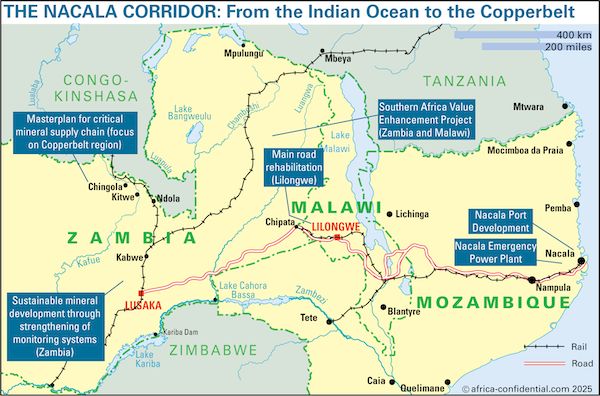
THE NACALA CORRIDOR: From the Indian Ocean to the Copperbelt
One of Prime Minister Shigeru Ishiba’s last diplomatic forays before his resignation on 7 September was his hosting of the Tokyo International Conference on African Development (TICAD 9) in Yokohama from 20-22 August. In Ishiba’s own lights, the TICAD summit could be marked as a success, against a harsh geopolitical backdrop, with 33 African heads of government or state participating and senior representatives from 49 states attending.
Like much of Ishiba’s year-long stint in office, his government’s shepherding of TICAD 9 was well conceived and sent positive messages – not least that Japan would be the only G7 economy to maintain its current level of Official Development Assistance and would push for an expansion of multilateral development banks and other international financial institutions. Such commitments won quick plaudits from the African delegates in Yokohama.
In Japan’s diplomatic plans, much as in its national economic strategy, a combination of tariff wars, geopolitical tensions and a sluggish global economy constrained its ambitions.
On taking up the premiership last year, Ishiba had promised to restore people’s smiles, but he was also renowned for his commitment to fiscal discipline. That applied as much to international commitments as it did to his opposition to tax cuts and higher spending. Foreign ministry officials underlined their country’s commitment to maintaining ODA levels but said there was no possibility of Japan substituting for aid funding from the United States or European Union economies.
Ishiba opened TICAD 9 with a stirring call for a new era of international cooperation, citing his own travels in Africa and technology exchanges. One of these involved Japan’s Nagasaki Prefecture using drone technology developed in Rwanda to deliver vital medicaments to the remote Goto Islands.
Starting up
The ‘Japan Africa Co-Creation for Industry’ was launched at TICAD to assist African start-ups to work with Japanese companies to develop new industries to serve Africa’s youthful and fast-growing markets. Those are two qualities that contrast with Japan’s declining birthrate and population.
Delegates applauded the concept and the structure of the partnership which brought in the African Development Bank (AfDB). Their disappointment was with its scale: it had a ceiling of US$5.5 billion for infrastructure and logistics projects. ‘That won’t go far in a continent of 1.4bn,’ a Cameroonian delegate told Africa Confidential. The same could be said for Tokyo’s Human Resource Development programme for 300,000 people, of whom 30,000 will be trained in Artificial Intelligence development.
The TICAD headlines – the shift from ODA pledges to de-risked capital and identified projects processing natural resources, especially critical minerals – point to the organisers’ close collaboration with the AfDB in Abidjan and the UN Development Programme in New York. What was missing from the discussions was a strategy to accommodate what is likely to be a more than 25% cut in UN funding in the budget plans to be debated at the UN General Assembly which opens in New York on 22 September.
At the heart of the Yokohama Declaration launched at TICAD was a turbo-charged multilateralism: a crowd-pleasing list of imperatives ranging from an African credit rating agency which it hoped would cut the cost of capital to trade-led industrialisation via the African Continental Free Trade Area and the piloting of special economic zones for electronics, automotive and green tech.
With the declaration’s reaffirmation of ‘rules-based multilateralism’ and comprehensive UN Security Council reform with full African representation, there was a sense of time-warp. Japan as the last defender of the rules-based order standing.
But Tokyo, facing a resurgent Beijing across the East China Sea, is as aware of the new world order as any European power. But it appears much more committed to upholding the international system, for sound national security reasons as much as higher-level commitments to cooperation.
A senior foreign ministry official at TICAD spelt out Tokyo’s mission to push for UN Security Council reform, getting full representation for India and African UN member states, as well as an enhanced role for Japan and other Asian states. ‘All UN member states should be involved in these negotiations,’ added the official and they should ‘…address historical injustices and ensure a more representative voice for African states.’
In the context of heightened geopolitical competition, Japan’s Africa policy is more than ever viewed through a China prism. ‘Japan seeks a stable, cooperative relationship with China while addressing serious security concerns, especially regarding the Senkaku Islands.’ With a stance that would be familiar to some African foreign ministers, Tokyo underlines the importance of its economic relations with China but emphasises its ties to the US as a reliable security ally.
Tokyo-Washington ties were weaker under Ishiba than they had been under his predecessor Shinzo Abe, who as a golf-playing conservative and nationalist proved more adept at courting President Donald Trump. It was also the inconsistency of US diplomacy in Trump’s first term that prompted Abe to rethink Tokyo’s regional alliances before he left power in 2020 (AC Vol 55 No 3, Abe in Africa).
That has morphed into the Free Open Indo-Pacific (FOIP) strategy which prioritises connectivity – originally between Japan and India but now crossing the Indian Ocean to link with East Africa – and wants to build two-way supply chains, focusing on critical mineral as well as processing and storage technology.
Tokyo’s backing for the ‘Economic Region Initiative of the Indian Ocean-Africa’ is part of this wider plan and is premised on greater regional integration and industrialisation.
These regional and intercontinental strategies are Tokyo’s counterpart to China’s Belt and Road Initiative (BRI). But they are avowedly multilateral in their leadership, bringing Tokyo and Delhi together initially – as opposed the Beijing-centricity of the BRI.
For African states, the most obvious difference is scale. At TICAD 8 in 2022, Tokyo pledged $30bn in investment by 2025 but Japanese firms have failed to live up to those targets, even when encouraged by state guarantee schemes (Dispatches 30/8/22, Tokyo promises $30bn to Africa a week after Beijing’s debt relief offer).
The partnership between Japanese and Indian firms – both on the Indian sub-continent and in Africa – is meant to boost the financial firepower of the strategy.

AFRICA-JAPAN RELATIONS: Focus shifts to investment, start-ups and blended finance

Japan is a leader in pulling together investment partnerships; for example, the Sumitomo-NamPower sustainable ammonia project. But Japan’s Foreign Direct Investment in and trade with Africa has under-shooting official targets for a decade. Part of the problem is the extreme risk aversion of Japanese corporate and their thin knowledge base on African economies. More diplomacy is needed if this is to change: to date Tokyo has signed six bilateral investment treaties with African states. That will need quadrupling if Japanese firms are going to take on their corporate rivals in Africa.
The comparison with China is instructive: Japan has disbursed $8.5bn for 80 infrastructure projects in Africa since 1993 but Chinese financial institutions have disbursed over $180bn of loans in Africa since 2000, according to the Global Development Policy Center at Boston University.
But beyond the stark monetary comparisons, Japan is pioneering new initiatives of building sustainable supply chains to secure cobalt, lithium, nickel and rare earths to give African producers a chance to diversify from the dominant Chinese-owned refiners (AAC Vol 6 No 9, Africa’s bidding war).
Announcing a move from mega-loans from policy banks to smaller, lower risk projects, Beijing had seemed to be downsizing its development ties with Africa as concerns rose about debt levels and stalling economic growth in the aftermath of the Covid pandemic. Yet at last year’s Forum for China Africa Cooperation (FOCAC), Beijing made financial pledges of over $50bn blending state-backed loans, quasi-commercial deals and market-led investments.
TICAD 9, the flagship for Tokyo’s Africa policy with its multilateral finance offer, green growth and large-scale training pledges, maintains its unique pattern of partnerships: bilateral and trilateral ties with India, France, and the European Union which help to share the risk and begin to address the shortfalls on scale.
|
