


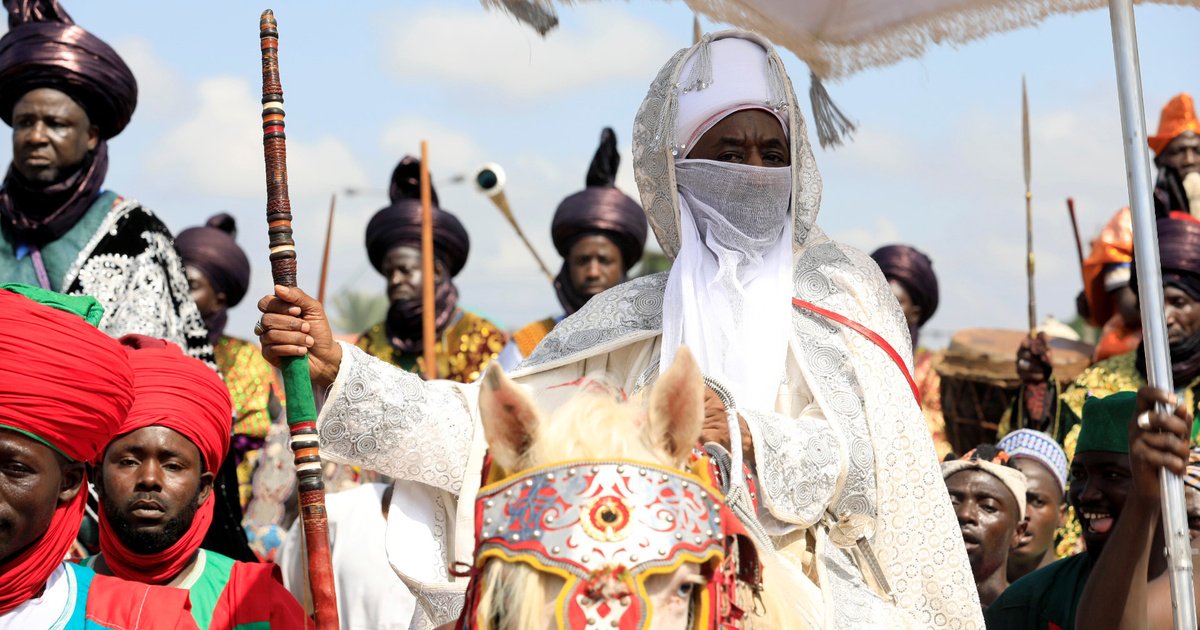
When, back in 2009, an interviewer asked Sanusi Lamido Sanusi, Governor of the Central Bank of Nigeria (CBN) at the time, whether he had any presidential ambitions, Mr. Sanusi gave a curt reply: “No, I don’t. I have ambitions to be the emir of Kano.”
Five years later, in June 2014, Mr. Sanusi got his wish with his installation as Emir of Kano following the transition of Ado Bayero, who had occupied the stool for fifty years. In March 2020, Sanusi’s reign was cut short when personal and political disagreements with then Kano State governor Abdullahi Umar Ganduje culminated in his dethronement by the latter and eventual banishment to Nasarawa State in the North Central region of the country. Last month, Governor Abba Kabir Yusuf reversed his predecessor’s action and reinstated Sanusi as emir, a move that so far has been resisted by Aminu Ado Bayero, whom Ganduje had installed as Emir following Sanusi’s deposition in 2020.
More on:
Nigeria
Democracy
Heads of State and Government
Civil Society
Political History and Theory
Perhaps understandably, much of the social commentary on the affair has focused on the element of elite power play. Both Sanusi and Bayero have powerful backers and allies within and outside the state, and in the case of Bayero, presumably at the federal level.
Others have focused on the juridical ramifications, inter alia the legality of the action taken by Governor Yusuf, particularly his abrogation of the Kano Emirates Council Law (2019) which created four new emirates—each with its own First Class Emir—and effectively circumscribed the Emir of Kano’s sphere of influence. In the meantime, both sides are claiming vindication following the June 20th Federal High Court ruling “setting aside all steps taken by the Kano State Government” to repeal the 2019 law. While Bayero’s lawyers have interpreted the ruling as a nullification of Sanusi’s reinstatement, the Kano State Government has welcomed it as supporting its actions, including the reinstallation of Sanusi. Pursuant to this interpretation, Kano State Attorney-General and Commissioner for Justice, Haruna Isah Dederi, has directed the State Commissioner of Police to dislodge the deposed emir from the mini palace where he has dug in since his dethronement last month.
No matter the eventual winner of the legal or political battle—and all indications are that we are as far away from a final resolution as possible—the Sanusi-Ado Bayero showdown offers the occasion to put traditional institutions in Africa under a critical microscope, especially against the backdrop of apparent heightened public and scholarly interest in them, the latter as part of a renewed focus on “the politics of heritage” specifically, and local level politics more broadly.
That this scholarship finds traditional institutions mostly agreeable and views them as an essential cog in the wheel of modern politics and social life in Africa is inarguable. For anthropologists Jean and John Comaroff for instance, what they refer to as “indigenous sovereigns” are the beating heart of “the increasingly assertive politics of custom in many corners of Africa” and are crucial for “understanding the tenacious hold that ‘traditional’ authority enjoys in the late modern world.” For political scientist Kate Baldwin, the “undemocratic character” of traditional chiefs, far from the philosophical deal breaker that some take it to be, does not in fact preclude them from “facilitating democratic responsiveness” and “brokering local development projects.” On the contrary—and Baldwin is quick to stress the paradox—it “gives them a capacity to organize responses to rural problems that elected politicians and state institutions lack.”
In the same vein, political scientist Olufemi Vaughan’s analysis of indigenous political power structures in Nigeria and Botswana points to their versatility, if not continued relevance. According to Vaughan, it is precisely this versatility that explains traditional power structures’ ability to survive both “the forces of colonialism and the modernization processes of postcolonial regimes” in Nigeria on the one hand, and chiefship’s emergence as “a critical domain for the articulation of local values and aspirations” in Botswana on the other.
More on:
Nigeria
Democracy
Heads of State and Government
Civil Society
Political History and Theory
These findings are quite interesting, especially to the extent that they stem logically from a functionalist inquest into the contemporary serviceability of theoretically redundant traditional power structures. The real question is what happens when, for example, we apply pressure to the question of the “undemocratic character” of these structures? Suppose we take the point about their resilience and adaptability, something that the relevant literature as represented by the foregoing is, perhaps rightly, eager to note, what exactly are we left with? Do Africa’s fledgling democracies really need the dubious ballast of traditional power structures so irreversibly steeped in ascription?
By taking direct aim at “the idea of the indigenous chief as a liberal political figure,” Cornell University philosopher Olufemi Taiwo appears to answer in the negative. For Taiwo, there can be no reconciliation between liberal democracy and modernization on one hand, and “some aspects of indigenous culture, such as the use of a chief as a political figure” on the other. In other words, chiefs cannot be liberals, much less liberals become chiefs because of “the metaphysical underpinnings of modern understandings of freedom and equality.”
From this standpoint, the eventual winner of the Sanusi-Ado Bayero tussle pales into insignificance once you accept that the stool that both contestants are seeking to occupy is, pace Taiwo, retrogressive and antimodern in its essence. The fact that the “office” itself commands a degree of reverence and valorization among the public, a truism often invoked to justify chiefship’s continued relevance, does nothing to change the fact. At any rate, one must wonder how much actual mystique is left in a position so vulnerable to the whim and fancy of every successive state governor.
The ensuing policy dilemma is an interesting one. For some time now, the case for incorporating traditional power structures into the democratic process in Africa has rested on their putative centrality to justice delivery at the local level, where, among other things, they have filled in for a criminally negligent state. Yet, rarely questioned is the underlying assumption of philosophical and moral continuity between power structures and institutions founded upon ascription, and a liberal democratic system with a basal commitment to merit. Afterall, if chiefship is antithetical to the democratic spirit, where is the sense in continuing to bolster it in the name of strengthening democracy?
Now, the nature of the sociocultural variables at play may be such as to justify tolerance for the shenanigans of chiefship in the short term, but there can be no doubt as to what needs to happen in the long term across Africa; the emirship, standing proxy for all other forms and manifestations of “indigenous sovereignty,” must be jettisoned.
It is difficult to imagine any other way.
Reina Patel contributed to the research for this article.
