



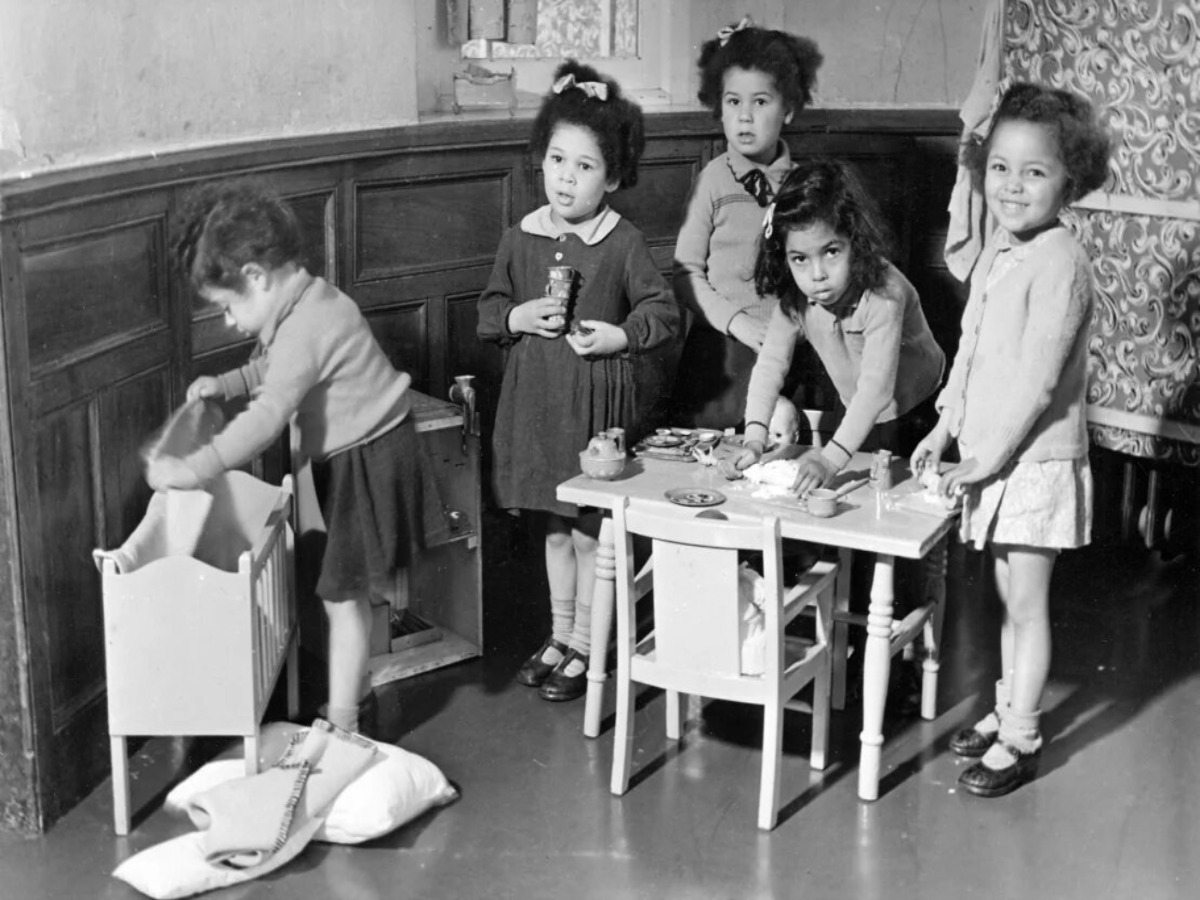
Holnicote House, a hotel on Exmoor in Somerset, United Kingdom, was once home to Britain’s first mixed-race orphanage. Carol Edwards, who spent the first five years of her life at Holnicote House alongside 25 other mixed-race children immediately after World War II, helped shed light on this little-known chapter of its history during a tour of the property.
Following a weekend walk, a guide took Edwards and her daughter on a tour of the estate, explaining its 500-year history, which ended around 1945. Edwards pointed out that an important part of its story had been missed.
Referred to as “brown babies” by U.S. newspapers, all of the children at the orphanage were born to white British mothers and African American GIs who had been stationed in Britain during the war. About 2,000 such children were born at a time when there were only 7,000 to 10,000 Black people in the entire UK. Their existence increased the Black British population by about 25%, but roughly half of these children were given up for adoption. Holnicote House, requisitioned by Somerset County Council in 1943, was the only children’s home specifically dedicated to them.
Edwards, now 79, recalls her time at the house fondly: “They cared for us and loved us all. We were all treated the same and never made to feel different. I feel quite privileged to have spent my first five years there. I think I was one of the lucky ones.”
For many other “brown babies,” the experience was far more difficult. Dr. Chamion Caballero, cofounder of the Mixed Museum, a digital archive of Britain’s history of racial mixing, explained that these children faced a double stigma of being both mixed race and born outside of marriage. They were treated as a social problem by the authorities and often found themselves isolated in predominantly white rural areas, where they experienced discrimination and lacked connection to Black communities. Even in Black urban communities, they sometimes faced rejection for being “not Black enough.”
READ ALSO: Mortgage company to pay over $8M to settle lending discrimination claims in predominantly Black Alabama neighborhoods
Of the approximately 240,000 Black GIs who passed through Britain during the war, the cultural clash was significant. The U.S. military was still segregated during this pre-civil rights, Jim Crow era. Black soldiers were mostly assigned noncombat roles, and their leisure activities were also segregated, with towns or villages designated as “Black” or “white” on different days.
Despite this, many locals in Britain preferred the company of Black GIs, finding them more polite and friendly compared to their white counterparts. However, attitudes shifted when mixed-race children began to be born, with sentiments reflecting: “Great to be friends, great to be allies. Don’t necessarily want you as a son-in-law.”
Edwards and another Holnicote resident, Ann Evans, shared similar experiences of being adopted and raised in white families, often facing discrimination. For Edwards, who was the only Black person in her school, discovering her racial identity was a gradual process. “I discovered who I was through music,” she said, finding a sense of belonging in the voices of Black artists like Sarah Vaughan and Nina Simone.
Evans, who was adopted by a Welsh family, also faced racial prejudice but found solace in her family’s support. Both women later sought to reconnect with their biological families, with varying degrees of success, but their shared history as part of the first mixed-race orphanage in Britain remains a significant chapter in their lives.
During her recent visit to Holnicote House, Edwards pointed out to the new owner that there were no photographs or references to its history as Britain’s first mixed-race orphanage. The owner promised to remedy this, ensuring that this important part of the estate’s legacy is not forgotten.
READ ALSO: How this Black genealogist helped Black Americans to uncover their family histories
