



In the vibrant tapestry of West African art, the threads of sustainability, cultural preservation, and environmental advocacy are woven together, creating a powerful narrative that resonates far beyond the region’s borders. As the eco-art movement continues to gain momentum, it serves as a poignant reminder that art has the power to inspire, educate, and catalyze change – one brushstroke, one sculpture, and one repurposed material at a time.
Marques Hardin on Eco Art
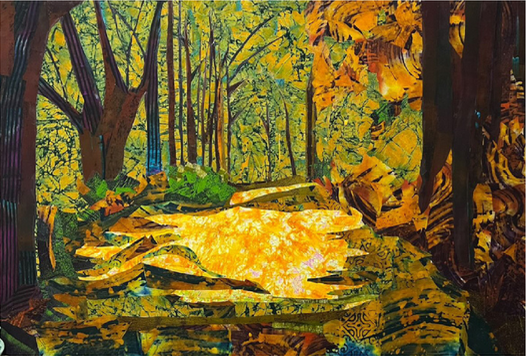
Jeffrey Baiboo, Place et peine, textile on canvas
The Rise of Eco Art in West Africa
In the heart of West Africa, a vibrant movement is taking root, one that intertwines artistic expression with environmental advocacy and cultural preservation. A growing number of artists in the region are turning to sustainable and recycled materials to create thought-provoking works that not only challenge traditional notions of art but also raise awareness about the impact of overconsumption and pollution on their communities.
Michael Gah
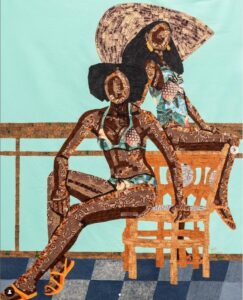
Michael Gah, Defining Moment, collage textile on canvas
At the forefront of this eco-art revolution is Michael Gah, a Ghanaian artist whose practice revolves around transforming discarded fabrics into captivating works of art. Growing up amidst the mounting crisis of textile waste pollution in Ghana’s waterways, Gah experienced firsthand the detrimental effects of our throwaway culture. His intricate weaving and assemblage techniques meticulously transform these environmental pollutants into mesmerizing, joyful portraits that celebrate Ghanaian culture and life.
Gah’s desire to work with scrapped fabric comes from growing up surrounded by these waste products around him. His mother was one of the people who instilled in him a sense of responsibility for the waste they produce. She would often reuse items like old shirts and turn them into mops or cleaning towels instead of throwing them away. When Gah began his artistic journey, his mother’s teachings reverberated into his creative practice, leading to his unique style of art.
Gah’s pieces urge viewers to reevaluate their relationship with consumption, disposal, and environmental protection in visceral and emotionally resonant ways. His work is a powerful critique of our throwaway culture, while simultaneously demonstrating the immense artistic potential hidden within humanity’s waste products.
Lawrence Torto
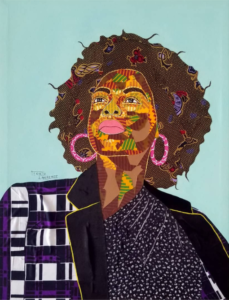
Lawrence Torto, Afro Nana Konadu, textile and acrylic on canvas
Similarly, Lawrence Torto also works with scrapped fabric in his art. Much like Gah, he too saw the unused potential of the textile waste littering the waters of Ghana. In his practice, Lawrence explores the dynamic interplay between fashion and art, ingeniously utilizing discarded fabrics and acrylics on canvas to craft imagery that transcends mere visual appeal, evoking profound emotional responses. Through an upcycling process, he meticulously peels back the layers of his materials, transforming them into intricate portraits and figurative works that establish a communicative dialogue with viewers, captivating the soul and stimulating the mind. This deliberate method is an experiment in creativity and sustainability, reflecting Lawrence’s unwavering commitment to both artistic innovation and environmental consciousness.
Lawrence’s works are a harmonious fusion of his cultural heritage, his passion for fashion, and his dedication to sustainable practices. Each piece is a testament to the artist’s ability to breathe new life into discarded materials, while simultaneously exploring the depths of human emotion and experience. His canvases are not merely works of art but rather profound expressions of his belief in the transformative power of creativity and the importance of preserving our natural resources for generations to come.
Jeffrey Baiboo
Jeffrey Baiboo, Place et peine, textile on canvas
Jeffrey Baiboo is another Ghanaian artist tackling the amount of fabric waste in Ghana by using it in his art. For Baiboo, his inspiration to use fabric as his “paint” came from a visit to his tailor. Seeing the mountains of scrapped fabric ready to be thrown away, Baiboo thought that there must be a better way to deal with these than simply dumping them. Within this mound of textile, he saw potential instead of waste.
Jeffery’s innovative approach has catalyzed a ripple effect, influencing and inspiring a multitude of artists towards greater creativity while simultaneously forging a sustainable path within the art world. His practice involves fostering relationships with fashion designers, seamstresses, and studios, visiting them to collect remnants and discarded fabrics. This conscious effort builds strong community ties while championing environmental sustainability.
Through his artworks, Jeffery aims to send powerful messages about waste management and the paramount importance of recycling. He contributes significantly to the global vision of resource conservation and waste reduction. By breathing new life into materials previously deemed useless, Jeffery’s creations serve as a clarion call, urging society to rethink its relationship with waste and embrace a circular economy mindset. His artistic journey is one that harmonizes beauty, creativity, and eco-consciousness, paving the way for a more sustainable future in the realms of art and beyond.
Tesprit
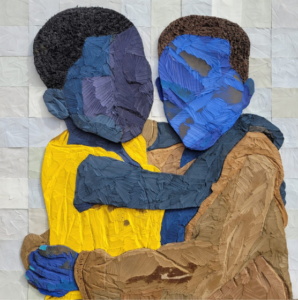
Tesprit, Amégno, Flip flops on canvas
In other parts of West Africa, other artists have also taken up the torch to champion sustainability in their art practice. Tesprit, a self-taught artist from Togo, is one example. Tesprit’s unique artistic medium consists of repurposed slippers, salvaged from the dumps of Lomé where they were once discarded. Layered onto canvas, these well-trodden soles depict scenes and gestures drawn directly from the lives of the Dzimakplao, Togo’s homeless children, offering an intimate glimpse into their world.
Through his work, Tesprit transports viewers to the contrasting realm inhabited by these resilient young souls. He sheds light on their struggles and vulnerabilities, but also captures their unbreakable optimism and resilience in the face of adversity. The faceless figures that populate his canvases, frozen in their everyday existence, serve as poignant reminders of the challenges faced by countless children in our modern era, challenges that should weigh heavily on our collective conscience.
Tesprit’s art is a powerful voice for the voiceless, a call to action that demands we confront the harsh realities of childhood homelessness. By transforming discarded materials into haunting vignettes, he breathes new life into the forgotten and elevates the stories of Togo’s most marginalized citizens to profound works of artistic expression.
Daouda Traoré
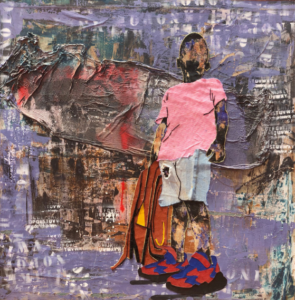
Daouda Traoré, Bah, collage of fabric, jeans, imitation leather, wool yarn, acrylic on canvas
For Daouda Traoré, his choice of art is both a reflection of his commitment to sustainability but also his environment. The textiles, discarded sheets, tin cans, millet bags, wool strings, and iron wires in his artwork become a way for Traoré to physically and metaphorically incorporate his life into his work.
Traoré takes inspiration from the students he teaches. As an art teacher in Sikasso’s public high school, his students’ creativity and search for identity influenced his own. Daouda’s works contain subtle yet profound poetry—a scattering of letters and fragments that coalesce into what he calls his “unreadable poems”. These compositions advocate for the vital importance of education, the inter-generational transmission of knowledge, and the fundamental values that guide him as both a creative force and an educator walking the tumultuous landscapes of Mali.
His richly layered paintings serve as reflective mirrors, simultaneously capturing his own existence, the communal experiences that shape the fabric of Malian society, and the oft-overlooked vistas of his homeland. Daouda’s artistic voice navigates the delicate balance between doubt and hope, resonating with intense personal introspection while also giving voice to the broader aspirations and resilient spirit of his people.
On his canvases, individual stories and selfhood intertwine inextricably with a deeper exploration of identity, cultural heritage, and a shared quest for understanding amidst the complexities of the present. Each work becomes a profound meditation, part personal diary and part semiotic love letter to the lands and narratives that sowed the seeds of Daouda’s singular artistic vision.
Sebastian Boko
Sebastien Boko, Grand Rêveur, wood, bike chain and metal
In Benin, artist Sebastian Boko learned the basics of creating art from his father, a skilled traditional carver, and elevated the art by incorporating other found objects in his work. Boko draws deep inspiration from the rich artistic traditions of his homeland Benin, particularly the powerful imagery and symbolic heritage of the Gèlèdé masquerade. Yet his work also pushes boundaries, transcending reverence for the past to forge new artistic frontiers. Each sculpture he meticulously crafts serves as a testament to this ethos – a harmonious fusion of ancient and modern, raw materials seamlessly intertwined with repurposed everyday objects like car plates, forks, and motorbike parts.
Boko’s artistic practice becomes something far greater than mere expression; it is a visual exploration, an aesthetic dialogue that celebrates the very essence of Benin’s cultural legacy while boldly embracing the creativity and innovation of the contemporary world. His works invite viewers into this dialogue, guiding them through a landscape where the ancestral and the avant-garde flow together in seamless reverence.
From the embodiment of Gèlèdé power motifs to the intricate assemblages birthed from society’s ubiquitous refuse, Boko’s sculptures demand we contemplate the interconnected…
