



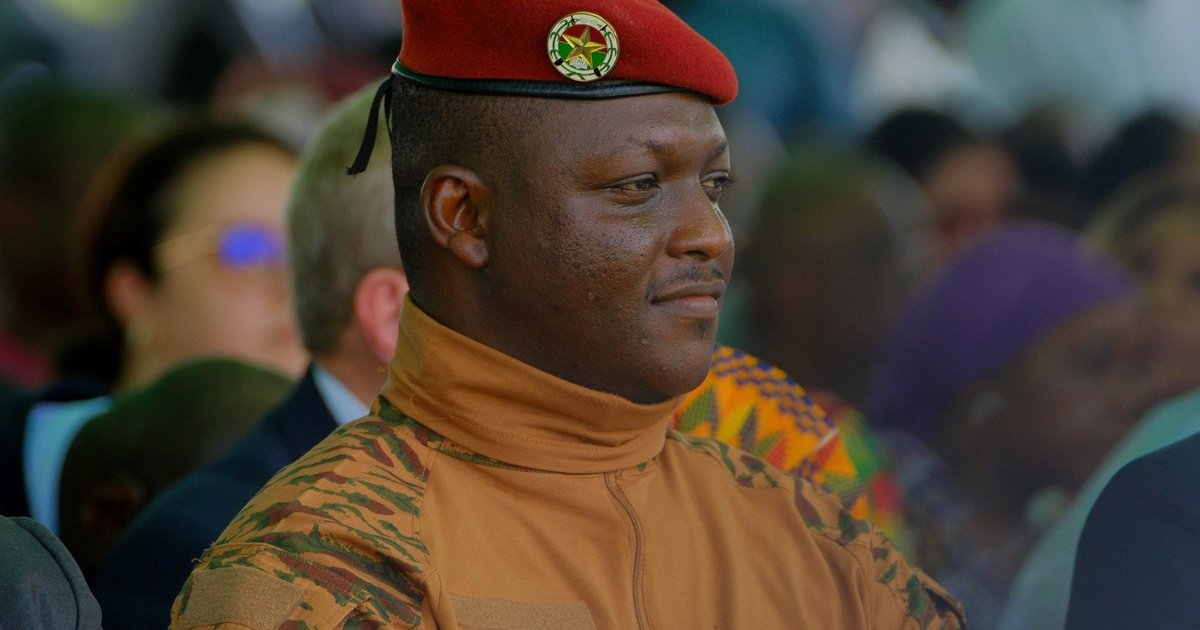
Burkinabe dictator, Captain Ibrahim Traoré, is the dashing poster boy for military rule in the West African Sahel. Not too long ago, he was just another anonymous officer deployed in special counterterrorism operations in the northern part of his country. Having pushed out Paul-Henri Sandaogo Damiba in a palace coup in September 2022, Traoré is, today, supreme leader of Burkina Faso and lord of all he surveys.
Racked by a decades-long Islamist insurgency which has displaced an estimated 2.1 million people, Burkina Faso may well be the byword for instability, and Traoré himself may not always take kindly to media and civil society criticism. Indeed, having initially suspended all political activity in the country, he has doubled down with a calculated assault on civil society. Yet, this appears to have done nothing to dampen seeming popular enthusiasm for his leadership. Back in January when he showed up at the presidential inauguration of Ghanaian president John Dramani Mahama in his military fatigues—complete with sidearm—he commanded the loudest ovation from the audience.
More on:
Burkina Faso
West Africa
Politics and Government
Civil Society
Populism
What explains Traoré’s popularity and what does it signal about contemporary perceptions of military rule and the dynamics of the political environment in the Sahel and the rest of the region?
One obvious factor in Traoré’s adulation in his youthfulness. At thirty-six (thirty-seven on March 14), Traoré is the world’s second youngest head of state. (Icelandic Prime Minister Kristrún Mjöll Frostadóttir is the youngest.) While Traoré is not exactly a spring chicken, thirty-six puts him closer to nineteen, the continent’s median age, than sixty-three, the equivalent for its leaders. For perspective, the mean age of the ten oldest African leaders is 80.2 years. Traoré’s age makes him effortlessly relatable even when he is not necessarily communicating anything.
Nor does it hurt that he readily associates with populist ideas and tendencies that resonate with young people. If his ubiquitous tactical gloves signal a readiness to get his hands dirty or pull the trigger as the occasion demands, declining a presidential salary and opting instead to keep his remunerations as a military captain is widely seen as an indication of personal austerity and genuine desire to be different from the ancien régime.
Indeed, if there is anything about the past with which Traoré is eager to be associated, it is the assumed legacy of Thomas Sankara, the charismatic Burkinabe military ruler (1983-1987) who, nearly four decades after his assassination by his close friend and ally Blaise Compaore, continues to be seen by many Africans—young and not so young—as a conjoined symbol of responsible leadership and anti-Western defiance. Thus, whether he is inveighing against Africa’s imagined “imperialist” and “neocolonial” enemies, lambasting the “neoliberal policies of the IMF and the World Bank,” or rousing Africans to true “sovereignty,” there is no denying Traoré’s wish to be seen as the twenty-first century reincarnation of the beloved revolutionary firebrand.
The much-discussed decay of conventional politics and ensuing frustration with civilian rule across the region has strengthened Traoré’s hand, if not his claim to power, eliciting a continent-wide popularity that means, for instance, that even the random Kenyan public transportation driver who has never before woken up to a certain kind of martial music is so enamored of Traoré that he is willing to plaster his (i.e., Traoré’s image) on his vehicle.
More on:
Burkina Faso
West Africa
Politics and Government
Civil Society
Populism
Traoré’s popularity has also been boosted by the marked shift in critical and popular sentiment across the region, away from perceived “Western paternalism” on the one hand, and towards “authentic” African ideas and aspirations, especially Pan-Africanism, on the other. While the shift definitely predates Traoré’s rise to political stardom, there is no denying his astuteness in hanging on to its coattails, subtly positioning himself as the bridge between the mass of frustrated ordinary Africans, and the halls of the African academy where, incidentally, he is viewed by some as the long-awaited arrowhead of an imagined continent-wide socialist revival. Indeed, much of the admiration for Traoré on the left side of the political spectrum—his standing among the Economic Freedom Fighters (EFF) in South Africa is a perfect illustration—seems motivated by this hunger for an ideological idol.
Whether or not he has the intellectual heft to become the black Lenin, there is little ambiguity as to where Traoré stands on the subject of Vladimir Putin’s Russia, which he fancies, together with China, as genuine friends of Africa, unlike France and other Western nations which presumably are only in Africa to perpetuate the logic of colonialism and feather their imperialist nests.
If Traoré loves and champions Africans in the abstract, one cannot say the same about flesh and blood Burkinabes. Not unlike Sankara, his putative hero, he is not comfortable with being challenged, and experience suggests that the more desperate he is to consolidate his hold on political power, the greater the likelihood that he will double down on muzzling the press, squelching the opposition, and sacrificing ordinary Burkinabes on the altar of public safety. Evidently, Traoré likes to speak for “his” people; what he can’t handle is the idea of his people speaking for themselves.
It is telling that the bulk of the support for Traoré and his brothers in arms in Guinea, Mali, and Niger comes from young people understandably put off by the chronic larceny of the political leadership and, as they see it, the ponderousness of liberal democracy. Given the median age in Africa, this should hardly be surprising. Youths who have never experienced the rampant depravity of military rule in Africa can be forgiven for seeing it as a costless shortcut to progress.
One thing is clear: they will find out soon enough that Traoré is just the latest in a long line of martial impostors. Beneath the populist swagger and ideological posturing, beneath the ostentatious austerity and love of parade is a cold, calculating, and implacable lust for power. We have the assurance of history no less that Traoré will trample over the bodies of his compatriots and intimate friends to hang on to it.
You can bet your red beret on that.
Nathan Schoonover and Giulio Bianco contributed to the research for this article.
