



“We, the daughters of mother earth … have come together to collectively decide what we can do to bring about a world which we would like our children and our children’s children to live in,” so states the Beijing Declaration of Indigenous Women.
Adopted in 1995, the document outlined the oppression of women around the world and demanded governments recognise “the social, cultural, economic, and religious rights of the Indigenous peoples in their constitutions and legal systems”.
Thirty years on, communities still face discrimination, threats and barriers that limit access to education, health services and routes out of poverty. Meanwhile the climate crisis, extractive industries and criminal gangs have reduced safe territories, destroyed livelihoods and created food insecurity.
It is increasingly women who are proving fundamental to fighting back, the stalwarts of their communities. A report published this year to mark the 25th anniversary of the International Indigenous Women’s Forum (Fimi) cites the many ways women are the key protectors of cultures and land.
“Looking ahead to November’s Cop30 in the Amazon, the call is clear: the world must stop seeing Indigenous women as victims and recognise us as the strategic actors we are,” says Teresa Zapeta, executive director of Fimi.
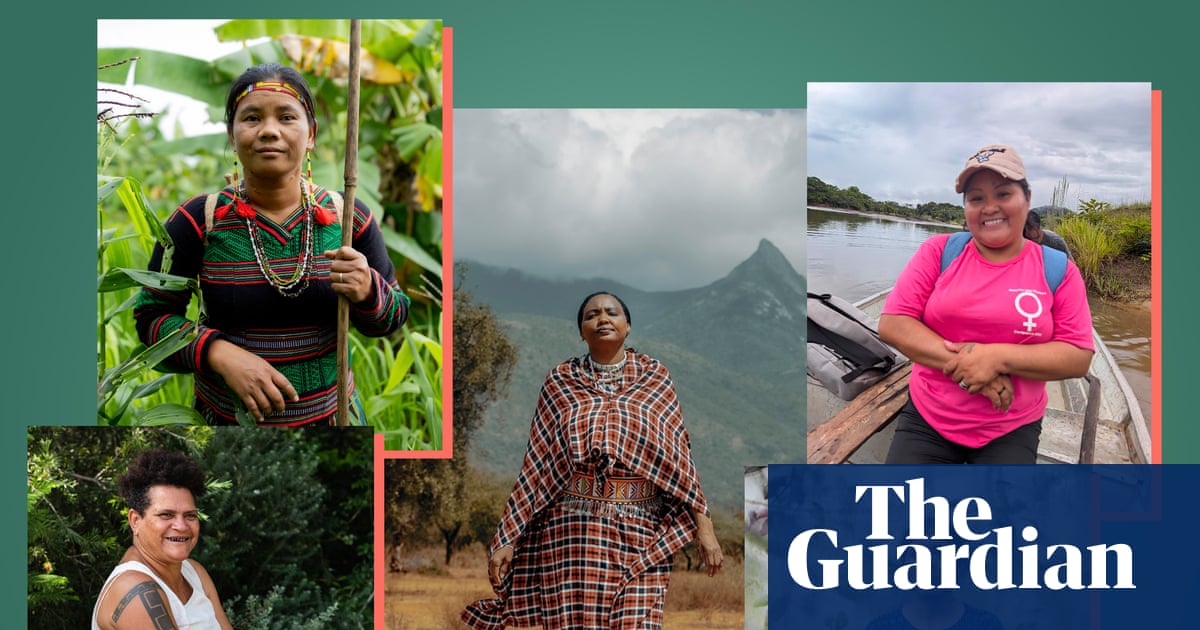
We spoke to five women leaders about their work and inspiration.
Florence Jaukae Kamel, Papua New Guinea
Florence Jaukae Kamel , in Papua New Guinea (PNG), was 17 when she had the first of her five children. They were young teenagers in 2009 when she left their father after he broke her tooth with a punch that left her blood splattered in the dirt.
When she told her brothers what had happened, they insisted she return.
Kamel refused, renting a small hut in her village of Iufi-ufa with eight Papua New Guinean kina, (£1.40) to her name. “I was jobless,” she says, “I was living in the village by doing gardening, and I had experienced all this abuse.”
Already known for pushing frontiers in fashion and politics – in 2002 Kamel was the first woman voted into local government in Goroka province, where she raised eyebrows with her unique dresses, woven in fabric previously reserved for bilum – a cloth bag used to carry everything from food to babies. “People said: ‘What is Florence doing?’ Some thought it was against our custom. But when people talked they motivated me to do more – I wore them every day, I had a whole wardrobe.”
In 2002, she set up a women’s collective weaving bilum. By 2006, she was dressing the PNG Commonwealth Games team, and has since exhibited in fashion shows and art galleries.
Weaving is more than an income, “It’s a bond, it’s a heartbeat,” Kamel says. “We share stories. We create laughter, joy, the peace that women need.”
She established an annual bilum festival, which has grown to a network of 3,000 women sharing stories and techniques, alongside training in marketing, money management and climate adaptation.
The network includes a safe house for women suffering domestic violence, with plans to build another.
“Most of the women here are unemployed and the skill they have is weaving. We are helping them to keep telling the stories that originate in their communities, and the training helps them understand what the markets are like overseas,” says Kamel, 53.
“We’ve got women who have bought sewing machines; women who have bought land. It has had a huge impact.”
They visit the elderly to collect oral histories, and run programmes for girls – many of whom are now in school because their mothers can pay school fees. “It makes me happy, seeing women having their own earnings and making decisions,” Kamel says.
Michelle Duff
Roeurn Heng, Cambodia
In 2019, Roeurn Heng saw on Facebook that part of Phnom Radang – a mountain sacred to her community – had been sold to investors.
Living in Mondulkiri province, near Cambodia’s border with Vietnam, the elephant tour guide and farmer had watched more and more land being developed for tourism. “If the mountain disappears, it is like losing the identity of the entire Indigenous people,” she says.
During the Khmer Rouge genocide of the 1970s, people survived by hiding on the mountain, says Heng, 40. And today residents of Heng’s Pou Lung village, home to the Bunong community, go there to pray for the sick and host religious ceremonies.
As word spread that nearly four of its 10 hectares (24 acres) had been sold, Heng organised villagers to act, filing complaints with provincial and ministry authorities. “I love nature,” she says. “When someone comes to destroy it, I’m heartbroken. I need to stand up and fight back.”
Growing up, Heng watched Bunong women trekking from home to home selling fruit and vegetables, carrying goods – and sometimes children – on their backs. In 2011, Heng was a vocal advocate of women’s efforts to build a central market and last year helped lead renovations of the market and its stalls and to add toilets for the women.
“It’s changed people’s lives because they can earn money for their families and have a proper place to sell – it’s easier,” Heng says. Women are able to save for their children’s education, and have forged deeper friendships with one another. But over the years, land grabs and deforestation have made it tougher to forage or grow produce.
The fight over Phnom Radang continues. Provincial authorities proposed that the buyers and villagers split the land equally – a suggestion rejected by the community.
Phnom Radang “is like a house with a door in the front and back. It cannot be divided,” says Heng. In 2022, one of the buyers sued her for incitement, a common charge used against Cambodia’s land activists. She was threatened with arrest, but her case has been in limbo since a hearing last October.
Provincial spokesperson, Neang Vannak, confirmed that a working group was investigating the dispute but declined to discuss Heng’s case. There were so many conflicts over land in Mondulkiri province that it was “slow to resolve”, he said.
Heng wants the authorities to help communities register their land. “This is a matter of faith,” she says.
Keat Soriththeavy and Fiona Kelliher
Immaculata Casimero, Guyana
When Immaculata Casimero spoke to the Guardian, she was preparing to meet her country’s president, Guyana’s Irfaan Ali , to discuss land rights.
The 42-year-old mother of four is an activist fighting for the rights of her Wapichan people – particularly women – on the ground and with the authorities.
“I’m the child of an Indigenous advocate, so I think it’s in my blood,” says Casimero. After more than a decade living outside her community for work, Casimero returned in 2015 and was elected councillor of Aishaltan village. This led her to become involved with the South Rupununi district council (SRDC), the authority representing the Wapichan people.
An estimated 10,000 Wapichan people live in Guyana’s south-west, on the border with Brazil. They have been fighting for the full legal recognition and protection of their ancestral lands since Guyana declared independence from Britain in 1966.
“It’s 1.6m hectares [4m acres] of pristine forest, which we Wapichan people have defended for generations. We have tried to keep out extractive industries but we have not always been able to,” says Casimero.
She is involved in a number of initiatives to protect Wapichan territory but also to safeguard cultural heritage, notably their language. These include a project to set up a university and bilingual schools where students study Wapishana as well as English.
after newsletter promotion
“Our language is our identity,” says Casimero. “It connects us to our land, it connects us to our food, our culture, our rivers, our mountains, our water.”
Much of her work is in the the Wapichan wizii women’s movement, which she co-founded five years ago. Casimero travels to villages to meet women and share information about rights, financial management and the environment.
“Women face more of the burden of climate change, especially as it relates to our traditional food systems,” she says. Unusual floods and longer dry seasons affect the cassava crops, cause food insecurity and ultimately lead to a loss of culture, especially among the younger generation.
“Nutrition, health, environment, they’re all interconnected,” says Casimero. “And when you’re dependent on food from the outside, that changes the culture.”
Constance Malleret
María Cahuec, Guatemala
“If we women don’t…
