


Markets have reacted with nervousness to the violence and political instability in Kenya.
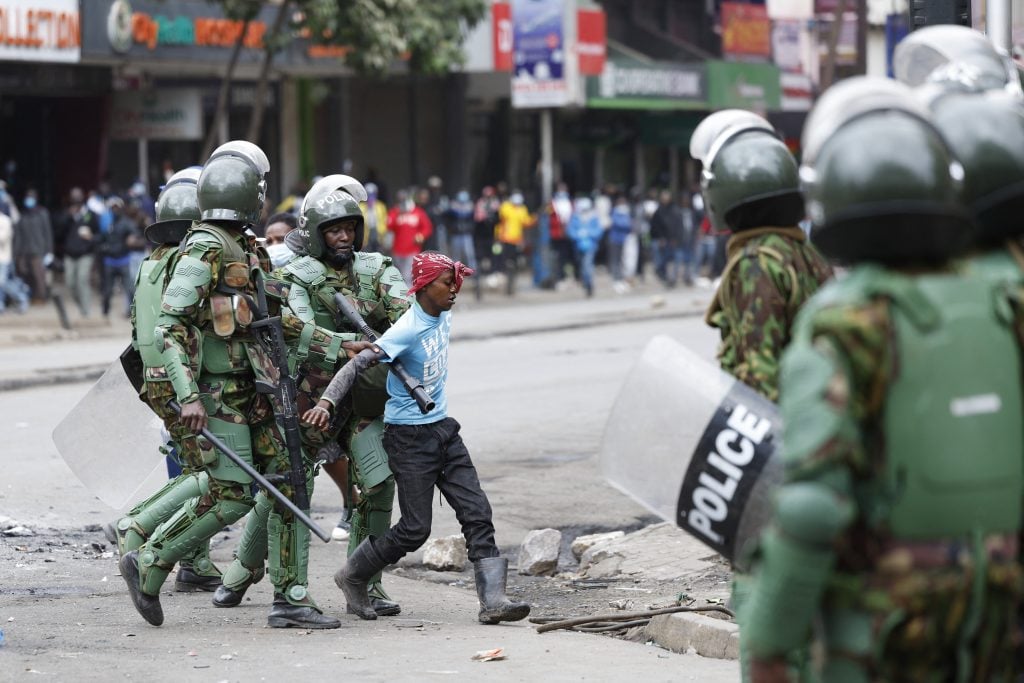
Kenya has become embroiled in nationwide riots that have reportedly left at least twenty people dead amid public anger over a proposed Finance Bill that set out significant tax hikes on essential goods and services.
Jason Tuvey, deputy chief emerging markets economist at Capital Economics in London, tells African Business that “the escalating protests in Kenya will add to the near-term headwinds facing economic activity as well as raise further question marks over the government’s ability to push through fiscal consolidation measures.”
“That could ultimately cause fears of a sovereign default – which had subsided earlier this year after a Eurobond buyback – to build again.”
While the government agreed to drop some of the tax measures earlier in the week, this has done little to calm tensions, with the riots continuing to escalate. In dramatic scenes, the Kenyan parliament in Nairobi was stormed and set on fire by protestors, while the police have reportedly fired live bullets at demonstrators. Ruto has claimed that the debate around the tax measures has been “hijacked by dangerous people.”
President Ruto initially aimed to introduce a 16% value-added tax on bread and a 25% duty on cooking oil. The Finance Bill also proposed a new annual tax on vehicle ownership amounting to 2.5% of the value of the vehicle each year, as well as a 16% tax on some financial services and foreign exchange transactions.
Further measures included an “eco-tax” of products deemed to be harmful for the environment, including personal hygiene items such as sanitary products and technology products like computers and mobile phones.
This sparked widespread outrage as Kenyans have faced rising cost-of-living pressures in recent years owing to elevated levels of inflation caused by global supply chain disruptions and a depreciating Kenyan Shilling (KES) that has pushed up the price of imported goods. Prices increases for food averaged 13.5% between June 2022 and June 2023, while fuel prices went up by 12.3% in the same period.
Ruto’s tax conundrum
The riots point to a broader problem faced by the Kenyan government, and many other African countries, of how to increase tax receipts in order to fund higher spending on development goals without overly burdening their citizens. In 2022, the United Kingdom had a tax-to-GDP ratio of 35.3% and the United States 27.7%.
By contrast, the highest ratio Kenya has reported since 2000 was 17.5% in 2017. Most analysts agree that boosting government tax revenues is a crucial step towards Kenya achieving stronger, more sustainable economic growth.
Jared Osoro, an economist based in Nairobi, tells African Business that “it is a noble ambition to try and raise taxes to finance development aspirations – but for that to be realistic, you must look at the structure of the economy. If the economy is substantially informal, it does not matter how fast it grows, it will always be difficult to collect sufficient tax revenues.”
“The government therefore needs to strike a balance between financing its development goals through taxpayers and financing them through carefully selected borrowing,” he adds.
However, the most pressing need for the Kenyan government is to assess whether its tax proposals are politically possible in the current climate. Osoro says the key “is finding a way to finance government expenditure without that coming at the expense of household expenditure and private investment.”
