



KWESI BOTCHWAY: I WANT TO CELEBRATE BLACK BEAUTY
Soul Contact, 2021
About:
There are artists and then there are artists-with-a-mission. The second category belongs to Kwesi Botchway from Accra, Ghana. Not only with his paintings but also with his entire art practice, he wants to raise the state of being of his people to a higher level.
A few years ago, Kwesi Botchway founded the WorldFaze Art Studio in Ogbodjo. Botchway was born anr raised in Nima, one of the largest Zongo communities in greater Accra (1). It is an old, diverse place of residence with a large Muslim community, a large number of African migrants, a famous market, but also a lot of poverty and a poor infrastructure. Not an environment where art plays a major role. Not exactly a favorable working climate for the many talented young artists who live there. Botchway is aware of this and not only wants to offer them an artist-in-residence opportunity and an exhibition facility, he also wants to guide them in their artistic development, inspire them and mentally prepare them for being an artist. In this way, he makes his community part of his art practice in a natural way.
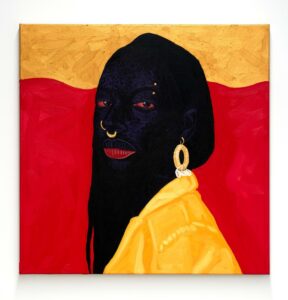
Free Spirit, 2021
Botchway mainly paints portraits. In this show – Rumors of Blackness – these are portraits of girls and women. Models from his environment, fictional models or models inspired by photos from magazines. He says he chose the genre because he loves it. That may be so, but there are more reasons why he prefers the portrait. In art history, the black person is hardly visible. When black figures are depicted, they are usually servants or enslaved. They are not in the foreground but are partly hidden behind white men and women. If they are there, then they are of minimal importance. With his portraits, he corrects the colonial history of the genre. He brings the past to the future. He makes it easy for black people to identify with his work. He implicitly urges museums and other art institutes to adapt their white collections. As one American critic put it succinctly: Representation matters.
But he does more. He doesn’t just want to portray identifiable black women, he wants to emphasize their importance, their role and their beauty. He wants to support them in the way they portray themselves. He wants to show their essence, their soul. So, he makes them proudly look at the visitor (Showy); therefore, he often gives them a mysterious gaze (Eyeing the Gossiper); therefore, he makes them seductive and solemn by painting their eyes and their lower lip orange; that’s why he pays a lot of attention to their earrings, that is why he uses metallic colors like gold, silver, copper and bronze in such a way as to become references to the richness of African culture. In short, his portraits are a tribute to the black woman. In doing so, he not only sends a message to the white viewer, Black Women Matter, but also to the black viewer who suffers from, as he himself puts it, a lack of self-appreciation, self-acceptance and self-confidence.
His portraits are recognizable for black people, they often raise questions for white people, they make everyone curious. These characteristics stimulate the viewer’s imagination. They can become triggers for a personal interpretation, a personal story. Botchway has further developed this narrative aspect in a number of recent works. In paintings such as Invested in a black and red shoe and Last Night Dream, the portrait becomes a chapter in a story. By providing more context, the artist makes it possible to get an impression of the daily lives of black women. The often monochrome backgrounds of his portraits make way for spaces, for interiors. This also ensures that the viewer has more compassion for the depicted person. In Last Night Dreamhe even adds a second scene at the top right, as a cliff-hanger.
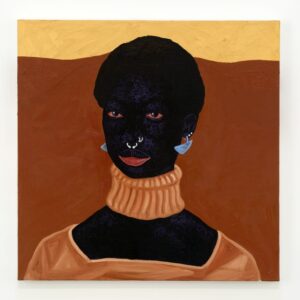
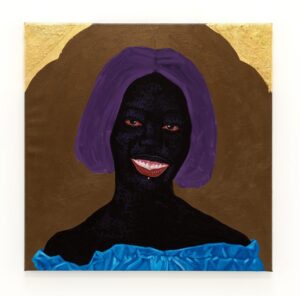
Born Bold, 2021/Rosy 2021
Kwesi Botchway’s portraits are a critical addition to a long, white, Western portraiture tradition. Because many portraits within that tradition originate from commissions, they are often, like Botchway’s, tributes, but tributes to representatives of the well-to-do, white class, to people who could afford to have a portrait painted by well-known artists. In that respect, the motives of the African artist differ. He wants to make ordinary people special, give them pride, and for that reason does not shy away from making reality a little more beautiful, while many classical white portraits play with reality to emphasize the status and power of the depicted.
Kwesi Botchway is impressed by the Impressionist style of artists such as Vincent van Gogh, Émile Bernard and Claude Monet. He also wants to join that tradition and add an African variant to it. This is not a question of criticism of a Western tradition, there is admiration and respect for famous predecessors. He likes to call his style Afro-Impressionism. This style is most evident in the vividly painted backgrounds of his portraits. Like for example in Waking Gold or in Free Spirit. He uses a more subtle variant for the faces and other visible body parts. They appear monochromatic purple, but up close they seem to have a grid laid over them, a grid of signs. Loyal to Self and 90s Style are clear examples of this. By mixing Impressionism with the Realism often used by African artists, he creates his own ism.
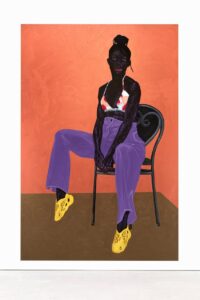
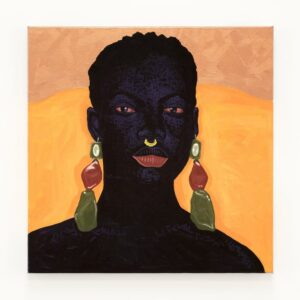
Sitting on a Throne, 2021/Valiant Lady, 2021
The term (West) African Renaissance is being used in more and more publications. It refers to a group of mainly Ghanaian artists who are attracting international attention with their portraits of African men and women. It is still too early to give a final explanation for this success. The fact that it started mainly on American soil and is now expanding there rapidly, makes it likely that the Black Lives Matter movement has played and still plays an important role. Particularly after the death of George Floyd the need for an honest representation of black people has increased. Worldwide. The perception of the black image by the white world needs to be adjusted. The prevailing prejudices must be eliminated. A realistic understanding of black culture is necessary more now than ever in the past. Artists can provide that. American artists as Kehinde Wiley, Kerry James Marshall and Henry Taylor have provided that. They are a source of inspiration for many African artists. Add to that the fact that Accra with the Ghanatta College of Art and Design had an academy that had an eye for recent international developments in the visual arts, and it is not surprising that African artists feel inspired to make their own contributions, in their own way, following their own motives. Even if the situation in Africa is not comparable to that in the United States, in both parts of the world the representation of black people does not correspond to reality.
Kwesi Botchway is an honest and striking representative of this Renaissance. With his idiosyncratic portraits, he manages to judge current art history without neglecting its achievements. The exhibition Rumors of Blackness is a prime example. The fact that he also involves his environment, his community, his African origin in his artistic practice, makes him an exceptional artist.
An artist-with-a-mission.
Rob Perree
Amsterdam/Brooklyn, December 2021
(this article was published in the catalogue of Kwesi’s exhibition Rumors of Blackness in Maruani Mercier Gallery Brussels. Until April 16, 2022)
