


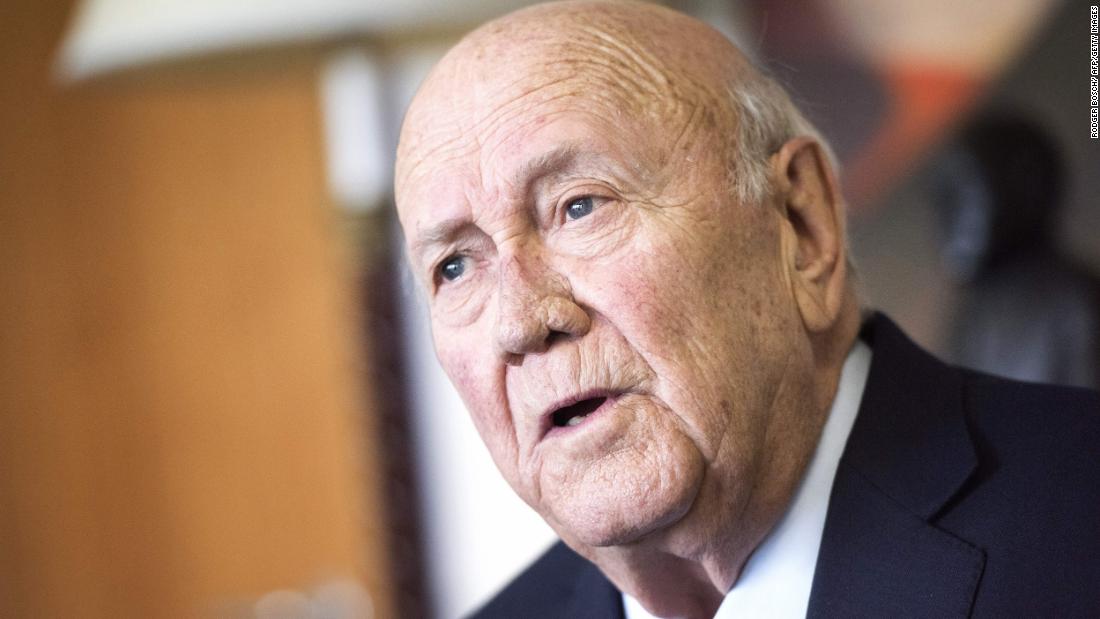
De Klerk released Mandela, his subsequent successor, from prison and laboriously negotiated with him a transition to democracy, ending a decades-long segregationist system that kept South Africa’s White minority in power over the Black majority for generations.
The two men shared the peace prize in 1993 for their work to end the policy, but de Klerk — who had served in governments that upheld apartheid, and who after his retirement appeared reluctant to condemn it unequivocally — remained a divisive figure in South Africa long after he left politics.
De Klerk died at his home in Fresnaye from mesothelioma cancer, the FW de Klerk Foundation said Thursday.
A deeply conservative politician whose party had long supported apartheid, de Klerk surprised his political clan and became an unlikely agent of change in South Africa during his five-year rule of the country.
He effectively announced the beginnings of a new country in one historic speech at the state opening of Parliament in 1990, revealing to a stunned nation that he would free Mandela, legalize anti-apartheid groups, end a national state of emergency and negotiate to end racial inequality in the country.
De Klerk’s political transformation, sparked by worsening racial tensions and the impending possibility of civil war, led him to be cast as a “traitor” by some conservative lawmakers.
It also marked the beginning of lengthy and tense negotiations, during which de Klerk and Mandela developed a complex relationship that occasionally resembled friendship but more often became strained, bitter and adversarial.
In 1993, de Klerk and other leaders ratified a new constitution that formally ended decades of racial segregation in South Africa.
De Klerk went on to lose South Africa’s first multiracial, fully democratic election to Mandela, before taking a post in the new government.
But after retiring from politics he made a number of conflicting comments about the era he helped bring to an end, and he leaves behind a complicated legacy in South Africa.
Archbishop Desmond Tutu paid tribute to his compatriot on Thursday, saying he “recognized the moment for change and demonstrated the will to act on it.”
“The former President occupied an historic but difficult space in South Africa,” a statement from Tutu’s office said. “Although some South Africans found the global recognition of Mr De Klerk hard to accept, Mr Mandela, himself, praised him for his courage in seeing the country’s political transformation process through.”
The nation’s current President, Cyril Ramaphosa, said in a measured statement de Klerk’s move to end apartheid was a “courageous decision.”
“Deputy President De Klerk’s passing, weeks before the 25th anniversary of our democratic Constitution, should inspire all of us to reflect on the birth of our democracy and on our shared duty to remain true to the values of our Constitution,” he said.

‘A convert’
Born Frederik Willem de Klerk and raised into a family of prominent Afrikaner politicians — his father Jan de Klerk was a conservative political heavyweight in the 1960s and briefly became acting President in 1975 — FW de Klerk worked as a lawyer before holding a number of ministerial posts as a politician.
He had been more widely cast as an obstructor than a revolutionary, given his lineage and steadfast conservatism.
But the brutal realities of apartheid had resulted in violence, displacement and growing opposition, and de Klerk ultimately recognized a change in course was needed.
He described himself as a “convert” in an interview with CNN in 2012. “The goal was separate but equal, but separate but equal failed,” he added. “We should have gone much earlier with the flow when the winds of change blew across Africa.”

De Klerk nonetheless created a complicated legacy both during his time in power and after his retirement.
In the same 2012 interview, de Klerk caused anger by equivocating on whether apartheid was a morally repugnant policy. “I can only say that in a qualified way … there were many aspects which are morally indefensible,” he said.
Last year, his foundation issued an apology after de Klerk claimed that apartheid was not a crime against humanity during an interview with South African public broadcaster SABC.
He told CNN he and Mandela were “close friends” by 2012. “There is no animosity left between us. Historically, there was,” he said.
“He still has an aura around him. He’s truly a very dignified and a very admirable person,” de Klerk added, shortly before Mandela’s death the next year.
De Klerk occasionally re-entered the political discourse after he left office. He reunited with Mandela while serving on the delegation that helped award South Africa the 2010 FIFA World Cup, a major event that allowed the nation to take the global spotlight for one month.
He also freely gave his thoughts on modern South African politics; in 2012 he told CNN “transition is taking its time” in South Africa, adding: “I’m convinced it’s a solid democracy and it will remain so, but it’s not a healthy democracy.”
British Prime Minister Boris Johnson said Thursday that “De Klerk will be remembered for his steely courage and realism in doing what was manifestly right and leaving South Africa a better country,” adding he was “saddened” by his death.
Irish Prime Minister Micheál Martin added that “his vision, along with Nelson Mandela, moulded a new South Africa.”
He is survived by his wife, three children and grandchildren.
