


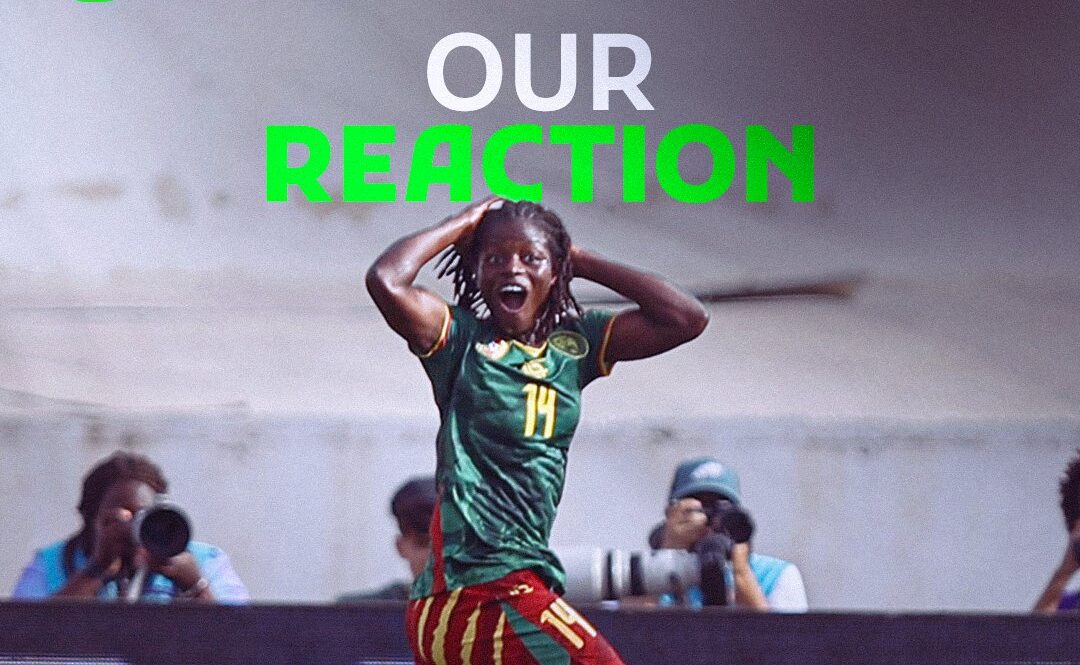
The Super Falcons’ quest for an 11th Women’s Africa Cup of Nations title has come to a painful end after Nigeria suffered a 1-0 quarter-final defeat to Cameroon at the Stade Larbi Zaouli in Casablanca.
For much of the contest, Nigeria created the clearer openings and spent long periods searching for the breakthrough. But when the decisive moment arrived, it was Cameroon who made it count.
A well-struck free-kick from defender Maéva Nyadjou proved enough to send the Indomitable Lionesses into the semi-finals and leave Nigeria facing another route to the 2027 FIFA Women’s World Cup.
Justine Madugu attempted to change the complexion of the game by introducing Esther Okoronkwo, Asisat Oshoala, Uchenna Kanu and Toni Payne, but despite a late push and several opportunities, Cameroon remained disciplined at the back to protect their advantage.
With the defeat ending Nigeria’s title defence, PREMIUM TIMES looks at five major talking points from the Super Falcons’ quarter-final exit for the very first time.

The gap between Nigeria and Africa’s emerging powers is narrowing
The Super Falcons remain the most successful team in WAFCON history, having won the competition a record 10 times, but their dominance can no longer be taken for granted.
The events of the past three tournaments have provided enough evidence that other African nations are closing the gap.
There were warning signs against Morocco in 2022 and again against the hosts in the previous edition. Cameroon have now provided another reminder that Nigeria can no longer rely solely on its long-standing reputation and abundance of talent.

Credit: CAF Women’s Football X Page
The result should prompt serious reflection within the Nigeria Football Federation, particularly on investment in women’s football and the broader development of the Nigerian game.
Failure to respond could leave the Super Falcons playing catch-up with emerging African powers that are becoming increasingly competitive.
Super Falcons pay the price for wastefulness
Cameroon goalkeeper Michaely Bihina was deservedly named Player of the Match after producing nine outstanding saves to keep the Indomitable Lionesses alive.
But Nigeria will also have to look inward, as the Super Falcons had opportunities to punish Cameroon but failed to make them count, particularly in the closing stages.
Esther Okoronkwo’s chance in the 92nd minute summed up Nigeria’s frustration. With an opportunity to level the contest, she opted to go for goal but narrowly missed the target.
Even six time CAF women best player Asisat Oshoala was visibly frustrated, with the experienced forward appearing to feel that Okoronkwo should have squared the ball to her when she was better positioned to tap into an empty net.
At this level, such moments can determine an entire tournament.

Credit: CAF Women on X
Nigeria still searching for a clear identity
One of the biggest concerns from Nigeria’s campaign was the absence of a consistent style of play.
Madugu experimented with several midfield combinations throughout the tournament. That could be interpreted as tactical flexibility and an attempt to adapt to different opponents, but it also increasingly looked like a team still searching for its best formula.
Nigeria never truly dominated a match in Morocco, and even the emphatic 6-2 victory over Egypt masked some of the defensive and structural weaknesses that a more clinical opponent could have exploited.
Those shortcomings resurfaced against Cameroon as the ten time champions were physically outmatched and man handeled at important stages, while the response from the bench failed to produce the tactical shift required to turn the game around.
ALSO READ: WAFCON 2026: Cameroon end Nigeria’s title defence, seal World Cup ticket
For a team with Nigeria’s pedigree, there must now be a serious conversation about the identity and direction of the side.
Plumptre’s absence exposed Nigeria’s surprising left-back problem
Perhaps one of the clearest lessons from Nigeria’s campaign was the impact of Ashleigh Plumptre’s absence.
The Al-Ittihad defender missed the tournament because of a foot injury, and the Super Falcons struggled to reproduce the balance and defensive security she provided on the left flank.

Nigeria conceded six goals across four matches, a statistic that would have been almost unthinkable during their previous campaign.
Last time out, with Plumptre operating effectively at left-back, Nigeria kept four clean sheets before conceding their first goal in the semi-final against South Africa.
This time, Plumptre’s absence was felt; Michelle Alozie and Rofiat Imuran had spells in the position, but neither was able to provide the same consistency, leaving an obvious gap that Nigeria must address.

Super Falcons miss out on direct World Cup qualification
Nigeria’s defeat means the Super Falcons have missed out on one of the four automatic African tickets to the 2027 FIFA Women’s World Cup.
The four teams that reach the semi-finals of WAFCON 2026 will qualify directly for the tournament in Brazil, but Cameroon claimed one of those places by eliminating Nigeria.
Madugu’s side must now take the longer route, as the defeated quarter-finalists will contest a play-off match on 13 August, with the two winners advancing to the 2027 FIFA Women’s World Cup.
For a country accustomed to qualifying for major tournaments, it is an unwanted complication to Nigeria’s World Cup campaign.
The Cameroon defeat has therefore raised questions that go beyond one disappointing result.
For the 10-time African champions, the next challenge is not simply finding a way through the World Cup play-off. It is finding answers to the deeper problems exposed by their WAFCON campaign; before the gap between Nigeria and Africa’s rising powers becomes even wider.
Discover more from Premium Times Nigeria
Subscribe to get the latest posts sent to your email.
