


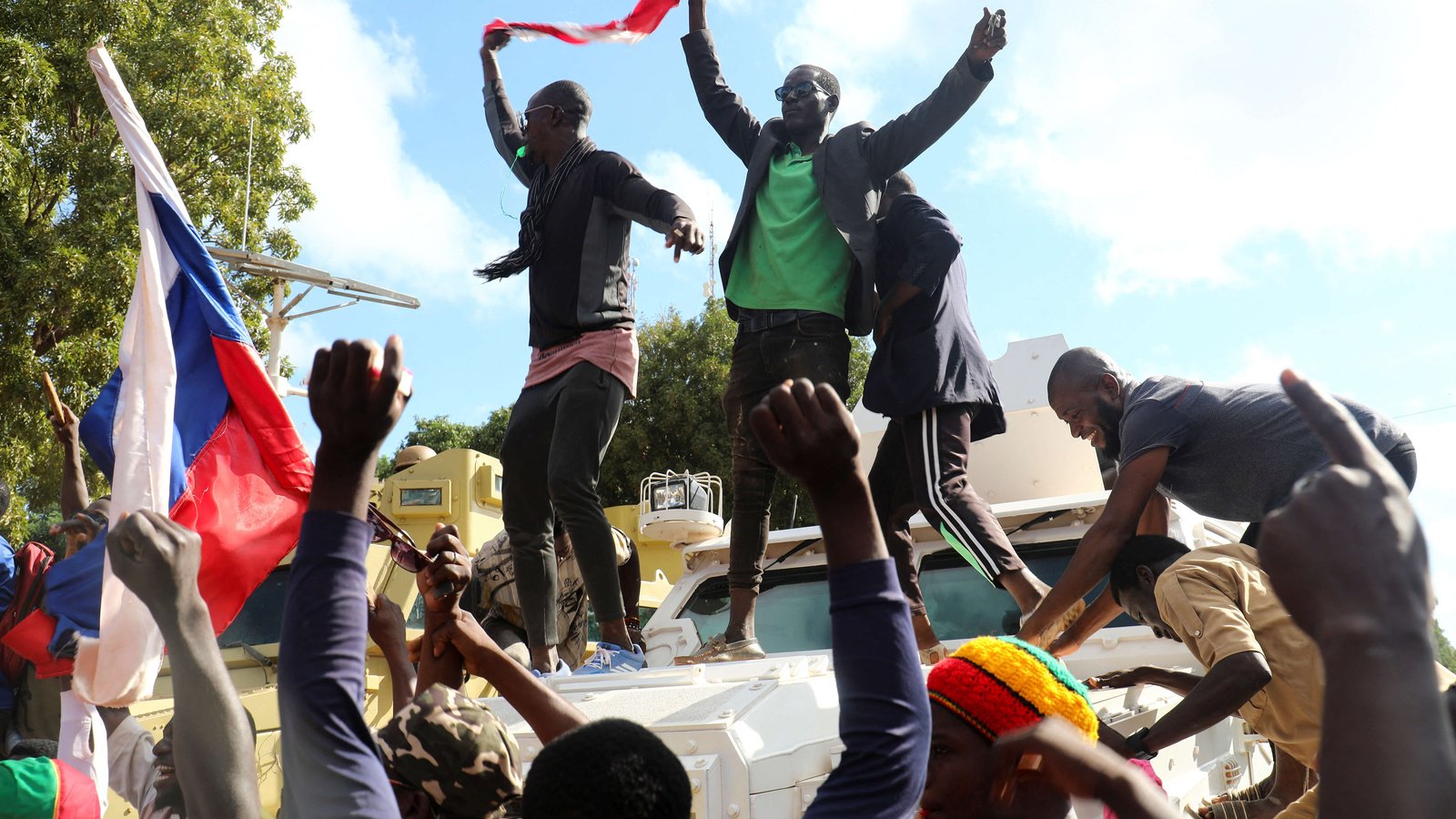
Over the weekend, a small group of soldiers led by 34-year-old Captain Ibrahim Traore overthrew the military junta of Lt. Col. Paul-Henri Sandaogo Damiba. Damiba had occupied Burkina Faso’s Kosyam Palace for all of nine months, having assumed power in January following the deposition of democratically elected president Roch Marc Christian Kabore. The Traore coup is the country’s ninth since its independence from France in 1960. Chances are it may not be the last.
Following a momentary standoff during which Damiba urged Traore and his fellow coupists to “come back to their senses to avoid a fratricidal war that Burkina Faso doesn’t need in this situation,” Damiba eventually stepped down, paving the way for Traore, who until the weekend was a Damiba henchman in the Patriotic Movement for Preservation and Restoration (MPSR) junta. Traore has dissolved the government, suspended the constitution, and closed the country’s borders.
More on:
Burkina Faso
Political Transitions
Fragile or Failed States
Violent Nonstate Actors
Islamic State
The United Nations (UN), the African Union (AU), the European Union (EU), the Economic Community of West African States (ECOWAS), the United States, and France were united in their condemnation of the latest putsch in the landlocked country of twenty million people. ECOWAS has used the occasion to “reaffirm its unreserved opposition to any seizure or retention of power by unconstitutional means” and demand “scrupulous respect of the timetable already agreed with Transitional Authorities for a rapid return to constitutional order.”
What Captain Traore will do next is anybody’s guess. Although he has admitted that the country faces an emergency “in every sector,” there is little evidence that, at 34, and having been a soldier all his life adult life, Traore has the training or experience required to govern. From all indications, he had shared Damiba’s frustrations concerning what he, Traore, recently called “the continuing deterioration of the security situation” in the country; but a schism gradually opened up between him and Damiba, who was facing intense pressure to secure the country, consolidate power, and reassure the international community with a timetable to restore democratic rule. In retrospect, the germs of the Traore-led coup d’état may have been sown from the very moment the Damiba-led coup was staged, with the latest takeover seeming to confirm expert fears about a perpetual cycle of political instability in the country.
While Traore may struggle to distance himself from the same “hazardous choices” that he once signed up to as a senior member of the MPSR, the greater worry for Burkina Faso and its immediate neighbors is whether, as it is, the country is governable without substantial external financial and military support.
All the indices point to a country that is gradually coming apart and arguably shedding some of the key attributes of statehood. For instance, 10 percent of the population (two million people) has been displaced and an estimated two thousand lives have been claimed by an Islamist insurgency which broke out in 2015. In July, hundreds of refugees, many of them children, fled into northern Ghana after a suspected Jihadist attack. On the whole, rebel groups linked to Al-Qaeda and the Islamic State West Africa Province (ISWAP) have hobbled the Burkinabe state, leaving it in effective control of “as little as 60 percent of its territory.”
These rebel groups are believed to be behind the recent spate of killings across the country, including the May attack on a military base in the eastern part of the country during which eleven police were killed; the massacre in June of at least one hundred civilians in the northern village of Seytenga; and last month’s episode in which at least thirty-five civilians were killed after a vehicle in an army-escorted convoy hit an improvised explosive device. According to the Fund for Peace Fragile States Index, the rise in violent extremism puts Burkina Faso among the five “most worsened” states in overall fragility. The others are Afghanistan, Haiti, Lebanon, and Myanmar.
More on:
Burkina Faso
Political Transitions
Fragile or Failed States
Violent Nonstate Actors
Islamic State
Nor are terrorists the only ones doing the killing. In August, Burkina Faso’s army admitted to accidentally killing civilians during a military operation in the country’s southeast.
To say that the situation in the country is precarious is an understatement, and it is significant that Traore has admitted to needing help with “defense, health, and infrastructure.” The United States, Britain, and the EU must go beyond condemnation and collaborate with the AU, ECOWAS, and regional leaders, especially Nigeria, Ghana, and Senegal, to ensure that this gap is not filled by Russia, whose mercenary Wagner Group, perhaps not surprisingly, enthusiastically welcomed the coup. Yevgeny Prigozhin, its presumed founder, has described Traore as “a truly worthy and courageous son of his Motherland.” Among other African countries, the group already has a footprint in Libya and Sudan.
While there appears to be considerable civilian sympathy for Russia, symbolized by images of Traore’s supporters waving Russian flags, it would seem to have more to do with a real frustration at chronic insecurity rather than a genuine belief in Russian allyship or altruism.
While preventing Russia from gaining a toehold in Burkina Faso should be of immediate concern, the crisis in the country and the broader Sahel is a historic opportunity for Western countries, working in concert with regional leaders, to think big in the region. This is not just because state fragility in Burkina Faso threatens the stability of its immediate neighbors; more crucially, the Burkinabe state is a microcosm of the deep-rooted problems of governability and state consolidation that recur across West Africa and the Central Sahel. It is bad enough that Traore lacks the tools to turn the situation around. The more profound problem is that the crisis in the country will overwhelm the most astute statesman.
Since this proposal will require that the United States, Britain, and the West commit more resources to the region, the question is bound to arise: why should they be doing so considering their own domestic woes against a backdrop of global runaway inflation?
The simple answer is that a stable West Africa is ultimately in the interest of the West, and wider Russian influence will only lead to greater destabilization. On that level, it is a matter of whether the West pays now or pays double later. Having just reaffirmed its commitment to “deliver democratic and security dividends” on the continent, the United States has an opportunity to put its money where its mouth is.
This publication is part of the Diamonstein-Spielvogel Project on the Future of Democracy.
