



The Kenyan government has announced plans to increase public spending, despite President William Ruto’s previous promises to slash spending and borrowing amidst growing debt levels in the East African country.
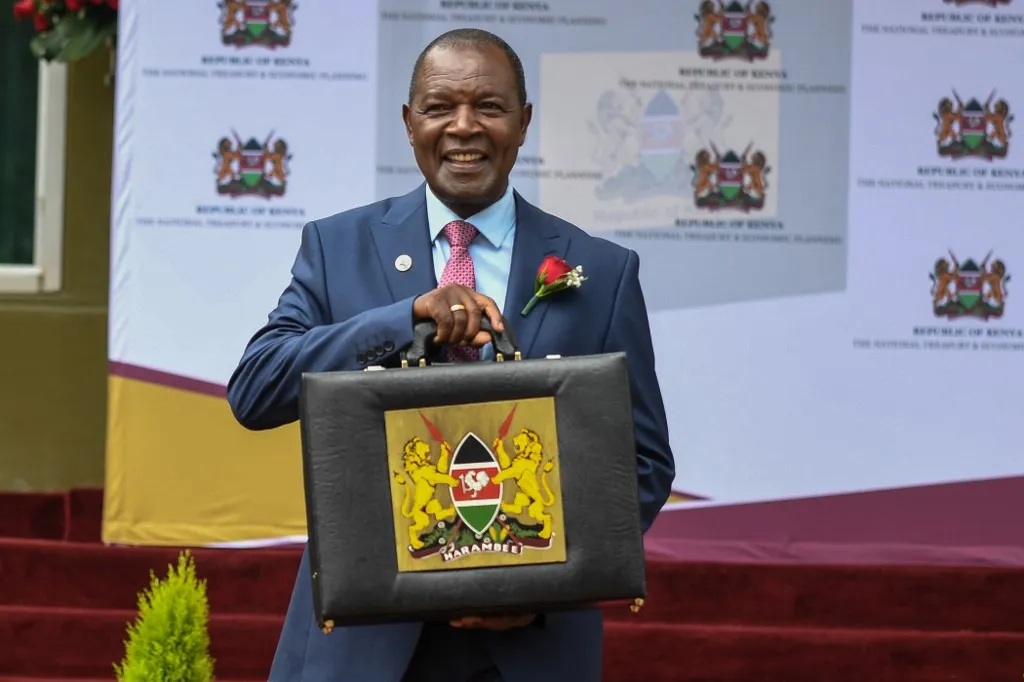
Last week, Kenya’s finance minister, Njuguna Ndung’u (pictured above about to deliver his budget speech in June), asked the National Assembly to increase the country’s budget by over 5% to KSh3.93 trillion ($26bn).
This mini-budget comes at a time when higher interest rates globally are making it more expensive for Kenya to service its external debt, which stood at around $35.05bn in April this year. A weakening Kenyan shilling – which has lost almost a fifth of its value against the US dollar this year so far – has also made it costlier to service dollar-denominated debt. The government is seeking additional funds to spend on debt repayments, as well as meet other financial commitments such as public sector salaries and pensions. Education, security and the agricultural sector see increased spending.
Related articles
Fall in value of shilling raises spending on debt
Arnold Kipkoti, strategy manager at NCBA Group in Nairobi, tells African Business that this “is necessary given prevailing market circumstances.”
“It is important to note that, since the fiscal year budget was set in June, a few economic variables have moved. For example, the cost of debt servicing has increased following the increase in domestic interest rates, forcing the government to revise upwards its cost of servicing both domestic and external debt,” Kipkoti says.
“The sharp depreciation of the Kenyan shilling also means that we are paying more interest in shilling terms for the same foreign currency amount. Furthermore, recent expenditure has been revised up by over 83bn shillings, triggered by the need to increase funding to the Teachers’ Service Commission, the Higher Education Ministry, and defence forces.”
While arguably a necessary measure, the government’s move would appear to be at odds with President Ruto’s pledges to reduce spending and bring borrowing under control. Upon taking office in September last year, Ruto immediately instructed the Treasury to cut KSh300bn from annual government spending and said that lower expenditure, along with more effective collection of tax revenue, was the country’s route “back to sanity”. The Kenyan president also pledged to be running a budget surplus by his third year in office.
Major debts should soon be cleared
Kipkoti notes that “the pledge for fiscal consolidation is a medium-term target” and points out that the government will soon have cleared some major debts, such as a $2bn Eurobond that matures in June 2024. “Once external financing flows normalise and the significant payments of external debt are done, the pledge to reduce spending may be back on the table,” he says.
The government will be hoping to reduce spending as soon as possible because current borrowing terms as far from favourable for Nairobi. Kipkoti explains that “the sustained tightening of interest rates in advanced economies, which is expected to persist into 2024, has made it costlier for credit issuers to access global financial markets.”
He adds that it is even costlier for Kenya to do so given “Fitch Ratings’ downwards revision of Kenya’s Long-Term Foreign Currency Issuer Default Rating (IDR) outlook in late July from stable to negative.”
Markets appear to have reacted negatively to the news of increased spending. The Kenyan shilling has lost a further 3% against the US dollar since the Treasury confirmed plans to increase its budget, with yields on government bonds also rising. Kipkoti says this reflects the fact that “financial markets have definitely added a sovereign risk premium onto Kenya.”
