


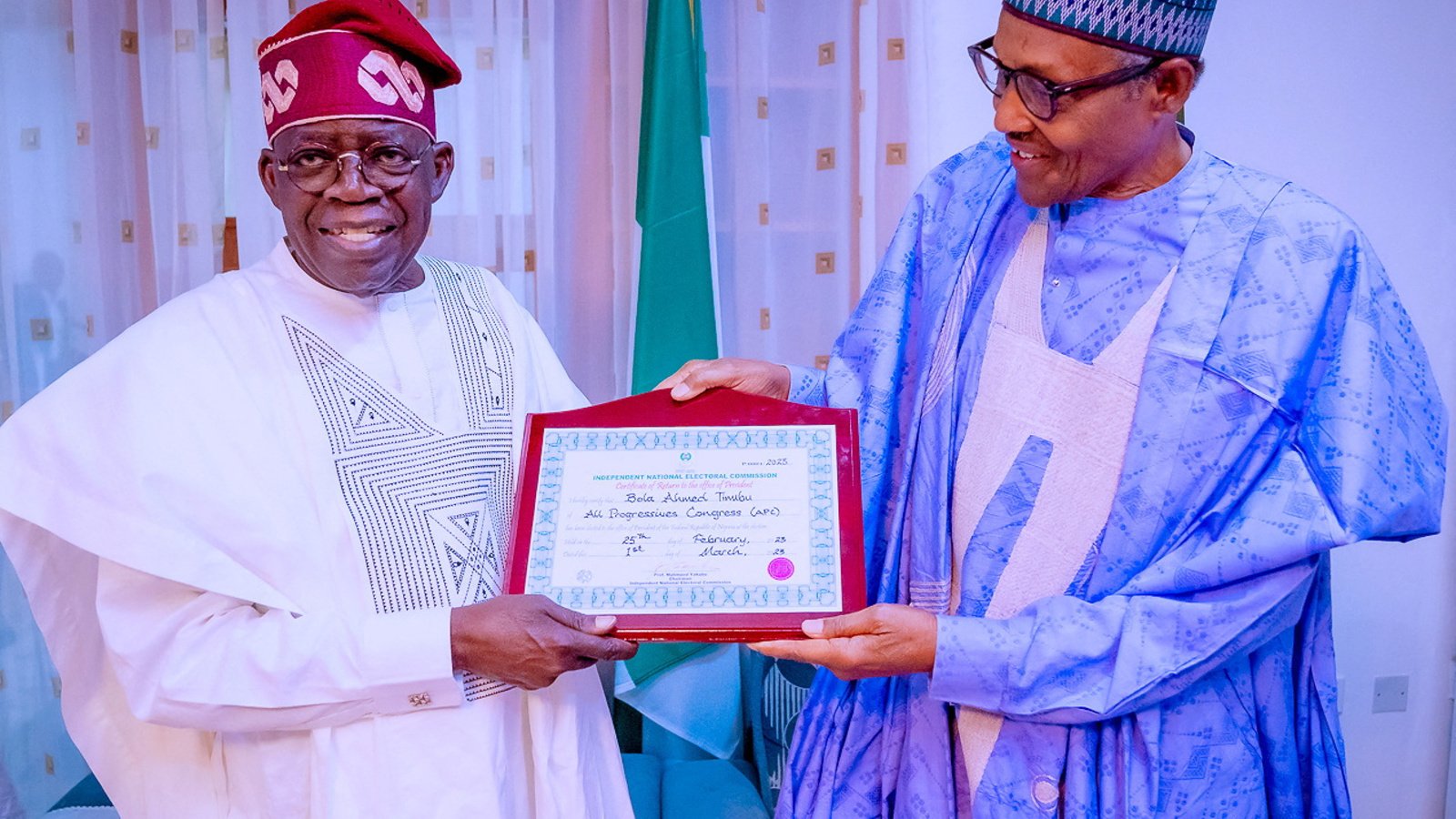
In one sense, the ongoing commotion in Nigeria over the educational record of President Bola Ahmed Tinubu is entirely about his personal failure to retire nagging doubts among the Nigerian public, and not just the political opposition, regarding the most basic details about his background and identity.
Having seen his challenge to Tinubu’s victory at the February polls dismissed last month by the country’s Presidential Election Petition Tribunal (PEPT), Atiku Abubakar, the standard bearer of the opposition People’s Democratic Party (PDP), promptly took his fight to the United States, where he prayed the District Court for the Northern District of Illinois to order the Chicago State University (CSU), President Tinubu’s alma mater, to release his school transcripts. According to Mr. Abubakar’s legal team, the release of the records was imperative in order to show that the President, in clear violation of Nigerian electoral law, had submitted a forged diploma to the Independent National Electoral Commission (INEC), which means he was technically ineligible to run in the presidential election. Immediate objection by President Tinubu’s lawyers that the release of the transcripts would cause their client “severe and irreparable harm” merely heightened public interest in Tinubu’s academic records.
More on:
Nigeria
Corruption
Civil Society
Heads of State and Government
Education
While the released transcripts appear to confirm that the President did indeed graduate from Chicago State University in 1979 with a B.S. degree in Business Administration (a fact also affirmed by CSU Registrar Caleb Westberg in a 125-page deposition to the same court following the release of the transcripts), the apparent failure of the university to authenticate a copy of the certificate submitted by Tinubu to INEC led to the not unreasonable surmise that the Nigerian President may have manufactured a diploma as proof of genuine educational attainment—the equivalent, if you will, of the U.S. president traveling with a forged American passport.
If there is at least evidence that Tinubu attended Chicago State University, the trail goes decidedly cold at the high school level as Government College Lagos, the institution where the president, by his own account, claims to have obtained his high school diploma in 1970, was in fact established in 1974. Not only have his critics been eager to point out this odd discrepancy (it is extremely rare to attend a non-existent school, and rarer still to graduate from one) they have also drawn attention to the president’s strange inability to name any of his high school classmates.
This is not the first time that details of President Tinubu’s biography, including, in some cases, his age and date of birth, have come under scrutiny. As Governor of Lagos State (1999- 2007), Tinubu spent much of his first term of office swatting away allegations similar to the one he currently faces of having fabricated his educational records and, according to some, assuming another individual’s identity.
No matter what the Nigerian Supreme Court, which is set to hear Atiku Abubakar’s appeal against the election petition tribunal ruling, has to say about all this (chances of the country’s apex court overturning the result of the February election and ordering a new one seem minuscule at best), it would appear that the controversy surrounding his academic records, plus lingering mystery over the high school he attended and why he claims to have obtained a high school diploma from an institution that was not even in existence at the time, has dealt a mortal blow to President Tinubu’s persona and moral legitimacy.
The Nigerian President’s travails are instructive on several levels. In the first place, they underscore the moral drama of a Fourth Republic (1999- ) whose animating spirit appears to be willful obfuscation. The Fourth Republic saw its first major scandal in July 1999 when, following media investigations, Speaker of the House of Representatives Ibrahim Salisu Buhari admitted both to falsifying his age and lying about having attended the University of Toronto. At different times, both President Goodluck Jonathan (2010- 2015) and President Muhammadu Buhari (2015- 2023) endured public pressure to produce their Ph.D. dissertation and high school leaving certificate respectively. In 2018, one-time Finance Minister, Kemi Adeosun, resigned her appointment following allegations that she forged her National Youth Service Corps (NYSC) certificate.
More on:
Nigeria
Corruption
Civil Society
Heads of State and Government
Education
In a country where the ration of elite honor is consistently meager and the competition for social eminence cutthroat, it is not unusual for highly placed individuals to cook up qualifications, falsify their age, or assume honorifics—witness the plethora of “Doctors,” “Engineers,” “Barristers,” “Professors” and “Architects,” not to mention “Sirs” and “Ladies,”—ordinarily meant to signal individual distinction in a particular discipline or profession.
In this, the Nigerian elite is a true facsimile of the broader society. For every lawyer who was never called to the bar, there is an ordinary bureaucrat who doctors his age in order to prolong his stay in public service. In his work on what he calls “a culture of corruption” in Nigeria, anthropologist Daniel Jordan Smith describes an economy of appearances whereby the ubiquitous shadow of deception looms over everyday relations and transactions. Long before fake news made its way into the global lexicon, the average Nigerian dwelled in a world of simulacrum teeming with fake lawyers, fake soldiers, fake policemen, fake students, fake doctors, fake educational institutions, fake certificates, and, even worse, fake medicine. In 2022, the investigation and enforcement directorate of the National Agency for Food and Drug Administration and Control (NAFDAC) disclosed that in the previous three years, the agency had seized around 4.8 billion dollars’ worth of counterfeit drugs. Nigeria is reported to be the developing world’s largest market for counterfeit drugs.
While none of this exonerates President Tinubu, who, judging from all available facts, appears to have a case to answer, it is nonetheless important to note that he (and ipso facto the political elite of which he is a leading member) merely exemplifies the prevailing normative order in the country. While he may well deserve to have the book thrown at him, it seems equally worthwhile to try and understand why the ethos he arguably encapsulates has gained ascendancy since the society-wide moral collapse dating back to the late military era, particularly the regime of General Ibrahim Babangida (1987- 1993); and why, across its public life, Nigeria seems fated to produce leaders just like its incumbent president for the foreseeable future.
Reina Patel and Alexandra Dent contributed to the research for this article.
