




- North Africa’s high rankings are linked to early investment in e-government, national AI strategies, and collaborations with EU tech partners, giving them a regulatory head start.
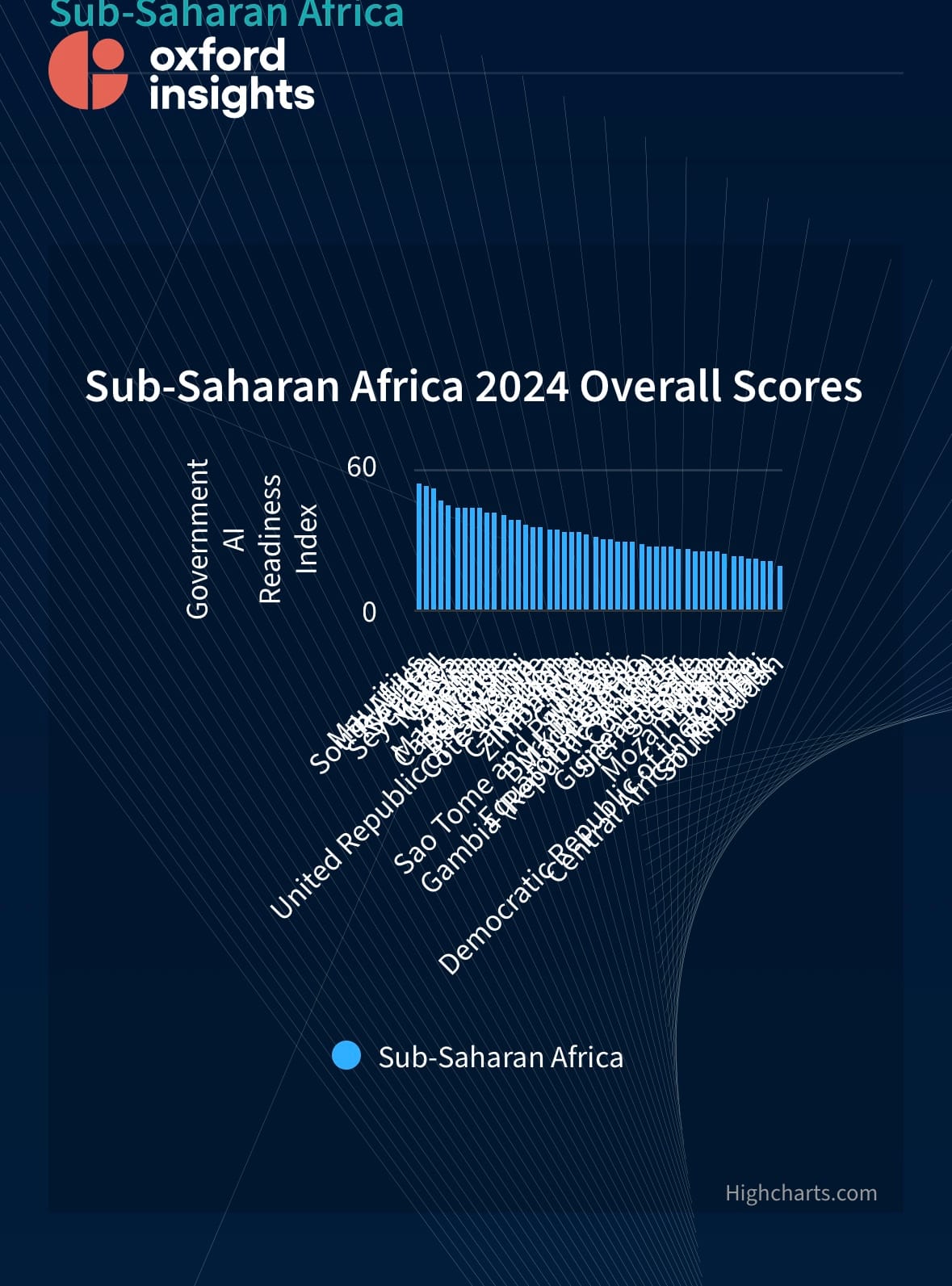
- Island nations like Mauritius and Seychelles show that digital readiness is less about size and more about digital-first economies backed by strong cybersecurity and data frameworks.
- Sub-Saharan leaders such as Rwanda and Kenya are tying AI readiness directly to development agendas, leveraging AI for agriculture forecasting, health diagnostics, and digital ID systems.
Deep Dive!!
Lagos, Nigeria, Friday, September 19 – Artificial intelligence is increasingly a benchmark for how African governments plan, regulate, and innovate. Preparedness reflects more than the acquisition of digital tools and rests on the ability to build reliable data systems, enforce legislation, develop skilled talent, and align technology with national priorities. In this sense, AI readiness is a measure of institutional strength as much as technological advancement.
The Oxford Insights Government AI Readiness Index evaluates these factors by assessing governance, infrastructure, and innovation ecosystems. A strong score signals that a state has not only articulated digital ambitions but also established the mechanisms to sustain them. Such readiness highlights the shift from aspiration to structured implementation.
In Africa, this progress is tied to practical needs. Governments are turning to AI to forecast climate risks in agriculture, expand access to education through digital platforms, improve healthcare diagnostics, and streamline public administration. The rankings, therefore, reveal the countries that are strategically positioning themselves to channel emerging technologies into long-term development and resilience.
10. Ghana
With a score of 43.30, Ghana sits among Africa’s ten most AI-ready nations according to the 2024 Government AI Readiness Index. Its progress is grounded in deliberate governance choices, including a ten-year national AI strategy led by the Ministry of Communications and Digitalisation. That plan links artificial intelligence to practical outcomes such as public service efficiency, research capacity, and responsible oversight. At the legislative level, the Data Protection Act (Act 843) and the active role of the Data Protection Commission provide safeguards that reinforce trust in AI-driven systems.
The country’s digital transformation has been strengthened by initiatives that expand both infrastructure and talent. The Ghana Card project, which has enrolled millions of citizens, is creating unified datasets that can support more accurate and scalable AI applications in areas like healthcare and administration. Alongside this, a growing innovation ecosystem including MEST, Impact Hub, and research programs at major universities is producing engineers and entrepreneurs who are experimenting with AI for local needs. These developments are tied together by Ghana’s broader digital economy strategy, which integrates regulation, workforce training, and digitization into a single policy framework.
Recent activity shows that Ghana is moving beyond planning into practical implementation. Government programs are being launched to put the AI strategy into action, while private incubators are supporting startups applying machine learning in agriculture, financial services, and health diagnostics. Civil society is also taking part, with AI-driven fact-checking and election monitoring projects gaining visibility. Together, these efforts illustrate a country building the institutional backbone and local expertise needed to translate readiness into long-term, scalable impact.
9. Nigeria
Nigeria holds a score of 43.33 on the 2024 Government AI Readiness Index. Its ranking reflects the scale of its digital ecosystem and the gradual institutionalization of AI within national policy frameworks. The National Information Technology Development Agency (NITDA) has drafted an artificial intelligence policy to guide innovation, data use, and ethical oversight. This complements Nigeria’s Data Protection Act of 2023, which established the Nigeria Data Protection Commission as a regulatory body to enforce standards in data governance, an essential foundation for the adoption of AI in public and private services.
The country’s readiness is underpinned by its digital landscape. Nigeria has one of the largest technology sectors in Africa, supported by hubs such as Co-Creation Hub (CcHub), which has launched AI-focused research programs in health and education. Universities and research institutes are increasingly incorporating AI into curricula, while talent export pipelines are connecting Nigerian engineers to global markets. With over 120 million internet users, the potential for large-scale datasets is significant, though still challenged by uneven connectivity and the urban–rural divide. What gives Nigeria a comparative edge is the combination of human capital depth and a thriving startup ecosystem that actively experiments with AI solutions.
Momentum is visible in both state-led reforms and private initiatives. The Federal Government’s National Centre for Artificial Intelligence and Robotics (NCAIR) has been tasked with supporting research, innovation, and capacity building. At the same time, startups are deploying AI in areas such as fintech fraud detection, agricultural yield forecasting, and language processing for Nigeria’s diverse linguistic communities. The interplay between government policy, a dynamic private sector, and an expanding research base suggests that Nigeria’s AI readiness is not just theoretical but is also moving toward structured implementation with the potential to influence both domestic development and regional innovation leadership.
8. Kenya
Kenya records a score of 43.56 on the 2024 Government AI Readiness Index. This position builds on its established reputation as one of the continent’s most dynamic digital economies. The government has anchored AI policy within its broader digital transformation agenda, guided by the Ministry of Information, Communications, and the Digital Economy. Regulatory measures such as the Data Protection Act of 2019, enforced by the Office of the Data Protection Commissioner, provide a framework for the responsible use of data, which is central to AI adoption. These institutional steps have helped secure Kenya’s place among the top performers on the index.
Underlying this readiness is a combination of infrastructure and innovation ecosystems. Kenya’s mobile-first economy, epitomized by the success of M-Pesa, has created an environment where digital solutions are rapidly adopted and scaled. This culture of innovation extends into AI through research hubs, incubators, and academic programs that train engineers to apply machine learning in finance, health, and agriculture. High levels of mobile penetration, expanding broadband access, and government investment in digital infrastructure are all contributing factors to the country’s readiness score. The integration of AI into key development sectors reflects Kenya’s ability to align emerging technology with national needs.
Progress is further reinforced by strategic initiatives and partnerships. The government has invested in innovation hubs such as Konza Technopolis, envisioned as a smart city and technology cluster, where AI research and startup activity are being encouraged. Collaboration with international organizations and private-sector actors has brought additional funding and expertise into AI-related projects, ranging from crop disease detection to automated health diagnostics. With a strong policy base, active innovation culture, and growing technical expertise, Kenya is steadily converting readiness into tangible applications that position it as a regional leader in digital transformation.
7. Tunisia
Tunisia ranks seventh in Africa with a score of 43.68 on the 2024 Government AI Readiness Index. Its placement reflects deliberate efforts to embed artificial intelligence within broader digital policy frameworks. The government launched a National AI Strategy in 2021, with the Ministry of Communication Technologies working alongside academic and private-sector partners to position AI as a driver of governance efficiency and economic growth. The strategy outlines priorities such as ethical standards, education, and research, supported by Tunisia’s long-standing tradition of technical universities and engineering schools.
The country’s readiness is closely tied to its investment in human capital and institutional capacity. Tunisia has one of the most established higher education systems in North Africa, producing thousands of ICT and engineering graduates each year. These institutions serve as the backbone of AI research and development, complemented by tech clusters in Tunis and Sfax that bring together startups, researchers, and investors. Stronger data infrastructure and regulatory foundations, including progress on data protection and cybersecurity legislation, have also contributed to the country’s performance in the index.
Ongoing initiatives show how Tunisia is translating its strategy into action. Partnerships with international organizations have introduced capacity-building programmes in machine learning, while government-backed incubators support startups applying AI in agriculture, healthcare, and financial technology. Pilot projects in e-government services are also underway, aimed at streamlining administration and expanding citizen access to digital tools. With its combination of policy commitment, technical expertise, and a maturing innovation ecosystem, Tunisia is steadily building the conditions required to turn AI readiness into measurable national impact.
6. Seychelles
Seychelles scored 44.13. Its placement illustrates how size does not limit ambition in digital transformation. The government has…
