



Over the weekend, twenty-nine-year-old Nigerian chess champion and children’s education advocate, Tunde Onakoya, broke the world record for the longest chess marathon after playing sixty hours nonstop in New York City’s iconic Times Square. The previous record of fifty-six hours, nine minutes and thirty-seven seconds was set in 2018 by the Norwegian pair, Hallvard Haug Flatebø and Sjur Ferkingstad. Onakoya, founder of the charity Chess in Slums Africa, used the occasion of his personal milestone to draw attention to the mission of his social project: “the education of African children around the world.”
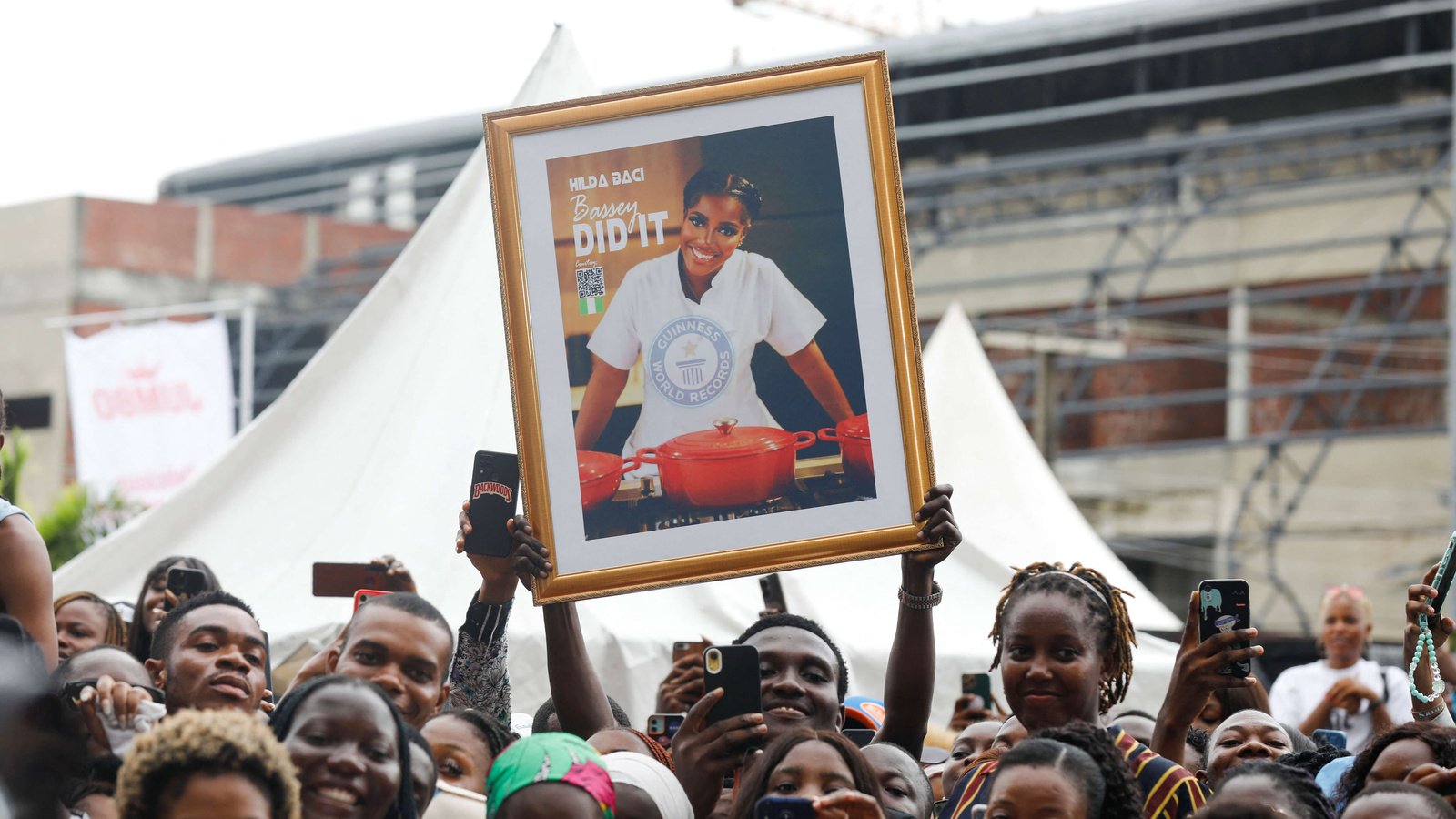
Onakoya’s feat is the latest example of a Nigerian attempting (successfully in his case) to break an existing Guinness World Record. Since the Dangote Flour Mill broke the Guinness Book of Records for the World’s Largest Puff-Puff pyramid by frying two metric tons of flour to celebrate the World Puff-Puff Day in October 2018, Nigerians across different walks of life have tried to topple various world records—ranging from the longest dance marathon to the world’s longest cook-a-thon, the longest full-body massage, the longest Instagram video attempt, the longest time to read aloud, the world’s most steps climbed on a ladder while balancing a football on the head, the longest painting marathon, and making the longest hand-made wig, to name just a few. The proposal by a Nigerian artiste, Sugartee (real name Alade Temitayo Oluwaseun) to break the continuous kissing world record which stands at fifty-eight hours, thirty-five minutes, and fifty-five seconds by organizing a seventy-two-hour kiss-a-thon was nixed by a killjoy Ekiti State Government in July 2023.
More on:
Nigeria
Sub-Saharan Africa
Aging, Youth Bulges, and Population
Corruption
While the world outside Nigeria has followed these attempts with bemused fascination, each effort (successful or not) appears to have encouraged other Nigerians to put yet another record on notice, unleashing a collective ardor for record-breaking that shows no sign of cooling anytime soon. Indeed, chances are another Guinness World Record is in peril by the time you are reading this.
Whence this obsession with breaking and setting world records, and what insight does it furnish about the collective psyche of Nigerians and the current state of the country?
The first point to note is that, even before digitization put the entire universe in the average palm, Nigerians have always had an outward attunement. One aspect of this is a palpable conviction (space does not permit a full elaboration here) that Nigeria is destined to dominate the world, and that there is something entirely regrettable about not being born Nigerian. The fact that Nigerians frequently lament, without a hint of irony, that it is a curse to be born Nigerian, does nothing to invalidate this.
This conviction is quite possibly a function of the country’s location and population. In time, every country develops a mythos from which it extrapolates a certain uniqueness; for Nigerians, the fact that one out of every five Africans is a Nigerian, and the country’s presumed strategic placement as the trigger of an imagined continental pistol are ample demonstration of the country’s Manifest Destiny.
From this perspective, nothing can be more natural than a Nigerian shattering yet another Guinness World Record—or a member of the ever-expanding Nigerian diaspora showing “those people” the stuff “we Nigerians” are made of. What their counterparts from other African countries see—and criticize —as in your face braggadocio, Nigerians self-assuredly dismiss as proof that they were born to rule, hence the boast that “Naija no de carry last” (translation: the Nigerian always comes first). For a Nigerian, it is pointless to argue whose jollof rice is best: Nigerian jollof—pity its poor Ghanian and Senegalese cousins —is inherently superior simply because it is Nigerian.
More on:
Nigeria
Sub-Saharan Africa
Aging, Youth Bulges, and Population
Corruption
If there is one thing that exceeds the confidence and passion with which Nigerians approach and seek to dominate the outside world, it is the intensity and vigor of their desire to outcompete one another. This thirst for distinction is partly occasioned by the asperity of the social climate, and partly by a struggle for ethnic eminence that seems to have been baked into the foundation of the Nigerian state since its inception. When the jury is in, those who keep the score in such matters will invariably announce the ethnic winners and losers of the latest round in an endless national contest for world domination, following which the announcement will become material for ethnic ribbing. That is how Nigerians roll.
While one would normally expect the sordidness of the Nigerian situation—the corruption and the decrepit infrastructure, for one—to be a mood dampener, remarkably, it has made hardly a dent on Nigerians’ sense of self-worth and affirmation. Au contraire, the more the Nigerian state has sunk into desperate squalor, the more boisterous Nigerians have become, and the higher their imagination has soared.
Against this backdrop, one is tempted to hypothesize that Nigerians’ attraction to the Guinness World Records is driven by a subliminal wish to be associated with an institution—plus an attendant set of goals—that is both reliable and predictable; in short, a process whereby, contra what obtains back home, the winner is not determined in advance because the metrics are objective, fair, and unfalsifiable. In other words, the current vogue for breaking records may well be a reflection of Nigerians’ deep desire for a society that works.
If the foregoing is valid, we should expect to see more Nigerians attempt to topple one Guinness World Record or another. They will make it or die trying.
Why? Because Naija no de carry last.
Reina Patel contributed to the research for this article.
