


On March 20th, South Africa’s third largest political party, the Economic Freedom Fighters, will stage a nation-wide shutdown. The Fighters, as they are colloquially known, are demanding the resignation of President Cyril Ramaphosa and an end to loadshedding. The country’s second largest trade union federation, the South African Federation of Trade Unions (SAFTU), has also confirmed that it will participate.
The mood in the country is uneasy. Talk of a shutdown invokes memories of last year’s July riots where 354 people died. Widespread looting erupted from a coordinated campaign of sabotage in protest at the jailing of former president Jacob Zuma. A recent strike by health workers, involving some isolated incidents of violence, has also led to a generalized antagonism to popular protest in the country—seeing a constitutionally-enshrined right treated as expressing malevolence and recklessness.
The EFF, and anyone who wishes to, absolutely has the right to protest on Monday. Whether the protest will be effective is another question. Setting aside that the EFF lacks a coherent political vision and program, “the shutdown” as a popular mode of protest is time-honored and ineffectual. Its logic is rooted in a conception of the masses as laying dormant, in wait, needing only to be “activated” and spontaneous resistance energies unleashed.
The truth is that collective action is not so easy. It comes with tremendous individual costs—sacrificing work and domestic responsibilities, for starters—for a very uncertain gain (if there is any bellwether of where mass sentiment is, the South African National Taxi Council is refusing to participate, indicating that most people will intend to be at work). The EFF, is of course right in highlighting the scale of deprivation and inequality in this country as just grounds for protesting. But it is precisely this, which makes political action risky and demanding for so many. Not least, when the possible costs are so stark—repression, to name one.
It is clear that progressive forces in this country need to regroup, and it is necessary to build a left popular front that encompasses many traditions, and which unites workplace and community struggles. But the basis of this effort must be a clear program, and a strategy for organizing people around it—identifying the issues people most deeply care about, developing achievable goals that can immediately improve their quality of life, and crafting campaigns to win them.
Today the left is fragmented between the so-called official left—the South African Communist Party and Congress of South African Trade Unions (COSATU), in alliance with the ANC—and the so-called “Independent Left,” who consist of trade unions, social movements, and civic associations unaligned to a political party.
There have been, and, currently are, several attempts to bring working-class organizations together, such as the United Front, the Working Class Summit. More recently, COSATU and the SACP are talking about the formation of a Left Popular Front. We have to evaluate these in terms of how they can advance class struggle politics and contribute to a broad political movement of the workers, the poor, and the landless.
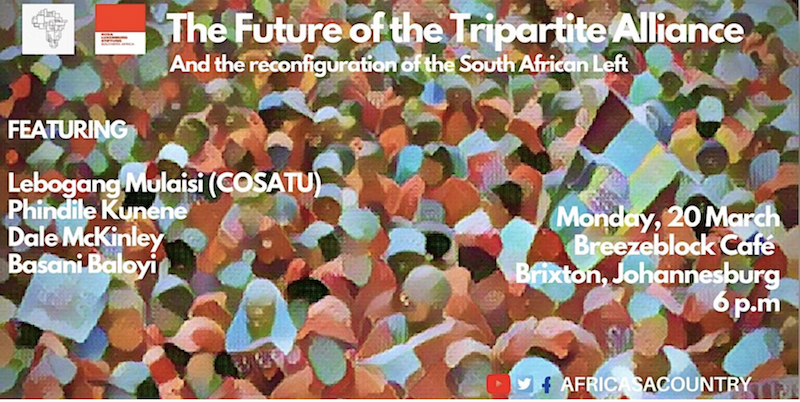
In this moment of urgency and realignment, there is a greater willingness among certain parts of the Left to look beyond old sectarian divides, to question old ways of thinking and to bring to the fore new leaders and new ideas. On March 20th, Africa Is A Country will convene a discussion on the future of the Tripartite Alliance in South Africa (COSATU and the SACP are in a political alliance with the ruling African National Congress). On this panel, leading analysts and activists will consider the past and future of the Tripartite Alliance. Has it worked and should it be saved? Are existing tensions reconcilable or insurmountable? And what does all of this mean for the South African left outside of the alliance?
If you are in Johannesburg and have some energy left after being on the streets, do come through.