




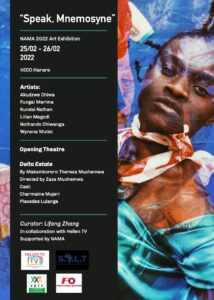
“Speak, Mnemosyne” is the title of an exhibition curated by Lifang Zhang. The show took place within the National Arts Merit Awards (NAMA) event at the Harare International Conference Centre (HICC) in Zimbabwe’s capital city in the final weekend of February.
Writer Barnabas Ticha Muvhuti caught up with the curator of the exhibition to unpack the show, and discuss the ups and downs encountered in the build up to the event and on the day of the show.
Exhibition poster, designed by Wynona Mutisi, image in the poster is work by Nothando Chiwanga
Would you please start by unpacking the exhibition for us?
Initially the idea came from the common experiences and emotional sentiment of loss in the past two years. Since the beginning of this global crisis, we have been exposed to people’s deaths everyday through statistics, news or social media posts. What hurts most is the loss of someone we loved, someone we knew or someone we had been longing to meet, weather caused by the pandemic or not. However, the way society functions does not provide enough spaces or means for us to confront the so called “negative feelings” such as loss and grief. We are told to move on with that void and the fear of being left behind. Not until they become an issue, a mental problem, which would then be handled through an institutionalized and systematic procedure. The pandemic has worsened the situation with the newly registered rule of social distancing. So, the original idea was to create a space of engagement, of shared experience.
No one has been spared by the impact of the pandemic. Is there a reason you selected women artists for this show?
I chose women artists because I believe that they possibly are more familiar with the experiences and might provide more possibilities in dealing with individual life crisis in the “new normal” that is often domestic, entangled with the global crisis. I decided to include a theatre in this exhibition to invite all the participants including the audience to create this space of engagement together. The six artists I invited are all quite young. Wynona Mutisi, for example, is only 23 years old. Loss might be considered too heavy a subject for this generation, but we are experiencing it, and we are thinking about these issues. As such, what really excites me is to think about the matters of loss and memory from our generation and from the perspective of women. All these artists have done work that is relevant to the topic.

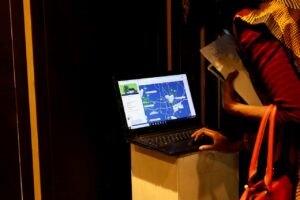
Audience interacts with Wynona Mutisi’s ditigal work Kumba
Tell us more about Vaviri Creative, the theatre group included in the show?
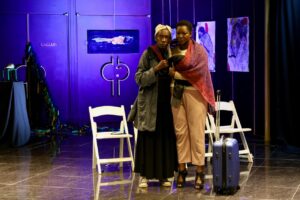
Yes, the director is Zaza Muchemwa, who got a NAMA award not for the first time. For her theatre ‘How Are You Really?’ she won the best director, and also the best production of theatre this year. Then the playwright is Theresa Muchemwa. The two cast members are Charmaine Mujeri and Placedes Lulanga. It is an all-women show.
Opening theatre Delta Estate directed by Zaza Muchemwa
How did the exhibition fit in the broader National Arts Merit Awards (NAMA) project?
The NAMA organising team accepted to accommodate our exhibition when they were planning for a one-week festival. As NAMA is an event that celebrates the achievements of established artists, it would be very interesting to have this exhibition of all young artist alongside the main event. It really speaks to NAMA’s theme ‘Zimbabwe and Beyond’ in the sense of time i.e., now and the future, and in the sense of space as three of the artists are based in Harare and three are based outside of Harare.
Loss, history, and memory are some of the main subjects addressed in this exhibition. I am thinking of our societies in Zimbabwe which are dominated by patriarchy. We also consider elders the embodiment of knowledge. They have experienced the most in terms of loss through and across generations. What would you say to someone who asks what young people know about loss, memory, and history?
First, we do respect that tradition of learning from the elders. It is important. But it is also important to listen and learn from the peers. I would start from the title “Speak, Mnemosyne” which is a quote from the Zimbabwean writer Petina Gappah’s ‘The Book of Memory’. In the novel, the jailed young heroine is accused of murdering her foster father, but she has her own version of story to tell. While writing the stories, the first sentence she remembers him talking to her is “Speak, Mnemosyne”. Mnemosyne is the goddess of memory in Greek mythology and the girl’s name is Memory. I use the title with a quotation mark. It is quite a short quote, but full of tension. I want to use this title to open the space and to have conversations with the artists’ work.
Installation view, Akudzwe Elsie Chiwa, Doreen, 2020.
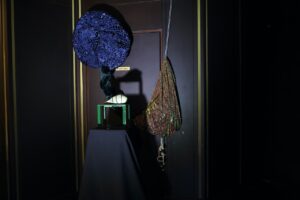
Akudzwe Chiwa’s work ‘Doreen’, for example is dedicated to her aunt who passed away very young, who she never met. In her work in general, family story is woven with anti-colonial history. She approaches history from the mythology in Masvingo that when a young girl has died, she would be buried by the water. She then becomes the goddess of the river and protects the family. Her work is dedicated to the women that she lost in the family and in history in the broader sense. Lilian Magodi and Kundai Nathan are looking at the experiences of young women in modern days. Wynona’s digital interactive work tells a personal story of her single mother raising three daughters and moving around different spaces in Harare. Her work invites audience to engage with her experiences of home, while Fungai Marima’s video work is about staying home during pandemic. It is a personal experience, yet it is also the experience of everyone in the world. Thus, Fungai’s work also posits the questions on the relationship between personal memories and collective narratives. Then Nothando Chiwanga’s work, as well as the theatre speaks to the loss of women, of self, their life condition, and the connections between women and between their experiences in general. You see these artists from our generation are really exploring the issues through art.
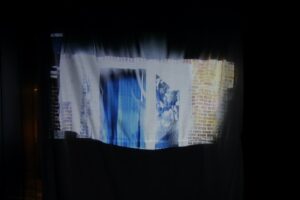
Installation view, Fungai Marima Threshold II (Stay At Home, Save Lives), Video 2021
Indeed! My observation is these artists employ different media and materiality, and their narratives vary. How do they compliment each other?
Originally, I did not plan to search for certain forms or stories. When I started my research on their work and my conversations with them, I realised the richness in the artworks in this young generation. They are working with different media like video, print, photography, installation, and digital art. They are also talking about personal stories in a broader social-historical context. I do believe it is important to shed light on their work. In the process of communicating and listening, I learned a lot from them. Zimbabwe, and Africa at large is a continent dominated by the young. It is important to learn from them and grow together.
With the artists being women are you also confronting patriarchy?
The intention is thinking about the topic from perspectives of women, and growing and working together, listening to each other and moving forward together. If confronting patriarchy happens in this process, I am happy.

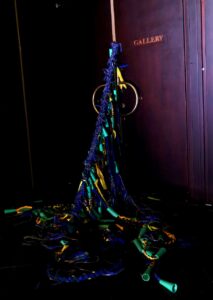
Installation view, Kundai Nothan, Zvamboko Zvavanorovesa, 2021
I know the focus of NAMA is showcasing and rewarding those who have achieved. Did your show get attention from NAMA itself and the public, or it remained a peripheral sideshow?
On that part, I must apologise to the artists. NAMA’s initial plan was a whole week of events lined up for the festival, consisting of theatre night, comedy, music, visual arts, etc. For the visual arts night, they were planning an exhibition with the National Arts Council. Ours would be the other curated show. This plan was adjusted on the penultimate hour. Our small exhibition became the only side project. And probably because of that, we did encounter some challenges. For example, at the Harare International Conference Centre (HICC), they would not allow us to drill on the walls. The lighting was not enough and there was no sound support for the theatre. I do not know if I can call this peripheral or parallel all this to the young or women artists’ position in the arts sector in general. Something interesting is that at the opening, I encountered the director of the National Arts Council who asked me about the idea of the exhibition and how I identified these artists. I answered him that there are many Zimbabwean artists who are doing well outside the country and do not have many opportunities and markets back home.
Would you have liked the show to go on for longer?
It ended up being for just a day. The space we had been given on the main show day was not ideal. Initially, the artists and I were excited about the main show day to engage with a broader public. I have to say that I disappointed them. However, Fadzai Muchemwa, the Chief Curator of the National Gallery of Zimbabwe, came through and was impressed by two works in the exhibition which she decided to include in an exhibition she shall curate. That makes me feel there is meaning in what we did. And I really appreciate all her support in the whole process from the first day. This exhibition for me is a small action. And I hope that, if I still take part in any type of artistic practices in the future, my involvement would be an action or an intervention, even if it is small. May I ask what you found interesting about this small exhibition?
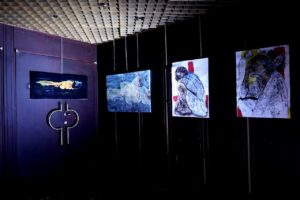
Installation view, works by Nothando Chiwangga and Lilian Magodi
I was drawn to the phrase you used to describe this initiative i.e., an intervention. A show of young emerging women artists does not occur often. Of this group, I knew about Akudzwe’s work which I encountered at the University of Cape Town’s Michaelis School of Fine Art a…
