



The governing body of world tennis is the International Tennis Federation. It organizes games between professional players, ranks them and sanctions tournaments. This includes junior players. Every year the top junior players compete in a series of graded tournaments around the world. The first tier is known as the junior “Grand Slams.” Like with the senior circuit, this refers to the four traditional open tournaments played at Wimbledon, in France, the US and Australia. Below these four are a group of six “Grade A” tournaments. One of these Grade A tournaments is played every October in Cape Town, South Africa. In 2019, that tournament was renamed the David Samaai Junior Open.
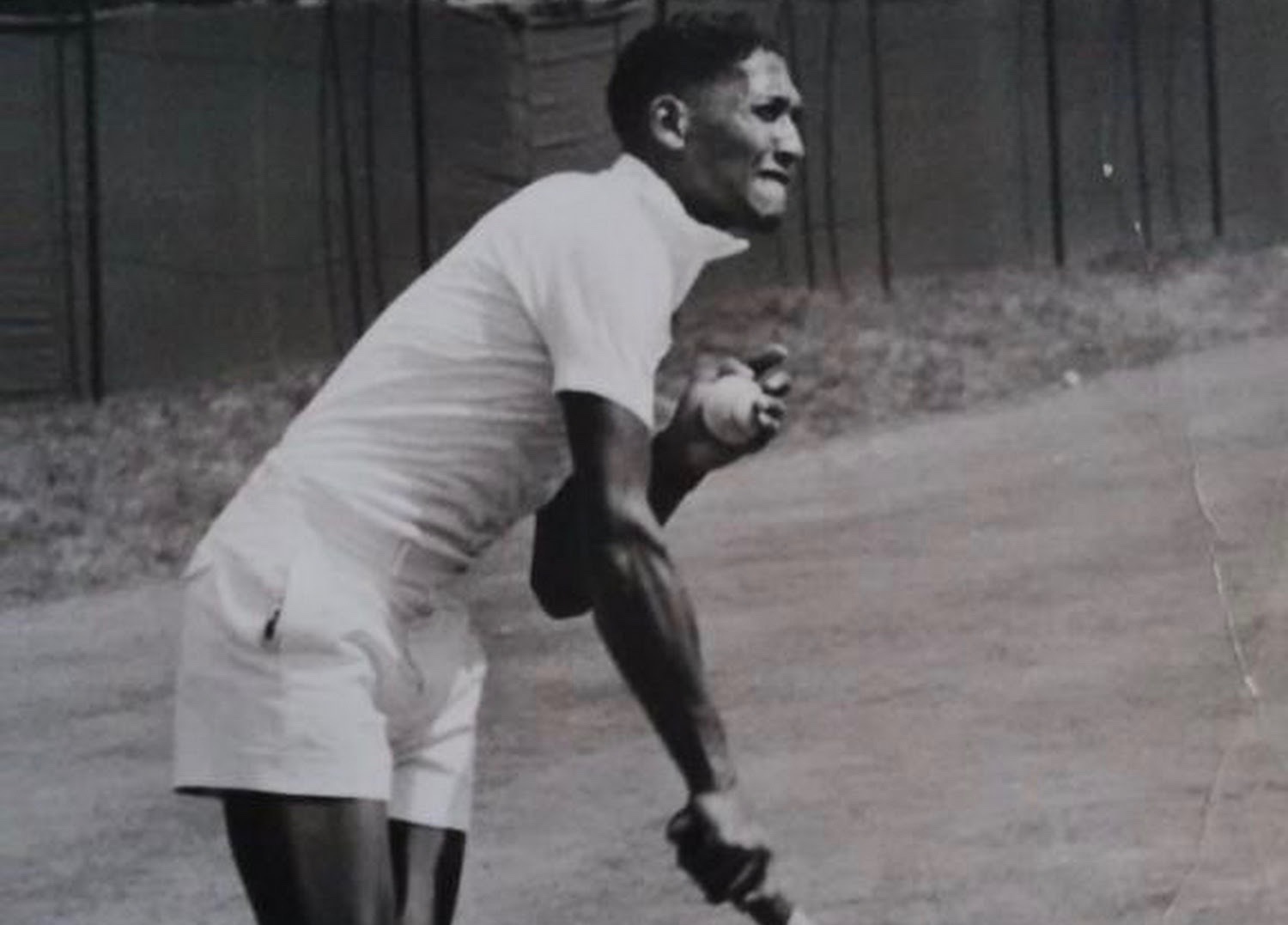
David (Davey) Samaai was the first black (and or coloured) South African to play at Wimbledon in 1949 when he was 21 years old. He may well be the first black or African tennis player to qualify for Wimbledon too. He qualified again in 1951, 1954 and 1960. His best performance was reaching the third round in 1954. In addition, he also played in the French, German and Swiss Opens. While overseas, he also won several smaller tournaments (mainly in Britain), and played against several of his white countrymen, beating some of them convincingly, including the captain of South Africa’s all-white Davis Cup (national) team, Gordon Forbes. As Samaai would later describe his game against Forbes; it was “a match which could never have materialized at home.”
In June 2019, a few months before the announcement of the David Samaai Junior Open, Samaai died at his home in Paarl in the Western Cape province. He was 91 years old. At the time, Gavin Crookes, then-CEO of Tennis South Africa (the body that runs organized tennis in South Africa), said about the renaming the Grade A tournament in Cape Town after Samaai: “Whilst this tribute will never adequately recognise the challenges he had to overcome as a black South African, playing in an era that was strictly amateur, as well as the achievements he attained as a top player in the world of tennis, I have little doubt the fact that these trophies will be presented to two of the top juniors in world tennis will go some way to making him proud – in his quiet and modest way.”
Crookes’ praise aside, it was his reference to Samaai’s “quiet and modest way,” that is telling.
Despite Samaai’s singular achievement – at a time when South Africa’s whites-only regime intensified its oppression of the majority black population – he is hardly mentioned in popular discourses about sports, especially in local and international media, and the legacies of racism in South African sport and society. And his achievements are not well known outside tennis. When Samaai is celebrated, there is, like with Crookes, a lot of talk about his quiet resilience.
The silence in popular media and culture around Samaai’s incredible achievements is even more depressing given that he played at a time when black tennis players hardly featured internationally. If you google “who was the first black (or African) player to compete at Wimbledon,” references to Althea Gibson first come up. Gibson, a black American tennis player who was born in the same year as Samaai, 1927, first qualified for Wimbledon in 1951 when she was 23 years old, two years after Samaai had already played at Wimbledon. She went onto an illustrious career, winning the Wimbledon women’s doubles championship in 1956 (with an Australian partner) and then won the women’s singles title in 1957, becoming the first black or African person to win a Wimbledon or any Grand Slam title.
When it comes to men’s tennis, in most tales of tennis history, Arthur Ashe, another American tennis player, is credited as the first black male player to compete at Wimbledon. Ashe first played at Wimbledon in 1963, fourteen years after Samaai. He would go on to win the Wimbledon men’s singles title in 1975, making him world number one that year. Ashe started competing as a professional in the late 1950s and would become the first global black male tennis star. He is still the only male black or African tennis player to have won at Wimbledon, the US Open (1968) or the Australian Open (1970). The only other black male player to win a Grand Slam singles title is Yannick Noah in 1983. Noah struggled at Wimbledon though; his best showing was in the third round. (Incidentally, Noah’s father, Zacharieh, was a professional football player from Cameroon whose team won the Coupe de France in 1961. After his retirement, Yannick Noah partly grew up in Cameroon where it was also where he started playing tennis.)
Of the leading male players still active, the best performance of Gael Monfils of France (his father is from Guadeloupe and his mother from Martinique, immigrants from France’s “departements” in the Caribbean) was a fourth round showing at Wimbledon in 2018. Jo Wilfried Tsongo, also French (his father is from Congo-Brazzaville), has been to the semifinals (2011 and 2012) and quarterfinals (2010 and 2016) of men’s singles at Wimbledon.
None of these players come close to the achievements of Serena Williams, who has won 23 Grand Slams, the most by any player in the Open era, including seven women’s singles titles. Williams is arguably the greatest tennis player of all time, male or female.
One reason for omiting Samaai’s achievement as the first black African player at Wimbledon, may be that the American narrative about everything – including designating who was “the first” at anything – dominates in the black world. Another may be that Samaai downplayed his achievement. Samaai’s biographer Michael Le Cordeur writes that Samaai detested being referred to as a “coloured tennis player.” It may also have something to do with how coloured people are viewed in South Africa; in some accounts they are not counted or don’t count themselves as black. However, there is no evidence that Samaai had anti-black politics. In fact, after he retired from tennis, he played a leading role in school sport organized by SACOS, known for its boycottt stance vis-a-vis apartheid segregated sports and for forging a political consciousnes among black (this included coloured and Indian) sports people at grassroots level.
A much more plausible reason may be that tennis is hardly considered a mass sport – whether in South Africa or elsewhere. However, Samaai’s own involvement in tennis as a player and administrator and the deep well of organized tennis culture in coloured, Indian and African townships under apartheid, undermines that popular perception. Samaai’s father, for example, played tennis in the 1930s, belonged to a club in Paarl and later built a tennis court for his sons in their backyard. Samaai himself met his wife on the court and they played mixed doubles together in amateur tournaments organized by a well-coordinated national coloured tennis association around the province and the country. Nevertheless, to this day, most South Africans experience tennis as a TV sport happening somewhere in Europe or North America, living vicariously through Venus and Serena Williams or Roger Federer (whose mother is a white South African; Federer, incidentally, was also Samaai’s favorite player).
Tennis, like other modern sporting codes, came to South Africa with colonialism. Unlike those others, tennis as a game became more associated with white elites and with money. The cost of playing (finding a court, court fees, equipment, the right attire) was prohibitive. As a result, tennis never developed the political or social connotations of sports like cricket (with English South Africans and false notions of equality), rugby (Afrikaner nationalism and white resilience and triumph in the face of international criticism of Apartheid) or soccer and boxing (with black mass participation, fame and class mobility) under Apartheid. (It is worth mentioning that sports like rugby and cricket have deep histories among the black population that parallel or even predate that of whites, but that the idea that black people came to them late, persists.)
As for professional tennis in and from South Africa – both under apartheid and now – it is mostly white players who represent the country overseas. Even when South Africa was the subject of sports sanctions, white players still played overseas. The ITF ostensibly banned South Africa from international tennis, but the country still fielded all white Davis Cup teams into the late 1970s after the ITF let South Africa qualify via the Latin American region. (In one case, in 1978, when the sports boycott movement against Apartheid nearly derailed a Davis Cup tie between South Africa and the USA in Nashville, Tennessee, the white South African Tennis Union recruited a 18 year old coloured tennis player, Peter Lamb, then on a college scholarship in the United States to the team to deflect criticism of its racist policies. They had no intention to play Lamb.) On top of it, white South Africans weren’t banned from competing as individuals internationally. As a result, players like Forbes, Cliff Drysdale, Ray Moore, and later Johan Kriek and Kevin Curran, still played world tennis on the ITF circuit throughout and right till the end of Apartheid.
South African tennis thus took on a very white and very exclusive image, which it still does to a large extent even after Apartheid. The combined effect of these media constructions and how the game was organized was to obscure tennis’ appeal among the black population and their role in its development as a sport. Samaai’s story is wound up with the independent tradition of black tennis and is a corrective to these misconceptions.
Samaai was born in 1927 in Paarl, a medium-sized town in wine country about an hour’s drive to the northeast of central Cape Town. Paarl is the largest town…
