




He generally loves stories. He doesn’t read them but he fantasizes about them when he sees something or hears something. His interest in slavery, especially as it occurred in Suriname with the Maroons, was sparked by the stories his grandmother told him.
Rob Perrée about the project Slavery Past by Isan Corinde
SLAVERY PAST
A project by Isan Corinde
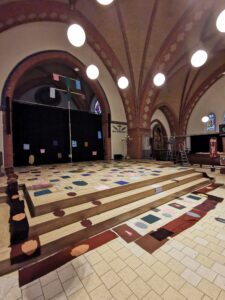
An exhibition about slavery presented at the former Antonius Church in Utrecht, a neo-Romanesque, pillarless building of yellow and red brick with tight walls and round arches, striking stained glass windows that color the in itself dark space and, now, with black curtains in front of the white walls that were once decorated with paintings. Where once there must have been an altar, there is now a stage. Since 2018, under the name Kloosterkerk, the church has been used for cultural events. Because, like so many Dutch Catholic churches, the Antonius Church has lost the battle against progress.
To present an installation with references to slavery in such a church shows courage. Namely, it means confronting a space that is not only physically dominant, but that still has unavoidable references to the past, to origins. An admittedly rich past, but also a past that in recent years has been contaminated by examples and forms of abuse of power for which the ‘title’ slavery does not cover the whole gamut, but which touches on its important characteristics.
Isan Corinde (1990, Brokopondo, Suriname) has dared to do just that. The attempt may not have succeeded completely – the whole remains too fragmented, has too little cohesion – but he still manages to present the theme in such a way that it touches many visitors. That was his intention.
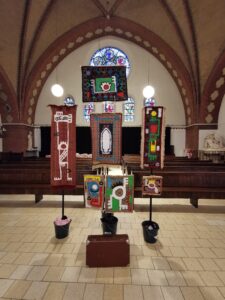
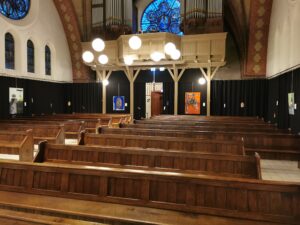
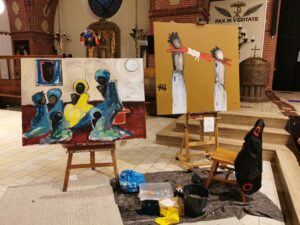
He stays away from the historical story of the building; he processes the space primarily in a practical way. He turns the nave of the church into a symbol of a slave ship. An installation of painted carpets he places in sight of stained glass windows in a similar arrangement, the colors of other stained glass windows recur in the paintings he hangs below them, the stage, which assumes movement and activity, he uses to present the results of a project with young people. These kids have printed, cut up and painted rags and sheets of paper with footprints pointing toward the exit, that read, ‘toward freedom’. By letting them continue to that exit, he manages to maintain the suggestion of moving (forward). This suggestion of liveliness is further underlined by the artist himself. During the exhibition, next to the stage, he works on new paintings that represent the theme. By way of performance.
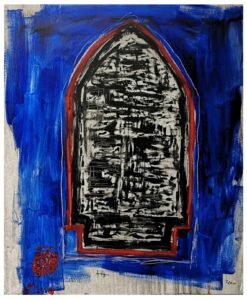
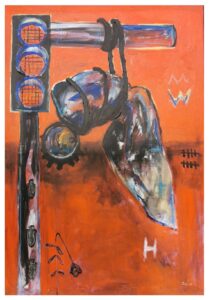
On the covered walls of the church, he hangs paintings that refer to iconic images of slavery. For example, that of the crammed slave ship that sank off the mouth of the Marowijne River in Suriname in 1738 and that of William Blake’s famous image of a slave hung by his ribs.
2.
The commitment to his people – the Maroons – he previously expressed in a Q&A with Surinamese writer Kevin Headley. In it, he says he wants to dedicate himself to the artistic development of children from his native region. Every time he returns to Suriname (since 2016 he has lived in the Netherlands, but Suriname is never far away) he organizes workshops with them and jumps in when he sees a need. ‘When I’m here I always see things I want to improve.’ He even dreams of a museum for Brokopondo.
Still, I was surprised that Corinde was also concerned with the slavery past. I know his work as optimistic, cheerful, colorful, funny and executed in a quasi childlike style that refers to a childhood apparently experienced as very pleasant in the interior of Suriname.
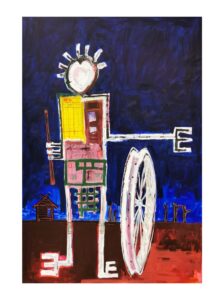
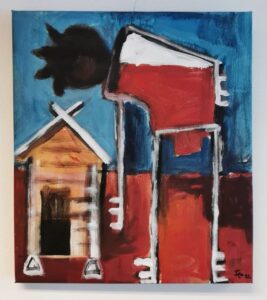
Two works unrelated to the Slavery Project
When I spoke to him, he corrected my assumption. He generally loves stories. He doesn’t read them but he fantasizes about them when he sees something or hears something. His interest in slavery, especially as it occurred in Suriname with the Maroons, was sparked by the stories his grandmother told him. With her, slavery was not a distant past. So she talked about it a lot and often. This forced him, as it were, to engage with it creatively, as an artist.
3.
Isan Corinde also wants to present his exhibition in Suriname. Where, that is not yet clear. There are few possibilities. There is no museum for contemporary art. There is only one professional gallery. The Hall – a big space in Paramaribo that you can rent – remains. That is a more compact, less expressive, less self-centered space than a church, but also a space that is uninspiring.
It might be an idea to work with his colleague Marcel Pinas on a large, local project. He, too, cares about the plight of the young people of the interior. He, too, eventually wants a museum in which he can show Surinamese people what artists – local and regional – have to offer. He, too, wants to highlight and protect the rich culture of the Maroons.
For such a project, the presentation in Utrecht was a hopeful start.
