




En Français
From sustainability efforts to mobile health and payments,
Africa is increasingly at the forefront of innovations that spread
globally – and it is a central part of Google’s own engagement with the
world. This past February, our
CEO Sundar Pichai addressed the African Union
and shared Google’s commitment to encourage and enable innovation and
entrepreneurship across the continent in support of African aspirations
for digital transformation to fuel economic growth.
Since 2017, we’ve trained 6 million young Africans and
businesses in digital skills. We’ve supported more than 50 African
nonprofits with over $16 million in grants, and helped 100 million more
people access internet services for the first time through Android. And we
have committed to investing
$1 billion
in support of Africa’s digital transformation over the next five years.
Africa is currently home to 1.3 billion people, or 16% of the
global population. It has the world’s youngest, fastest-growing, and
increasingly urbanized workforce. Our work in Africa has never been more
important, and that’s why we recently created a one-of-a-kind position to
connect directly with stakeholders across the continent through
pan-African institutions such as the African Union Commission, UN Economic
Commission for Africa, and African Development Bank.
Stepping into the role is Pren-Tsilya Boa-Guehe, a former U.S.
diplomat most recently working at the U.S. Mission to the African Union.
She brings a wealth of policy and NGO experience in Côte d’Ivoire, Mali,
Morocco, Geneva, and Washington, D.C. We caught up with her to talk about
the role:

Pren-Tsilya, tell us a little bit about what you’ve been up to since
starting at Google.
The last few months have been a whirlwind – moving to Kenya during the pandemic, starting in a new office while working from home, and settling in my role. It’s still surreal to me that I’m working here. And, of course, there’s been all of my work to build out an agenda for Google with the African Union (AU) and for our CEO to participate in the AU Summit. Pan-African institutions like the AU are critical partners because they enable African leaders to shape the continent’s priorities. It’s a privilege to work with them to amplify our impact in the region. My first objective was to develop a comprehensive policy portfolio in partnership with colleagues at Google, reflecting the investments we have made and the needs of stakeholders across the African continent. These include:
- Supporting Africa’s COVID response through economic recovery.
Technology has been a lifeline for many people throughout the pandemic.
As we head into year three of the pandemic, I’m looking to develop a
partnership with pan-African institutions focused on the economic
recovery through digital skills, training, and tools for small and
medium businesses for
women
and youth entrepreneurs across the continent. Through
Kiva, Google is providing $10M in low-interest loans to help small
businesses and entrepreneurs in Ghana, Kenya, Nigeria and South Africa
get through the economic hardship created by COVID-19. Google is also
investing directly in African start-ups through a dedicated $50 million
Africa Investment Fund and our global
Black Founders Fund.
-
Enabling internet access and facilitating digital trade for Africa’s
economic growth.
The internet economy in Africa has the potential to grow to
$180 billion
by 2025, but there are some regulatory and infrastructure challenges
that must be addressed to reach this goal. Our
Digital Sprinters report informs our activities and policy priorities around Africa’s
digital transformation. The AU’s continent-wide policy initiatives can
help to accelerate Africa’s digital transformation through the AU’s
Digital Transformation Strategy
and the
African Continental Free Trade Area. These initiatives will help to position Africa to leapfrog by using
technology as a driver of economic growth. On the infrastructure front,
Google is bringing really innovative solutions to expand affordable and
reliable internet access. Our
Equiano subsea will run through Togo, South Africa, Namibia, Nigeria and St
Helena and
Project Taara uses
invisible beams of light to deliver high-speed connectivity to rural
areas in Africa.
-
Advancing climate protections
in advance of the first African COP.
COP-27, the global climate summit, will be held in Egypt later this
year – marking the first time the conference has been held on the
continent. As Africa is especially vulnerable in our current climate
crisis, Google will be working directly with African leadership and
international organizations ahead of the conference to address this
problem.
-
Providing a platform for African cultural treasures and
collections. Africa has such rich cultures and traditions. Since 2012, Google Arts
& Culture has partnered with institutions across the continent to
preserve art and culture, providing a free online platform which
anyone around the world can access. The result is
hundreds of expertly-curated stories about Africa by Africans. This includes Mali Magic, a project that shines a light on Mali’s
vibrant culture through its
manuscripts
and Street View of at-risk
mausoleums
and mosques. There is also
Cradle of Creativity, a
project dedicated to the creative history and heritage of Africa. I’m
eager to partner with the AU to share more of Africa’s magic with the
world.
What does your day-to-day look like?
To implement these top priorities, my day-to-day involves lots of
meetings. I see myself as a bridge between Google and African institutions,
so I’m constantly meeting key stakeholders across the continent that are
part of the ecosystem– African government regulators, leaders of African
institutions, corporate leaders, NGO leaders, think tank representatives,
and people on the ground who use and are impacted by Google products daily.
I try to understand their policy priorities and challenges and strategize
with Google teams to see how we can be helpful. We are doing a lot in
Africa, but I’m passionate about seeing how we can do even more.

Picture of Pren-Tsilya and Government Affairs Director for Africa
Charles Murito meeting with AU Commissioner Albert Muchanga and AU
Special Advisor Jean Bertrand Azapmo to discuss partnerships for small
and medium businesses, women’s entrepreneurship, and digital
trade.
Another important part of my work is participating in policy discussions,
publications, and forums to exchange ideas and share Google’s thought
leadership on issues we care about. For example, I share our views about the
kinds of
policies
that can truly transform Africa’s digital economy. And, I’m excited to start
traveling again to attend conferences in person when it is safe to do so.
One of my first trips this year was in March to Mombasa for a policy
discussion on the AfCFTA. Companies like Google need to be on the ground for
these discussions to see how we can meaningfully contribute to African-led
solutions to African and global problems.
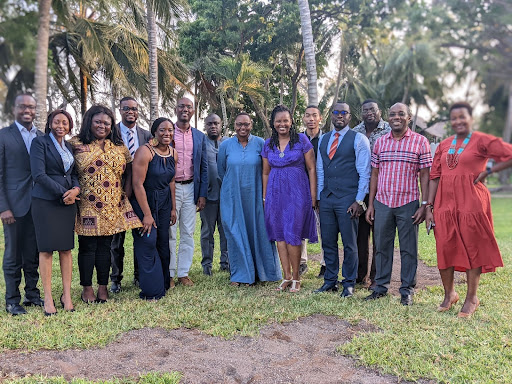
Pren-Tsilya meeting in Mombasa with representatives from the African
Union Commission, AfCFTA Secretariat, UN Economic Commission for Africa,
private sector, and think tanks.
Why is this job important to you?
The AU Commissioner for Infrastructure and Energy, Amani Abou-Zeid,
once said, “technology is not a luxury in Africa, it’s a necessity.” I
really believe that and I believe I can be a part of that change through
Google. And this job is personal to me because, although I’m an American, my
roots are from Cote d’Ivoire. I have found that my multicultural background
has helped me to relate to my counterparts at the AU and its diverse 55
member states.
My family is proud that I’m contributing to Africa’s digital
transformation. I’m humbled to be working with such historic institutions
and with an incredible company to improve the lives of Africans via
technology.
How can folks keep up with your work?
Feel free to keep up with Google in Africa on
Twitter
and our blog.
Posted by Melike Yetken Krilla, Head of International Organizations
====
Google présent au sommet de l’Union africaine
Des efforts en matière de développement durable à la santé
en passant par les paiements mobiles, l’Afrique est de plus en plus à
l’avant-garde des innovations qui se répandent dans le monde entier – et
elle constitue un élément central de l’engagement de Google dans le
monde. En février dernier, notre
PDG, Sundar Pichai, s’est adressé à l’Union africaine
et a fait part de l’engagement de Google en faveur de l’innovation et
l’entrepreneuriat sur le continent, en apportant son soutien aux
Africains qui aspirent à s’engager dans la transformation…
