



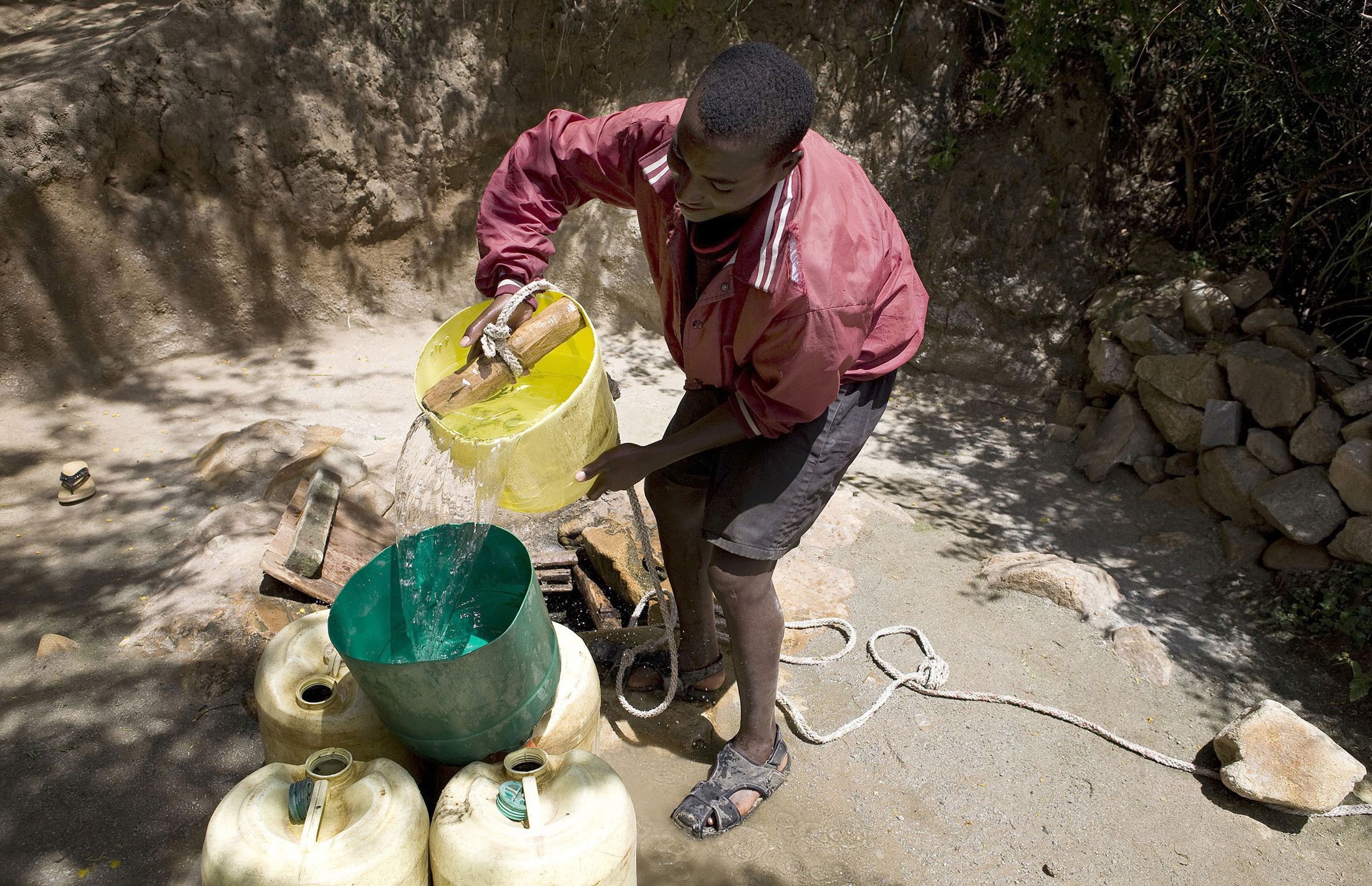
Access to clean, affordable, and safe drinking water is both a fundamental human right recognized by the United Nations and Goal 6 of the United Nation’s Sustainable Development Goals. However, access to this essential resource in Africa is not yet universal, with 1 in 3 Africans facing water scarcity and approximately 400 million people in sub-Saharan Africa lacking access to a basic drinking water. Access to water remains a pervasive development issue across the continent, as a 2019 report by the World Resources Institute (WRI) revealed: Indeed, addressing climate change and poor management of water resources and services is paramount to tackling Africa’s water stress.
Aqueduct, an online geographic information system (GIS) tool produced by the WRI to map global water-related risks, reveals Africa’s extensive exposure to water-related risks (Figure 1). Their model accounts for a variety of metrics, such as vulnerability to floods and droughts, water stress, and seasonal variability. “Extremely high water risk,” demarcated in dark red, covers large swaths of arid northern Africa, southern Africa, and eastern Africa. However, water risk throughout the continent is quite heterogeneous, as light patches, such as those along the Nile River, are interspersed with the areas suffering from critically high water risk. The equatorial and tropical regions around the Democratic Republic of the Congo also enjoy significant surface area with noticeably less water risk than their continental neighbors.
Figure 1. Africa faces some of the highest water risk in the world

Source: “Climate Change Is Hurting Africa’s Water Sector, but Investing in Water Can Pay Off,” World Resources Institute, 2019.
The authors maintain that understanding the continent’s water risk factors is an essential prerequisite to instituting changes to the poor management of its water resources and services, alongside bolstering climate resilience. As such, the authors highlight several areas within the water sector that require investment to improve climate resilience and better public service delivery.
Africa’s agricultural sector, the authors claim, is poised to face significant exposure to water-related climate risks in the future. As 90 percent of sub-Saharan Africa’s rural population depends on agriculture as their primary source of income and more than 95 percent of the region’s farming is reliant on rainfall, the consequences of unpredictable rainfall, rising temperatures, extreme drought, and lower crop yields expose one of Africa’s poorest communities to increasingly intense climate- and water-related hazards. Considering these hazards, WRI proposes that intergovernmental risk-pooling mechanisms, such as the African Union’s African Risk Capacity (ARC), could be increasingly important sovereign insurance mechanisms to mitigate climate disasters, as they provide faster payouts than humanitarian aid.
The effort will be expensive: According to the authors, securing universal safe drinking water, sanitation, and hygiene in sub-Saharan Africa requires $35 billion per annum in capital costs. While efficient “smart design” of water management systems can promote greater climate resilience for water and sanitation services, the WRI attributes securing adequate revenue to maintain new infrastructure as the biggest challenge facing African policymakers and engineers in the water sector.
Investing in climate-resilient green infrastructure provides a myriad of benefits throughout the economy, namely, generating jobs, alleviating poverty, and diminishing the impact of climate change on Africa’s most vulnerable and marginalized communities. African governments, according to the WRI, should actively factor in these water risks to develop infrastructure systems that protect people, save money in the long run, and preserve the delicate ecosystems that their economies and the livelihood of their citizens depend upon.
For more on climate change in Africa, read “Figure of the week: Climate change and African agriculture,” “Climate adaptation and the great reset for Africa,” and “Africa can play a leading role in the fight against climate change.”
