


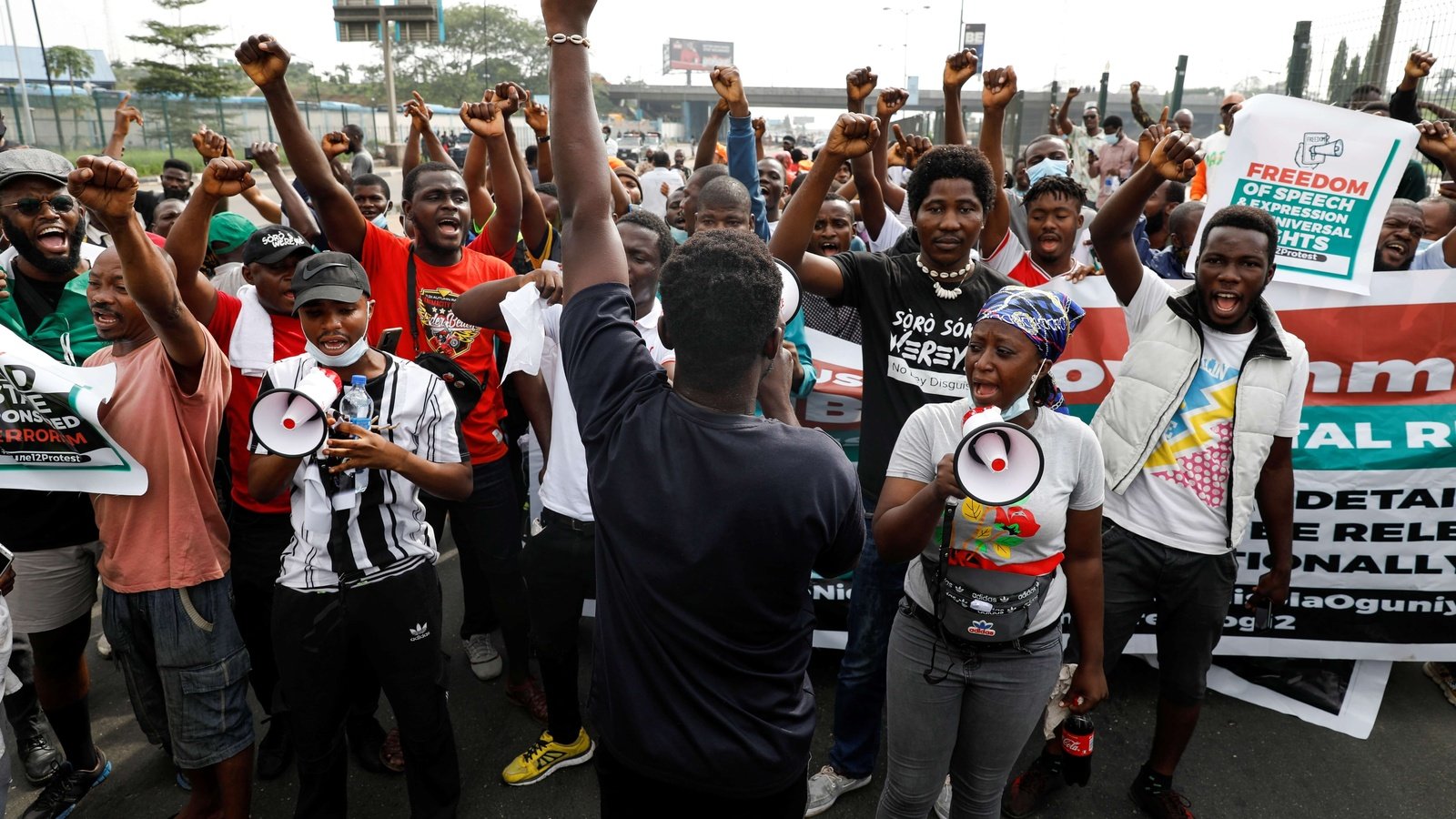
Twice in recent weeks, Nigerian statesman Olusegun Obasanjo has revealed his unease about the state of democracy in the country and in Africa more broadly. Responding to a reporter’s question on the recent military putsches in West and Central Africa, the one-time military head of state and civilian president was strikingly pessimistic, suggesting a need for “an alternative” since “the liberal democracy we are copying from settled societies in the West won’t work for us.” Doubling down on the same theme over the weekend, Obasanjo called for the abandonment of a system that has only “nurtured unemployment and poverty,” having failed to deliver “peace, security, stability, prosperity, wealth-creation, employment, and the wholesomeness of the society.”
The inaugural president of the Nigerian Fourth Republic has not been alone in his criticism of Nigerian democracy. Although former Ekiti State Governor Kayode Fayemi could not be more politically different from the one-time president, he nonetheless agrees with Obasanjo that “liberal democracy is not working” in Nigeria and that the country was approaching “a dead end” in that regard. For Peter Obi, the candidate of the Labour Party (LP) in the February presidential election, “transactional politics, disrespect for the rule of law, endemic corruption in the executive, legislature and the judiciary are pulling Nigeria dangerously away from democracy.” Like Obasanjo and Fayemi, Obi also worries that “the mindless erosion of the very ideals and tenets on which Nigeria’s democracy was built, if not checked, will only push the nation deeper into lawlessness.”
More on:
Democracy
Nigeria
Rule of Law
Civil Society
Censorship and Freedom of Expression
Anxiety about the trajectory of democracy in Africa and its evident failure to deliver the hoped-for improvement in the lives of ordinary people is hardly the preserve of Nigerian statesmen. If anything, despondency with democracy, or, to be precise, disgust at its ostensible manipulation for narrow elitist ends, has been a fixture across Africa, particularly where, bucking expectation, throngs of young people have welcomed coup plotters with open arms. In most cases, seeming support for the military has been combined with vigorous condemnation of France and other Western countries, believed by some to have had a hand in the continent’s unending economic woes.
Africans’ disenchantment with democracy is not unwarranted. With few exceptions, democratic rule on the continent has been nothing but a continuation of autocracy by other means, a point that many of those who have taken to the streets to express solidarity with the military have been all too eager to emphasize. As periodic elections have become more or less routine across the region (a study by Jaimie Bleck and Nicolas van de Walle puts the number of multicandidate presidential and multiparty legislative elections between 1990 and 2015 across some forty-six African countries at 184 and 207, respectively), the possibility of substantive change has inversely receded.
Not only that, many African leaders have used the façade of electoralism to perpetuate themselves in power. Five sitting African heads of state (Equatorial Guinea’s Teodoro Obiang Nguema Mbasogo, Cameroon’s Paul Biya, the Republic of Congo’s Daniel Sassou Nguesso, Uganda’s Yoweri Museveni, and Eritrea’s Isaias Afwerki, respectively) have held office for more than three decades each. All, incidentally, are in the process of grooming their sons as successors. Ali Bongo Ondimba, ousted by his own presidential guards last month, succeeded his father, Omar Bongo, who ruled for a total of 41 years. The country’s new military leader, Brice Clotaire Oligui Nguema, and the ousted Bongo, are cousins.
The region continues to pay a high price for the ensuing political and economic stasis. Unsurprisingly, those whose votes do not count have been voting with their feet, which is why an estimated twenty thousand African academics and researchers relocate to Western countries annually. According to the Pew Research Center, “at least a million Sub-Saharan Africans have moved to Europe since 2010.” Emigration of highly skilled individuals (the number of Nigerian-trained medical doctors currently licensed to practice in the UK tops 11,000) leads to a severe workforce shortage which devitalizes critical sectors of the economy and deprives the continent of the know-how necessary for economic development. The moral damage is arguably more profound: disaffection breeds hopelessness, which drives vices born of desperation.
Against this backdrop, the ongoing democratic inquest could not be timelier, especially insofar as it helps to put the alarming ugliness of political leadership in Africa on display. Democratic deliberation, as the vast literature on the subject attests, is a net good for democracy, drawing the light—and occasionally the heat—of criticism toward the system’s failings and oversights. The freer and more searching the deliberation, the more robust the public sphere.
More on:
Democracy
Nigeria
Rule of Law
Civil Society
Censorship and Freedom of Expression
This is all the more reason why it is crucially important not to throw out the baby with the bathwater. While criticism of democracy is necessary and defensible, and while it is important to continue to advocate for a democracy that delivers on jobs, security, and prosperity, the muddle-headed suggestion that liberal democracy is somehow incompatible with Africa must be eschewed. It is one thing to say that liberal democracy has failed, and another thing entirely to extrapolate from that failure that liberal democracy could not succeed in Africa. While the former is justifiable, the latter is inexcusable.
The idea that “the liberal type of democracy as practiced in the West will not work for us” is deeply flawed. First, resting on an unproven metaphysics of difference, it unwittingly panders to the racist notion that African societies are so utterly “Other” that one may rightly expect what works elsewhere in the world not to work there. Furthermore, the argument, if one may dignify it with the name, assumes an affinity between liberal democracy and the West that has no basis in reality, and ignores the arduous journey that the West has had to undergo in order to have the success that it currently boasts. If the history of liberal democracy in the West tells us anything, it is that liberal democracy is exacting work, and there is never a shortage of actors or institutions at any given time ready and willing to pull it down. Contemporary United States is particularly instructive on the latter point. Lastly, the argument elides the substantial progress under the auspices of the same liberal democracy observed in African countries, such as Zambia, Malawi, and Kenya.
On the whole, the answer to less democracy is more democracy, and perturbation about its prospects in Africa is a reminder of the existence of a deep and persistent yearning for good governance, fair and free elections, transparency, and the rule of law. Student protests that forced Senegalese President Macky Sall to abandon his pursuit of an unconstitutional third term in office are the most recent illustration. The ongoing inquest must focus on ways of stoking this fire. Frustration with democracy is part and parcel of the history of democracy. But it must be carefully shepherded lest it opens the back door to reactionary politics.
Reina Patel contributed to the research for this article.
