


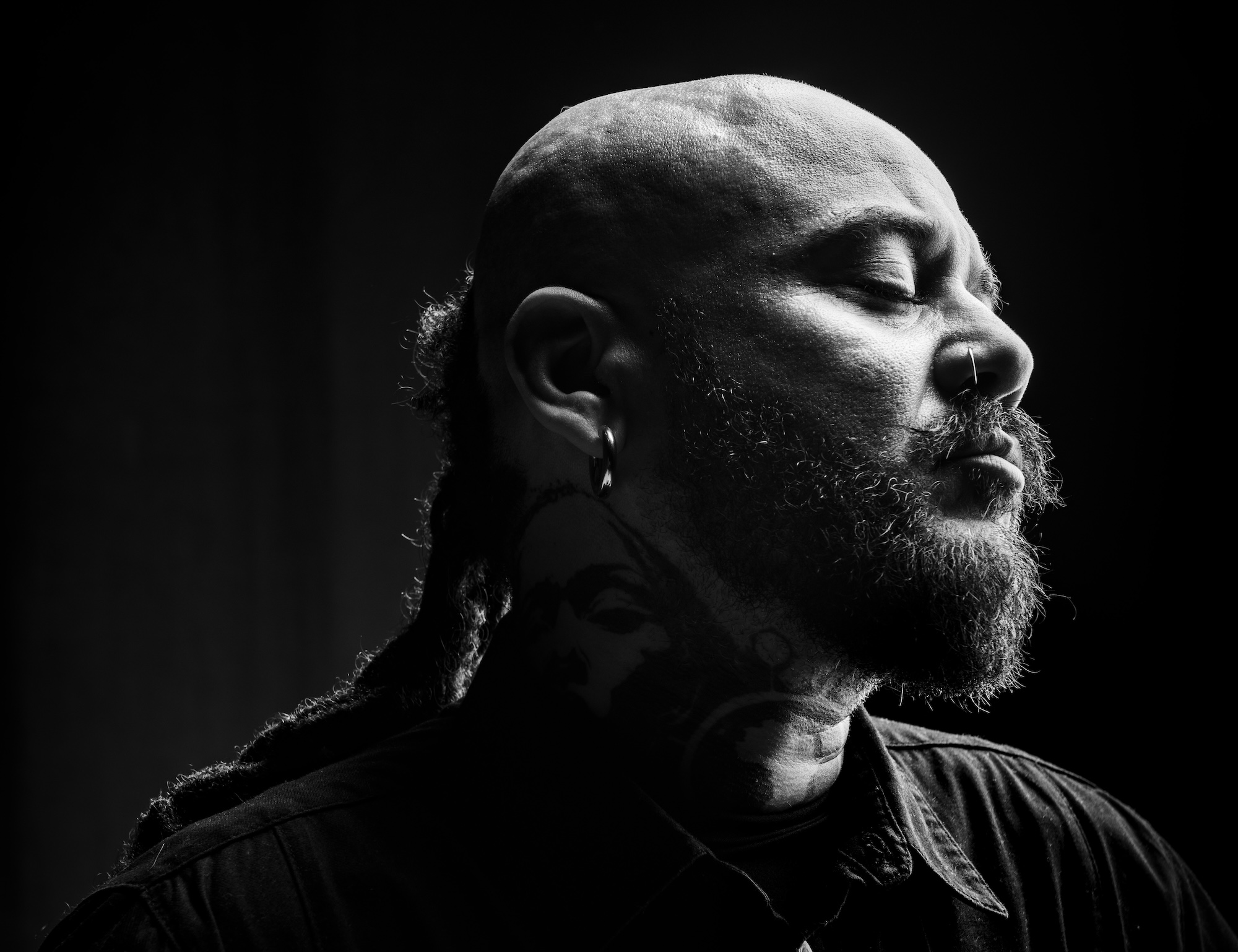
“What strength is that?” asked Sérgio Godinho, one of the most important Portuguese singer-songwriters, in 1972, when Portugal was still submerged in the long night of fascism—dragging out the agony of its colonial system, condemning people to an unjust war, and spreading the carnage in massacres like the one that took place that year in Wiriyamu, Mozambique. Those were harsh times, marked by a “dormensia ku korrenti” (dormancy with chains), as Scúru Fitchádu would later write and sing in Nez txada skúru dentu skina na braku fundu (2023), his second album, where he reworked and re-signified the poetics of the guerilla and African liberation movements, placing them in the cold concrete thickets of the contemporary city.
More than 50 years have passed since that distant 1972, though the frictions of that memory remain alive in the present. After all, as we’ve recently witnessed in Portugal, where the racist far-right political party Chega had 22.5 percent in the 2025 elections, the serpent’s egg was never properly incinerated—there it is today, transformed into a hydra with 50 furious heads, ready to crush anyone who dares to resist. There they sit, all of them—sons and grandsons of fascists, colonialists, and repackaged terrorist bombers—now comfortably nestled in the honorable seats of Parliament.
By historical coincidence, Scúru Fitchádu’s third album, Griots i Riots, was released the morning after the 2025 election, a day of hangover and shock for those who grew up believing that fascism belonged to the past tense—that places of repression like Tarrafal, or the political violence of the militias in the street, would remain matters of memory, not future threats looming on the horizon. That historical coincidence, as we said, made this album all the more urgent, a symptom of its own time. Urgent, because it’s impossible to hear the unrelenting shout of “Kema palasio kema” without picturing the pigs who would roast beautifully in that redemptive fire. And symptomatic of our time because to the fifty pigs named in the track “Resistensia,” the album’s final piece, we now need to add at least eight more—and, perhaps, sharpen the blades, load the spit a little heavier, and throw some extra fuel into the blaze.
“What strength is that?” Let’s return to Sérgio Godinho’s question. What strength do we “carry in our arms,” one that “demands only obedience”? What force puts us at “ease with others but at odds with ourselves”? These days, we look around lost, downcast, already tasting blood in our mouths. And still, this music—this immanent fury—cuts through the daze, offering not a manifesto of ready-made ideas, but a concrete possibility: to give rage a sense of collective power.
That possibility emerges from the meeting of griots—whose patient wisdom crosses time and space—and riots, urgent responses to immediate violence, a right to self-defense for those who, to borrow again from the last album’s words, refuse to live as a “bakan kontenti tristi i filiss koitadu / ku se sina la dentu borsu i ku korda na piskoss ben marradu” (content, dumb, sad and happy fool / playing with fate in your pocket and a tight rope around the neck).
Griots i Riots picks up exactly where Nez txada skúru dentu skina na braku fundu left off. In “Treinament,” the final track of that record, it spoke of waking up once again with a purpose—“like a dog with clenched teeth and a sore jaw, red eyes waiting for night to fall.” It called for a “prepared militancy” like a root growing strong, turning to weapons and theory with a precise dilemma: “liberation or death.” Not coincidentally, those are also the first words heard on Griots i Riots, wrapped in the crystalline sound of a kora played by Mbye Ebrima, then immediately disrupted by the distorted low-end frequencies that define Scúru Fitchádu’s sonic world.
Guided by this political mantra, the album is built upon the tension between theory and practice, word and action, body and orality, the city and self-interrogation—conceiving of revolution not as a distant utopia but as a concrete, daily possibility. Not something that will come from palaces, vanguard leaders, or expert commissions, but from the praxis of lived experience, rooted in committed communities.
Knowing there is no revolutionary theory without revolutionary practice, Griots i Riots confronts the hard time of reality with the slow time of ancestral wisdom; it challenges the anesthetized apathy of political and cultural intervention by conjuring a dissension that opens cracks toward another future. This confrontation between times and tensions—between memory and urgency, between word and action—is not just a poetic or political gesture. It’s also the compositional principle structuring the album, shaping its rhythm and breath. We hear it right away in “Griot i Riot,” the intro, where ancestral wisdom, carried by the kora, is layered over and gradually contaminated by sonic grime—punctuated by background screams and urgent vocalizations.
Once the blueprint is set, the strategy follows. “Idukasan i saud,” a fast-paced shout of popular revolt that reworks poetic lines from Sérgio Godinho’s À Queima Roupa (1974), is followed by “Kel karta di alfuria…,” a bass-heavy, reflective track about the traps of false liberations lost in the bourgeois entanglements of the Big House. “Funda na poss,” a visceral blow against pop culture’s submissive posture, is succeeded by “Du ta morrê,” an austere and slow meditation on death and grief. The accelerated precision of “Kema palasio kema” clashes with the poetic delivery and harmonized distortion of “Símia Kodjê”—a track with Conan Osiris, where a fado-tinged voice has never sounded so richly defiled. “Prekariadu,” a battle cry against the suffocating precarity of lives in the urban jungle, gives way to “Caoberdiano Barela,” a moving reinterpretation of Princezito’s classic, reminding us that this is a long story still unfolding. Finally, “Resistensia” closes the album, ensuring we don’t forget the clear identification of the targets: the pigs that squeal, the wolves that howl, the sheep that let their guard down.
By his third record, Scúru Fitchádu has lost neither the searing, rough dissent of Un Kuza Runhu (2020) nor the poetic, ethical, and sonic density of Nez txada skúru dentu skina na braku fundu. In Griots i Riots, we hear the same insubordination, the original impulse, the same grime meant to disrupt the management of a rotten peace. But we also hear an artist who is increasingly a dense and sagacious poet, seeking to expand and master his own language, without ever yielding to the cynical reason of our times. Above all, a creator who writes about his time and his people, attuned to their latent anger, invested in the search for new answers born from everyday struggle. A creator whose music becomes the soundtrack of those who refuse to live in chains, yet who allows himself to explore—in both sound and content—deeper reflections on the human condition, the possibilities of agency, the consciousness of death, and the potential for what’s to come: an ongoing attempt to answer Sérgio Godinho’s question: What strength is this that we carry in our arms? Let us keep asking—and keep fighting. On this side of the barricade, no one will die on their knees.
