



By Nobukhosi Ngwenya
At policy and conceptual level there is considerable agreement across society on the need for spatial integration, but the details of how to effect integrated service delivery that can also attend to the profound legacy of spatial inequality still need to be ironed out. Consequently, since 2009, the African Centre for Cities (ACC) has been engaged in several speculative research projects, including the Integration Syndicate and the Density Syndicate, which seek to harness the possibilities for social integration across the city.
It is with this socio-spatial imperative in mind that this project – the Black River Syndicate – has been launched. The Black River Syndicate is a three-year urban living lab in which the site for exploration and participatory experimentation is the Black River (and its eastern tributaries). Flowing through the Cape Flats and merging with the Liesbeeck River to form the Salt River and flowing further north into the Atlantic Ocean, this river has been significantly impacted by human activities along its banks.
The project officially kicked off on the 17th and 18th of January with a Futures Exercise that was facilitated by Professor Geci Karuri-Sebina and Thireshen Govender. Hosted in collaboration with the Urban Futures Studio, the one-and-a-half-day exercise saw participants being invited to take part in a process through which alternative narratives of the future of the Black River could be explored. Participants included stakeholders from local government, professional associations, grassroots organisations, academia, and community members. Although not representative of all the interested and affected stakeholders of the Black River, the group presented enough diversity for the team to test and develop the lab’s methodology.

The first day began with ACC’s director, Professor Edgar Pieterse, welcoming participants and providing an overview of the aims of the Black River Syndicate. Pieterse stressed that the protagonist of the futures exercise – the Black River – presents an endless stream of opportunities for us to begin stitching together Cape Town’s fragmented socio-spatial fabric given that it flows through several racially and economically disparate neighbourhoods.
To introduce participants to the idea that there are different ways of anticipating the future, they played the Polak game. Attendees were then divided into three groups, and guided through a “learning by doing” futures literacy and strategic foresight process centred around ‘oppositional’ or ‘contested’ spaces. Within these groups, we time travelled to probable futures – the future that we are currently headed towards – and preferred futures – the future we desire. Participants were then presented with varying reframing scenarios during the creativity exercise. Through the reframing scenarios participants were being invited to visit an unfamiliar future; a future that is not constructed with reference to desirability or probability before returning back to the present to consider what new questions the reframing scenarios presented in relation to what we currently believe to be important and feasible. On the basis of these activities, new ideas including new shared images of the future, values, projects and ways of working were distilled.
On the second day, attendees were introduced to the Three Horizons framework. In this activity, the vision(s) of the future developed on the first day were connected to present day social, political, economic, etc. systems and structures. This futures method enables them to examine the current systems and ways of doing things (Horizon 1), describe innovative ideas and systems that have not been mainstreamed but can be in the future (Horizon 3), and the pathway where the transition between Horizons 1 and 3 occurs (Horizon 2).

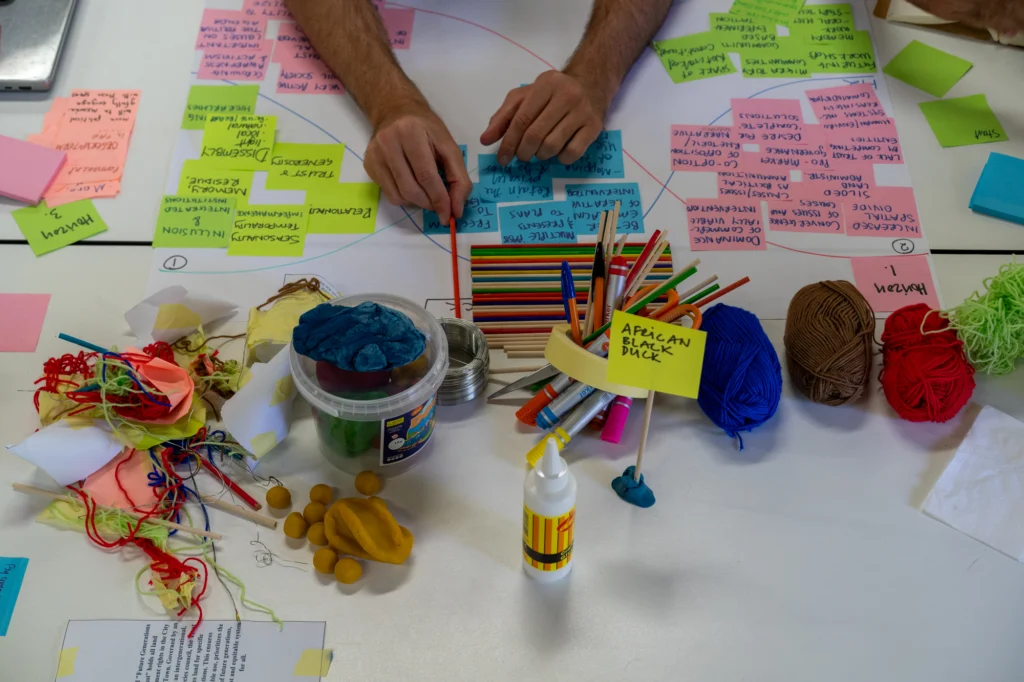
The key outcomes of the exercise included, first, an enhancement of participants’ basic futures literacy and an understanding of how anticipation and imagination can be used in this project. Second, the participants learnt how to proactively use the future to build a more anticipatory governance practice in urban developments. Lastly, through the recognition and realisation of aspirational, sustainable futures, the exercise surfaced actionable insights in the forms of ideas and activities that will inform collaborative project activities across the project’s duration. The team is currently developing a programme of activities based on these ideas. Details will follow soon.
Photographs © Barry Christianson
