



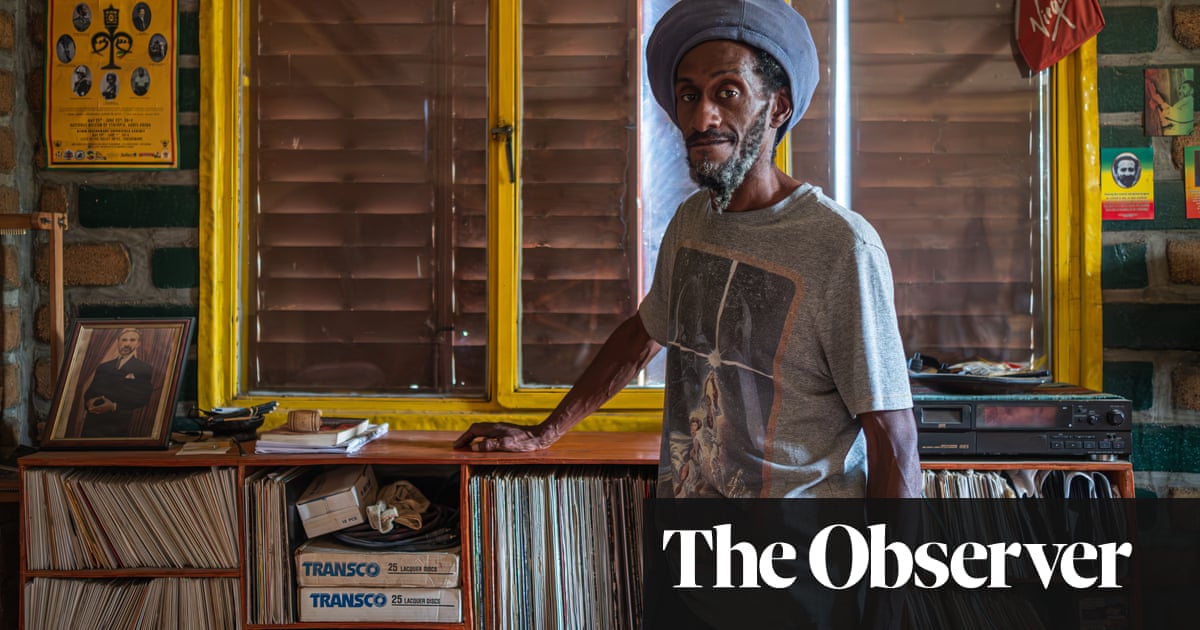
In 1999, Ras Paul, a west London DJ born to Jamaican parents, sold part of his voluminous vinyl collection to buy a plot of land and build a house in Shashamene, 125 miles south of Ethiopia’s capital, Addis Ababa.
Seven years earlier, he had become a Rastafarian, around the time of the 100th anniversary of the birth of Ethiopian emperor Haile Selassie, whom the religion reveres as the Messiah. “As an Ethiopian descendent, I wanted to come home,” he says. “It’s the place I felt I belong.”
Paul was not alone. At its peak, more than 2,500 Rastafarians from around the world moved to Shashamene. Recently, though, the Rastafarian community’s relations with the locals have come under strain.
Shashamene is in Oromia, Ethiopia’s biggest and most populous region. Since 2018, Oromia has been gripped by an ethnic insurgency that claims the Oromo people are marginalised in Ethiopia’s federation. It has also seen protests over political representation and land, including a particularly violent outbreak in 2020.
Newly established Protestant churches have also taken aim at the beliefs of Rastafarians and their use of cannabis. Newcomers have struggled to secure the right to stay in Ethiopia. Others who have been here for decades are forced to live illegally because the immigration authorities will not renew their documents.
Several Rastafarians are fighting legal battles with locals who are trying to evict them from their land. Faced with these hurdles, the Rastafarian community is preparing to submit a petition to the government, claiming their rights are not recognised.
For many people here, the image of Haile Selassie and even Ethiopia’s national colours of red, green and yellow – both ubiquitous in Rastafarian culture – are not symbols of anti-colonial black liberation but of imperial oppression. Local people risk arrest for displaying the old flag of Haile Selassie’s empire.
“Before, I was proud to go out wearing red, gold and green,” says Paul. “Now I hesitate to wear it, big time. Even the church can’t fly it in Oromia.”
The presence of Rastafarians in Shashamene stretches back to fascist Italy’s occupation of Ethiopia in 1935-1941. Haile Selassie, a devout Orthodox Christian, did not believe himself divine and tried to disabuse his worshippers of the idea.
But after he regained his throne, the emperor granted 500 acres of crown land in Shashamene to “black people of the world” who had campaigned in support of Ethiopia. Pan-Africanists from the Caribbean and the US, including black Jews and Muslims, settled there in 1955 as part of the Ethiopian World Federation (EWF), a body established in New York to lobby for Haile Selassie.
The first Rastafarians did not arrive until the following decade, galvanised by the Ethiopian emperor’s historic state visit to Jamaica in 1966. At the time, the Caribbean island was suffering from drought; when the Ethiopian emperor arrived, it finally started to rain. For many, this confirmed his divinity.
Haile Selassie was deposed by a Marxist-Leninist military junta in 1974 and murdered a year later. Symbols associated with the emperor were suppressed. The land granted to the EWF was confiscated, but Rastafarians were still allowed to settle in Shashamene as part of a sweeping collectivisation drive that gave land from the aristocracy to the peasantry.
“My parents came here at that time as farmers and land was given to them,” says Maurice Lee, 46, who was born in Shashamene. He switches effortlessly between Jamaican-accented English and Amharic, Ethiopia’s main language. Today his family run a Caribbean restaurant on the plot.
Restrictions eased when communism ended in 1991. A year later, the centenary of Haile Selassie’s birth saw a huge wave of “repatriations” to Shashamene. However, with the land grant gone, new arrivals had to buy land as investors or rent properties. Many found it difficult to secure residence permits and drifted away.
Today, the community is fighting to reclaim the land granted by Haile Selassie. They face an uphill battle. When the emperor gifted the land, Shashamene was a roadside settlement of a few thousand people. Now it is a sprawling boom town of about 210,000, full of hastily built houses and half-finished roads. The original 500 acres are no longer vacant fields but are populated by shops, homes and government offices.
“We are not living here as we are supposed to be living,” says George Isles at the EWF headquarters in Shashamene, a building bedecked with red, green and yellow and located behind a petrol station on a busy road, where heavy-goods vehicles trundle amid swarms of tuk-tuks.
Isles, a carpenter, was born in Hammersmith and grew up in Montserrat. He arrived in 1992 to help build the EWF’s office and never left. The teachings of Marcus Garvey, the spiritual lodestar of Rastafarianism, who founded the Back to Africa movement, informed his decision to stay.
“Africa is where we originate as black men,” says Isles. “We came to the western world as slaves. So to get to know ourselves, we have to go home – and home is Africa.”
Alex Reina, a French Rastafarian who came to Shashamene in 2004, agrees: “Ethiopia was the only black country to resist colonialisation,” he says. “It makes sense for us, the descendants of black slaves, to attach ourselves to Ethiopia.”
Reina runs the Zion Train Lodge in Shashamene with his wife, Sandrine. He says it “was very scary to be a Rasta man and wear red, green and gold” during the protests of 2020, but tensions have eased. That year, they had to go to court to gain recognition that they owned their land, which the previous tenant tried to reclaim.
“The land gifted by His Majesty is occupied by local people these days,” says Reina. “Many Rastas were chased away. But we are determined to remain. It’s impossible for a black man to really emancipate if he stays in Babylon.”
