




BBC News, Nairobi

 Gerald Karicha
The reported disappearance of more than 80 government critics over the last six months has caused a huge public backlash in Kenya.
A judge has warned he will imprison top security officials for contempt of court on Monday if they fail to appear for a third time to account for a recent string of alleged abductions.
The case is linked to the disappearances documented by Kenya’s National Commission on Human Rights since nationwide protests against proposed tax hikes began last June.
At least 24 are said to still be missing.
The police and government deny kidnapping and illegally detaining protesters, but the country has a history of state-sponsored abductions, and some Kenyans fear they are returning to that dark past.
The Inspector General of Police Douglas Kanja and Directorate of Criminal Investigations Director Mohamed Amin were ordered to produce in court seven social media influencers who disappeared in December.
Five suddenly reappeared in early January at various locations across the country.
Mr Kanja’s lawyers asked the court for more time to record statements from them and file a report.
Billy Mwangi is one of the five. The 24-year-old was dropped off by his alleged abductors 75km (46 miles) from his hometown in Embu, in central Kenya, in an apparent act of intimidation.
Billy’s father, Gerald Mwangi Karicha, told the BBC his son was traumatised.
“The boy has not shared a lot,” he said. “All I can say is that when he came, he was not his usual self. He looked to be in shock.”
Billy, a college student who had been a vocal critic of the government on social media, disappeared on 21 December 2024 while at a barbers’ shop in Embu.
According to witnesses, hooded men arrived in a Toyota Fielder and a double-cabin pick-up, bundled him into one of the vehicles and sped off.
Within hours, his family’s worst fears began to unfold.
“Most weekends, we are together watching football. His club is Chelsea; mine is Arsenal,” Gerald said.
He called Billy to discuss a football match on the evening of his disappearance, only to find his son’s phone switched off.
The barbers’ shop owner later informed him of the abduction, triggering a frantic search.
Billy’s mother collapsed when she heard the news and the weeks that followed were agonising for the family.
As soon as he was found, Billy was taken to hospital for a routine check-up. His family says he is still recovering from the trauma, but his release has brought them some measure of relief.
Like many who have reappeared after alleged abductions, Billy has said little about his ordeal, perhaps out of fear.
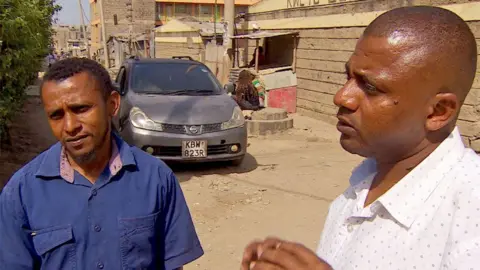
Jamil and Aslam Longton also kept quiet after they were released in September from 32 days in captivity.
The brothers were warned, says Jamil, that they would be killed if they went to the media.
Three months later, a government official publicly referred to their case as a lawful arrest.
The siblings took this as confirmation that a government agency was responsible for what they had been through and found the courage to speak out.
“The constitution of Kenya is very clear,” says Jamil. “You should be arrested and taken to court within 24 hours. Ours was 32 days. We were never given a lawyer to represent us anywhere.
“We were not allowed to see our family or communicate to our family. So this is not an arrest, this is an abduction.”
The brothers told the BBC that Aslam had helped organise protests against tax rises in the town of Kitengela near the capital, Nairobi, and had been warned by security agents to stop his activism.
One day in August the two were pulled into a car by their home, hooded and handcuffed, and taken to an unknown location where they were held in small dark cells.
Aslam says he was regularly beaten, his tormenter demanding to know who was funding the protests.
“I was very scared,” he says. “When the door was opened that man would come with a fibre cable and a metal rod.
“I was scared he had come to beat me or finish me off – there were only two options to beat me or to kill me.”
Jamil describes their abductors as heavily armed, able to track their mobiles phones and confident enough to pick them up in broad daylight, operating with a level of resources and degree of flexibility that human rights groups have reported in many cases.
But this does not mean they are official security operatives, says government spokesman Isaac Mwaura, denying that the state is behind abductions.
“Organised security may also be part of organised crime,” he told the BBC.
“It could also be for political reasons… Our political detractors have really railed on this issue. They actually run with it just to settle up political scores.”
Mr Mwaura declined to comment on the case of government minister Justin Muturi, one of the most damning indictments of Kenya’s security agencies.
Muturi says his son was picked up by the National Intelligence Service (NIS) and only released after he made a direct appeal to President William Ruto.
“That is a matter of investigation, because that is his side of the story,” said Mr Mwaura. “But what is a counter-story of the National Intelligence Service?
“I would want to say categorically that the president of the republic of Kenya, who is the head of government, has not sanctioned any forms of abduction whatsoever, because he is a man who believes in the rule of law.”
In fact, Ruto has publicly promised to stop the abductions, forced to respond to public outrage, and to concern from Western allies.
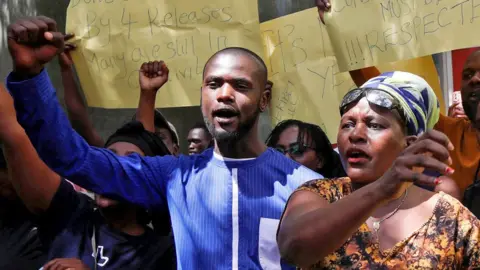
Many are distressed that the apparently systematic disappearance of anti-government activists has resurfaced in this way, recalling similar methods under the authoritarian leadership of Daniel arap Moi in the 1980s and 1990s.
 Reuters
Gitobu Imanyara, a journalist and activist who campaigned for multi-party politics in the early 1990s, was arrested and beaten by Moi’s regime. He has no doubt he is seeing the “Moi playbook” in action now.
But, he says, times have changed. Constitutional amendments have established more mechanisms of accountability and “there is a greater segment of Kenyan society that will not be intimidated”.
“The democratic space has expanded so much the government cannot wish away democratic voices of dissent,” he told the BBC.
Plus with social media, “the word spreads out almost instantaneously”, he said.
“We cannot be censored the way we used to be censored in those days when we could only use landlines.”
Reports of disappearances have tapered off in recent weeks.
But despite the announcement of police investigations, no-one has been charged, let alone convicted, for carrying them out.
Several advocacy groups have petitioned the attorney general asking that abduction cases be referred to the International Criminal Court (ICC).
As for the families of those still missing, the nightmare continues.
“We are so depressed, so devastated,” says Stacey Mutua, the sister of Steve Mbisi, one of the seven who disappeared in December.
“We are hoping they’ll release him. [Most] of the abductees were freed, but he is still missing. We’re praying he’ll be found.”
You may also be interested in:
 Getty Images/BBC