


If the twenty-nine odd members of the Yoruba Nation self-determination group who stormed the Oyo State secretariat, Ibadan, in the early hours of Saturday April 13 go down in history, it will most certainly not be for their strategic genius. For a group with the apparent intention of taking over the secretariat as the opening gambit of a larger attempt to establish a breakaway Yoruba state, they could have done better than the skeletal masks which hardly did the job of disguising their identities and the five English Pump Action guns and three locally made barrel guns in their possession. Failing that, they could at least have put up a fight against the handful of security personnel that the Oyo State government quickly rustled up to neutralize them. All this, together with the fact that no single shot was fired while the “assault” on the secretariat lasted, points to the conclusion that the agitators may have been driven more by a desire to send a message than an actual resolve to “overthrow the Nigerian government.”
Understandably perhaps, this is not the way the authorities have seen it. While the Oyo State government quickly, if inexplicably, moved to demolish the building where it believed the agitators had made their plans, the State Police Command arraigned the arrested agitators before a local magistrate court on charges of “treasonable felony, unlawful society, illegal possession of firearms, and conduct likely to cause a breach of the peace.” For his part, President Bola Tinubu used the occasion of the arrest to remind Nigerians of his “irrevocable commitment to the unity of Nigeria and constitutional democracy,” while warning “Those who think they can threaten the sovereignty of Nigeria” that they “will have themselves to blame. They have a price to pay. And we are not going to relent.”
More on:
Nigeria
Race and Ethnicity
Demonstrations and Protests
Civil Society
Democracy
Whether genuinely ham-fisted or expressly designed to send a message to the authorities, the Oyo State secretariat incident is a timely reminder of perennial political tensions simmering under the surface of Nigeria’s struggle to consolidate liberal democracy. If the hope at the inception of the Fourth Republic in May 1999 was that hand-to-hand political combat (the metaphorical kind) would blunt the serrated edges of ethnic identitarianism, that expectation has been massively disappointed. If anything, the manifest shortcomings of civil rule, chief among which are festering corruption and the failure to expand economic opportunity, particularly among young people, have (1) reinforced cynicism about liberal democracy, (2) encouraged the feeling that the road to political salvation lies outside an irreparably defective Nigerian architecture, and (3) empowered the leaders of ethnic-driven movements and associations. In other words: legitimate impatience with a misfiring Nigerian democracy appears to have reminded various groups within the Nigerian federation the reasons for their disgruntlement with Nigerian federalism ab initio.
If the waters of ethnic disaffection run so deep, how do we explain the cack-handedness of the Yoruba Nation agitators? One probable explanation is that the agitators were constrained by the paradox of mobilizing for a breakaway Yoruba republic at a time when a Yoruba co-ethnic, Bola Tinubu, is the incumbent Nigerian President, a move that makes them vulnerable to accusations of being ethnic traitors. As members of the predecessor O’odua People’s Congress (OPC) were to discover during the Olusegun Obasanjo presidency (1999- 2007), nothing is more difficult than mobilizing for secession when one’s co-ethnic happens to be the first citizen.
A second probable explanation is that the rag tag character of the Yoruba Nation group is a reflection of the state of contemporary Yoruba political dissidence, witnessed by (1) the evolution of the OPC from a group that once insisted on violent separation from the Nigerian state into one currently on the payroll of the same state as, among other things, a protector of oil pipelines; and (2) the steady bourgeoisification of its one-time fire-spitting leader, Gani Adams, from political outsider to cultural guarantor and card-carrying “Big Man.” An excellent new study by anthropologist Wale Adebanwi ably documents this institutional and personal transformation.
We should note in parenthesis that the ostensible leveraging of self-determination for personal aggrandizement and power is neither unique to Gani Adams nor the Yoruba region. If anything, it is indicative of a pattern seen in different parts of the country whereby various entrepreneurs have mobilized the threat of violence—or often the real thing—to accumulate tremendous personal wealth and, consequently, amass considerable political influence. In the Niger Delta region, the examples of Government Eweizide Ekpemupolo, aka Tompolo, Ateke Tom, and Mujahid Dokubo-Asari, formerly Melford Dokubo Goodhead, Jr., immediately jump to mind. Most telling perhaps is the example of incumbent Nigerian President Bola Tinubu, who, at least while he was in political exile, proudly flew the flag of Yoruba secessionism and once told a reporter that “I don’t believe in one Nigeria.”
In any event, in Yorubaland, the effect of the transformation of OPC into basically a security arm of the establishment is to open an opportunity to its left, ideologically speaking. This is the all-important sociological context of the emergence of the Yoruba Nation agitators—decidedly more radical than OPC, clearly less resourced (intellectually and materially), yet by no means any less legitimate.
More on:
Nigeria
Race and Ethnicity
Demonstrations and Protests
Civil Society
Democracy
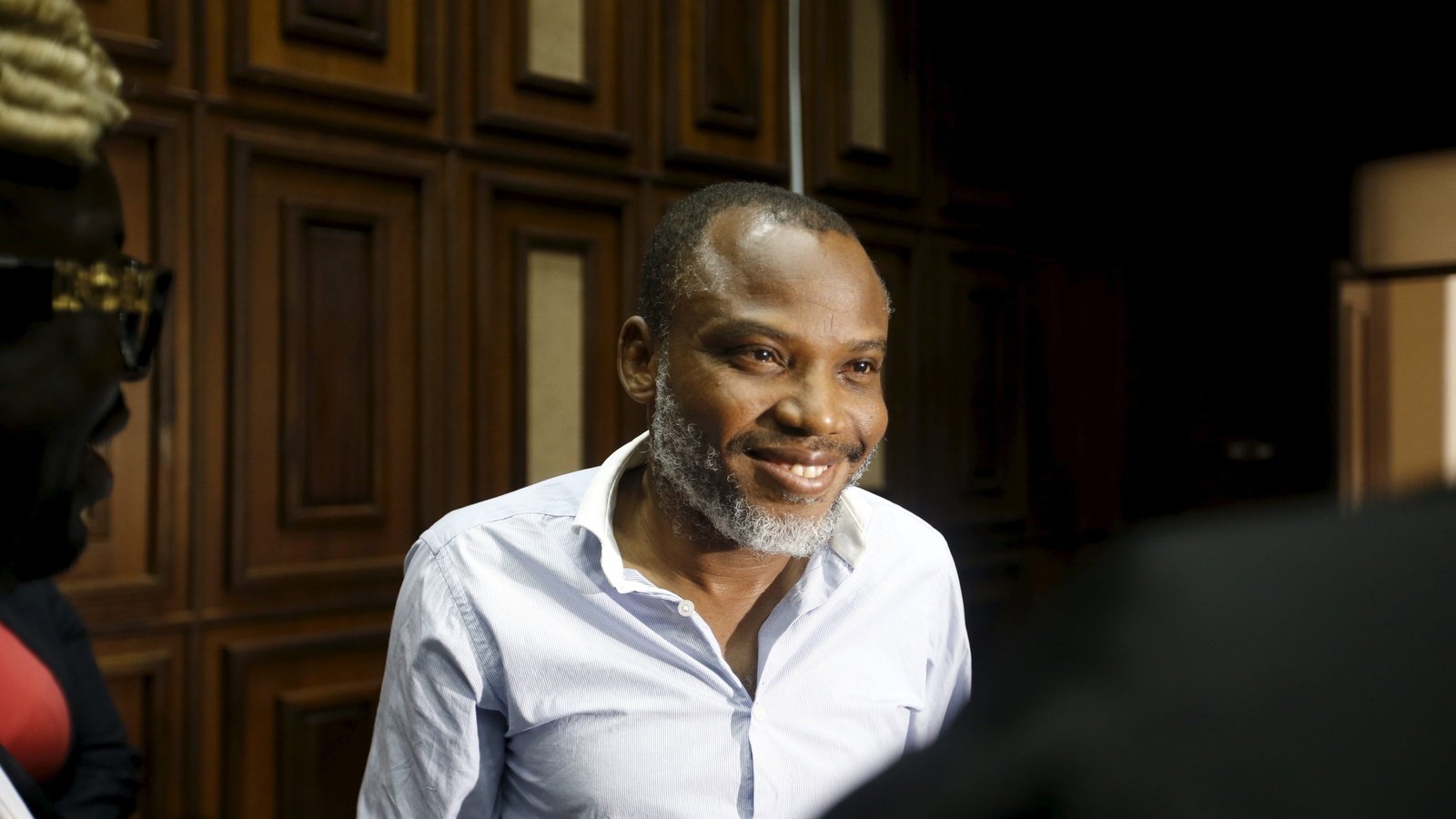
The situation in the Eastern region seems more volatile, partly on account of the continued detention of the leader of the Indigenous People of Biafra (IPOB), Nnamdi Kanu, and partly on account of a fundamental difference between the Igbo and Yoruba cases for self-determination as follows: if the Yoruba seem tactically hamstrung by having “one of their own” in the nation’s highest office, the Igbo, rightly, continue to be embittered by never having been in that situation. Massive support across the Igbo heartland for the candidacy of Peter Obi during the last presidential election was partly driven by an understandable desire to see that situation rectified once and for all. To the extent that the Igbo elite appears to have abandoned IPOB, for instance conspicuously refusing to take up a plausible case for Kanu’s release with President Tinubu, it is because of its—the Igbo elite’s—continued reservations about IPOB’s political strategy, especially the group’s perceived indiscriminate use of violence, including against fellow Igbo.
If the Igbo elite has more or less abandoned IPOB because the group is “bad for business,” Fulani self-determination provides an excellent illustration of the positive intertwining of economic livelihood and ethnic identity. With Yoruba and Igbo self-determination focused to different degrees on negotiating an exit from the Nigerian state, Fulani self-determination, primarily a reaction to their perceived mischaracterization as the black sheep of the Nigerian federation, has consisted in excavating and narrativizing Fulani heritage with a view to establishing an illustrious pedigree that is believed to transcend the narrow confines of Nigeria. As part of this process, a more culturally sensitive Miyetti Allah Kautal Hore has been carved out of the existing Miyetti Allah Cattle Breeders Association of Nigeria (MACBAN), the former expressly created to “defend the interest of the Fulani herders, to fight for their rights, dignity, and against all forms of stigmatization of the Fulani nomad pastoralist (sic); and to preserve the Fulfulde language and Fulbe culture.”
Taken together, these contending nationalisms—all active in the cyber world, all loaded to the hilt with the accoutrements and paraphernalia of an independent state—point to the tenacity and boisterousness of the tradition of thinking beyond Nigeria. One reason they are unlikely to disappear anytime soon is the starkness of the underlying grievances. Nobel laureate Wole Soyinka’s recent call to the Nigerian leadership to “decentralize development as massively as possible” speaks to the currency of the sentiment.
The Nigerian constitution insists (and the Nigerian elite agrees) that Nigeria…
