




 Stary Mwaba
Zambia’s notorious “black mountains” – huge heaps of mining waste that scar the Copperbelt skyline – are deeply personal to Stary Mwaba, one of the country’s leading visual artists.
“As kids, we used to call it ‘mu danger’ – meaning ‘in the danger’,” Mwaba tells the BBC.
“The ‘black mountain’ was this place where you shouldn’t go,” says the painter, who was born and lived in the Copperbelt until he was 18.
“But we would sneak in anyway – to pick the wild fruits that somehow managed to grow there,” the artist recalls.
Nowadays, the young men heading to “mu danger” are looking for fragments of copper ore in the stony slag of these towering dumpsites – the toxic legacy of a century of industrial mining production in Zambia, one of the world’s biggest copper and cobalt producers.
They dig deep and meandering tunnels – and hew out rocks to sell to mostly Chinese buyers, who then extract copper.
It is tough, dangerous, often illegal and sometimes fatal work. But it can also be lucrative – and, in a region where youth unemployment is about 45%, for some young people it is the only way that they can make ends meet.
 Stary Mwaba
Mwaba’s latest work – on show at the Lusaka National Museum this month – tells the story of the young people who mine the black mountain in the town of Kitwe – and captures the rhythms of life among the residents of the Wusakile neighbourhood.
They work for gang masters known as “jerabos”, a corruption of “jail boys” – hinting at their perceived criminality.
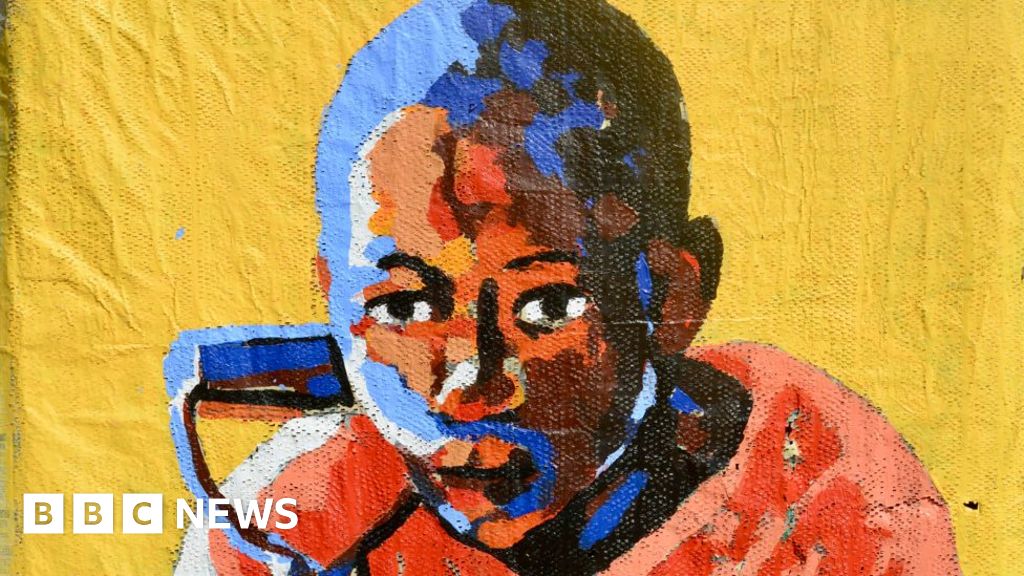
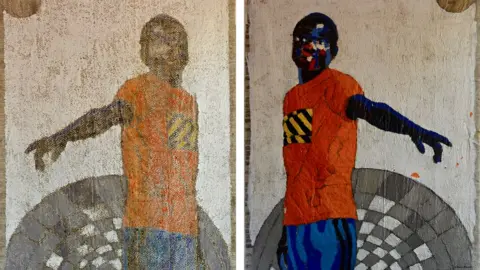
The artist has painted a series of large portraits, using old newspapers as a canvas. He cuts out articles that grab his attention – what he refers to as “grand narratives” – and sticks them on to a backing paper.
He uses a soldering gun to burn away some of the words and create a series of perforations in the stories. Then he pours in paint to create the portraits, or what he calls the “little narratives”.
“I take these grand narratives, and I create holes so that you can’t make sense of the stories any more. I then impose images of people I know on to them – to show that little stories, the little narratives of ordinary people also count,” Mwaba explains.
“They have stories that are important and are part of the bigger story.”
 Stary Mwaba
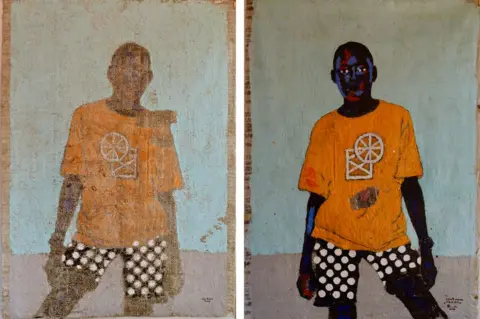
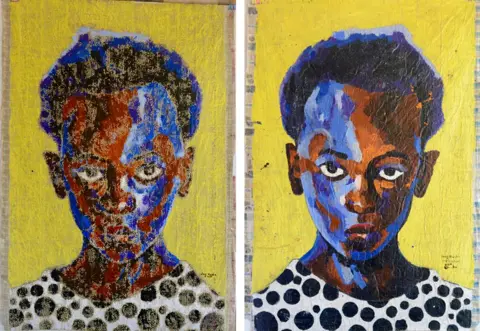
The portraits can be seen from both sides and, in characteristic Mwaba style, are brightly coloured.
The artworks are coated with a transparent acrylic and the borders of newspaper held together with clear tape because they are very fragile – like the existence of the people Mwaba has painted.
They live in the shadow of the black mountain – the site since the early 1930s of millions of tonnes of waste, full of toxic heavy metals – which wreaks havoc on people’s health and the environment.
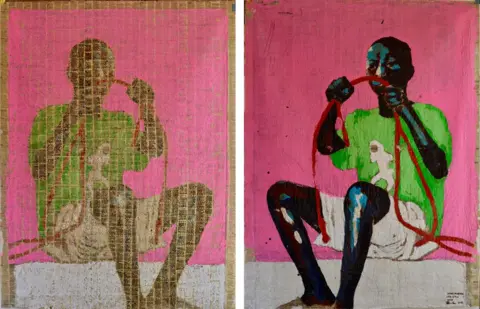
One painting from his current work is entitled Jerabo and shows a miner preparing safety ropes that are tied around his waist as he lowers himself down narrow precarious tunnels, dug out by hand and prone to landslides.
 Stary Mwaba
Earlier this year, the entire water supply to Kitwe, home to about 700,000 people, was shut down after a catastrophic spill of waste from a nearby Chinese-owned copper mine into the streams that flow through neighbourhoods like Wusakile into one of Zambia’s most important waterways, the Kafue River.
Mwaba hears stories of hardship and survival during the drawing, photography and performance workshops that he and other artists have held over several years.
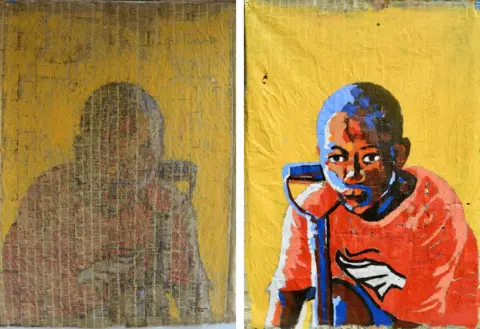
Shofolo portrays a young man almost hugging his precious “shofolo” – the Zambian English, or Zamglish, word for shovel. Such tools are “a personal lifeline”, Mwaba says.
 Stary Mwaba
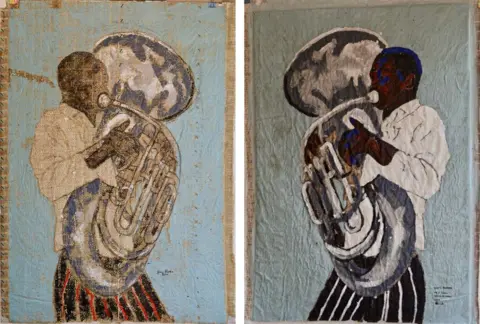
Ipenga captures the tuba player of a local church group as he parades through the streets one Sunday morning.
Most social lives in Wusakile revolve around either the church or the bar, Mwaba says.
 Stary Mwaba
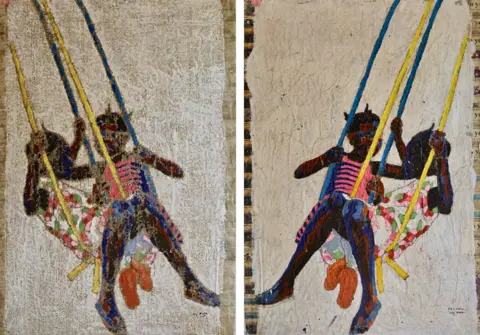
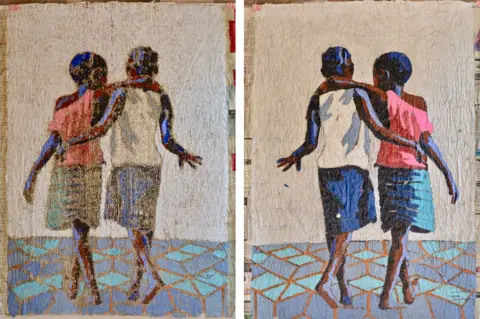
But the two young girls in Chimpelwa make their own fun on home-made swings.
Strung up in the sturdy branches of a tree are yellow and blue heavy-duty cables – once high-voltage electrical cables, their copper wire innards have now been stripped out and sold as scrap metal.
 Stary Mwaba
Mwaba comes from a family of miners – his great-grandfathers and one grandfather worked down the mines and his father above the ground.
But the 49-year-old’s interest in the impact of Zambia’s mining as a subject for his paintings began almost accidentally in about 2011 – after he helped his daughter, Zoe, with a science project at the Chinese International School, which she attended in the capital, Lusaka.
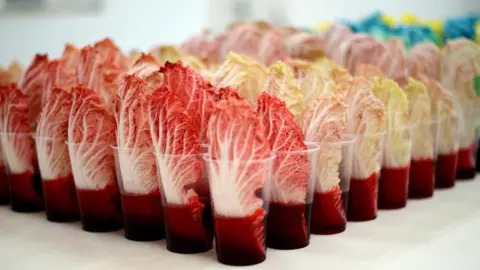
The task was to demonstrate how plants absorb minerals and water. He and Zoe went to the market and bought a Chinese cabbage. It is not indigenous but is now eaten in many Zambian homes.
It has a white stem so is ideal to absorb the food dyes that Zoe decided to use to show how minerals would be similarly drawn into the plant.
Mwaba remembers that the use of Chinese cabbage made the audience “uneasy and so uncomfortable”.
 Stary Mwaba
At the time, the late Michael Sata was campaigning for the presidency – and tensions were high because of his vitriolic rhetoric against the Chinese, who are accused locally of dominating the Zambian economy and exploiting workers.
So Mwaba turned the science project into a work of art – in which he explored the Chinese presence in Zambia’s mining sector through three Chinese cabbage leaves, one dyed yellow to depict copper, one blue for cobalt and the third red for manganese.
His Chinese Cabbage brought Mwaba much international acclaim, and he returned to Zambia in 2015, glowing with the success of an art residency and exhibition in Germany.
He went to Kitwe, where he had spent some childhood years. But his focus changed from just exploring the Chinese presence in Zambia to trying to tell the story of the black mountain people.
“I went back to a place where I grew up and things had changed so much,” the artist says, adding that he “never, ever imagined that I would see the kind of the situation I see now – the poverty”.
“It was a very emotional space and I was sad,” Mwaba says.
 Stary Mwaba
Mwaba had moved to Kasama in Northern Province in 1994, after his father suddenly died. Three years later Zambia’s mines were privatised – leading to massive job losses and an unprecedented economic crisis in the Copperbelt.
The black mountain – always a source of environmental and health problems – now became somewhere to earn money.
“The worst thing that happened is when the black mountain was super-profitable, most of these young people quit school.”
Unable to get a job anywhere else, Mwaba’s cousin Ngolofwana joined a crew of jerabos. Every day he wakes up and risks his life just to stay afloat and feed his family.
But even when the government has banned mining there, the dumpsite’s wealth is tightly controlled by an aggressive hierarchy – with the top, sometimes very wealthy, jerabos often living up to their nickname.
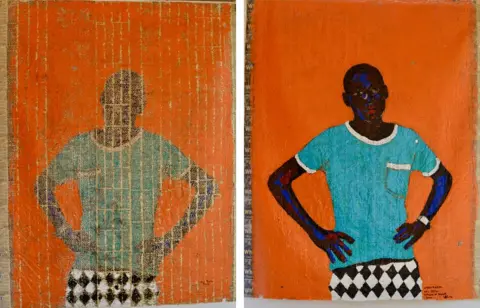
Frustrations further down the jerabo chain – of feeling exploited, giving up on education to fund someone else’s lavish lifestyle, and having little say in their own futures – are reflected in the painting of one young man in a turquoise T-shirt standing with his hands confidently on his hips.
 Stary Mwaba
Boss for a Day came out of a workshop in which Mwaba invited people to take their own photographs, striking a pose that reflected their hopes and dreams.
And occasionally Mwaba’s art may change the course of someone’s life.
Mwaba recalls a time where an older jerabo came to a workshop and said: “Hey, I really like what you’re doing.
“I think I may not understand it, but it’s best for my young brother to be coming here because I don’t want him to go through what I went through.”
Penny Dale is a freelance journalist, podcast and documentary-maker based in London
More BBC stories on Zambia:
 Getty Images/BBC