



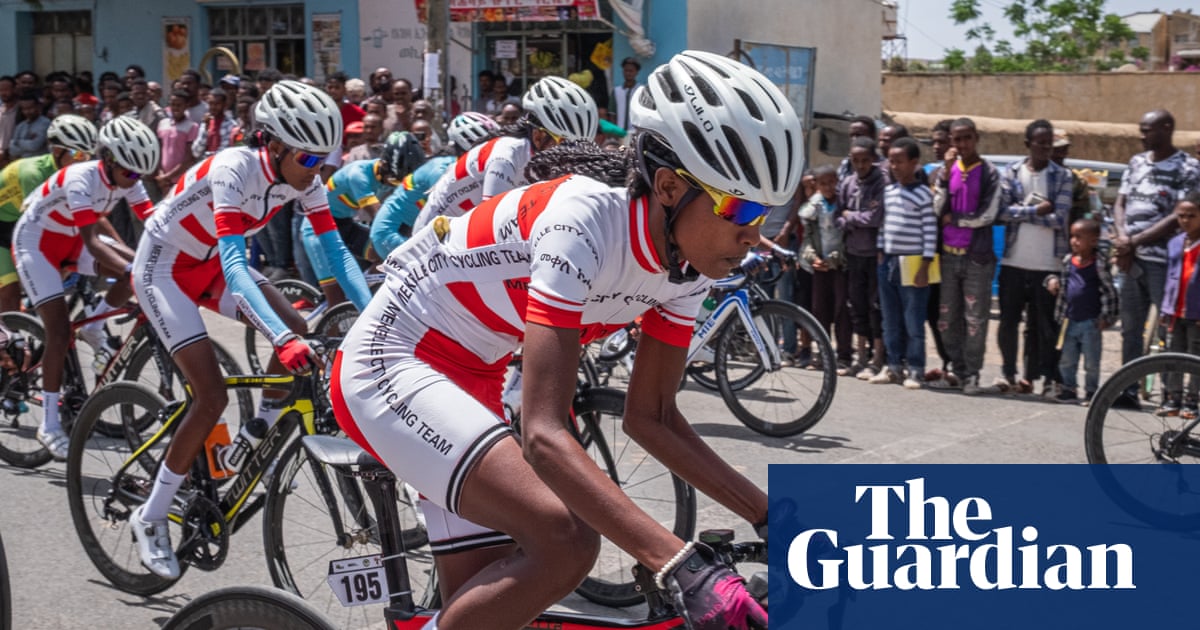
As the cyclists wind through the mountains, team coach Tadesse Mikiele, trails in a blue minivan, making observations and discussing tactics with his staff. At one point, he beckons over the captain, Genet Mekonen, who has been trailing at the back.
“Why are you slowing down on the declines?” he asks her. “You need to be brave. Increase your speed, attack when you go downhill.”
Genet peels off to rejoin the group at the front. Two days before their next race, Tadesse says he is happy. “You can see, on the hills, they move up as a team. They do not separate, they support each other. We are in good shape.”
Eighteen months ago, tanks lumbered along this road in Ethiopia’s northern Tigray region. Drones pummelled targets from above. At a roadside village, Eritrean troops allied to Ethiopia’s military massacred dozens of people. It was the final battle of one of the bloodiest wars of recent times, pitting Ethiopia’s federal government against Tigray’s rebellious regional rulers.
Today, Tigray’s cycling teams, including the women of coach Tadesse’s Mekelle 70 Enderta club, are competing on the road again, a small sign of the fragile normality that has returned after two years of devastating war. Hunger and insecurity persist in several areas but sport, at least, has resumed.
During the war, Tigray’s internet and phone lines were cut off. Aid was obstructed and the banks were shut, so people couldn’t access savings to buy food. The UN secretary-general, António Guterres, called the restrictions a “de facto humanitarian blockade”. A UN panel concluded that all sides had committed war crimes.
Tigray’s women suffered greatly. The UN experts concluded that Eritrean and Ethiopian forces waged a campaign of sexual slavery and that Tigray’s fighters perpetrated sexual violence in the neighbouring regions of Amhara and Afar. In total, 600,000 people were killed across northern Ethiopia, according to the African Union’s main peace negotiator.
“I don’t have words to describe it, it was a terrible time,” says Genet at the team hotel after training. “I survived by the will of God.”
Tigray is known in Ethiopia for its cycling culture. It has steep, mountainous roads and a history of investing in the sport. But conditions can be treacherous. Cyclists contend with gaping potholes, minibuses speeding around blind bends and the occasional wandering cow.
Just three of Tigray’s six women’s cycling teams survived the war. Mekelle 70 Enderta, based in the regional capital, had 16 cyclists before the conflict. Now it has eight. Only four were part of the prewar team, which was scattered during the conflict.
One of the club’s cyclists spent a year on the frontline, fighting in dozens of battles before rejoining her teammates. “I didn’t think I’d survive, let alone return to cycling,” she says. Others were displaced. The club survived thanks to the efforts of coach Tadesse, who worked to piece it back together.
“Cycling needs continuous training, with very few break days, if you want to be competitive, but we couldn’t go out for almost three years because of Covid and the war,” says Genet. “We were completely stuck … it was tough to return.”
Last month, Mekelle 70 Enderta competed in a tournament held over several days in Axum, a holy city whose main church is said to hold the original Ark of the Covenant. Hundreds of spectators lined the streets to watch the bikes. In November 2020, Axum was the site of the biggest massacre of the war when Eritrean troops went door-to-door slaughtering hundreds of men and boys. The memory of the massacre still hangs heavily over the city. A minute of silence was held before each race to commemorate the dead.
“Almost all” of Tigray’s male cyclists signed up to fight and many were killed, says Berihu Mesfin, general secretary of Tigray’s cycling federation, which organised the recent event. Several teams had their bikes looted by soldiers and struggled to raise money to replace them. “We’ve started competitions again,” says Berihu, “but cycling in Tigray is still recovering.”
The women of Mekelle 70 Enderta have not been paid since October 2020, the month before the war erupted. They live in a team dormitory, where they get meals, but no money to cover personal expenses. “We can’t buy clothes or even soap, but we are still here, surviving, for the sake of the team,” says member Serkalem Taye.
If Genet is the leader, who binds everyone together with her humour and ability to relay the coach’s instructions, then Serkalem is its engine room, who sets standards for fitness and endurance. There is a strong bond between the cyclists, both old and new, says Serkalem. “We see each other as sisters. The result is never for one person, it’s for the team, so we support each other.”
after newsletter promotion
Serkalem, from southern Ethiopia, spent much of the war in the capital, Addis Ababa. Her parents did not want her to return to Tigray but in the end accepted her decision.
“I lost many friends, so coming back was hard,” says Serkalem. “But I’ve lived here for nine years and the people of Tigray are like my family. That is why I am still living and training with the team without any salary. They showed me a lot of love and respect, and I’m very grateful to be back here.”
The team’s newest member is 19-year-old Nebyat Tesfu from Adigrat in eastern Tigray, a town known for producing great cyclists, which witnessed a lot of fighting. The war almost snuffed out her young career before it began.
“Daily we felt fear,” she says. “There were airstrikes, the sound of guns, and the deaths of neighbours. It was too dangerous to go outside.”
Nebyat first sat on a bike five years ago. When she started training by herself after the war, she worried about landmines. At first people were fearful when they saw her coming down the road, mistaking her cyclist’s Lycra for a soldier’s fatigues. “They would run away,” she laughs.
Cycling officially resumed in Tigray in June 2023, eight months after a ceasefire ended the war, with a competition featuring teams from every corner of Ethiopia. Tigray’s cyclists won all but two of the races, says Berihu. At the African Games, held in Ghana in March, all six women chosen to represent Ethiopia came from Tigray, including three from Mekelle 70 Enderta. Serkalem and Genet were among them. Coach Tadesse, who shows off photos of the games on his phone, counts this among his proudest achievements.
“When we first restarted, the objective was just to get the team back on its feet, but these ladies are very tough,” he says. “I would have been happy to provide just one cyclist, but we managed three. I was delighted.”
Despite coaching for two decades, Tadesse admits there were times when he felt like giving up during the war. “I’m still with the team for the sake of these women,” he says. “They have sacrificed a lot to achieve what they have. I don’t want to let them down.”
