
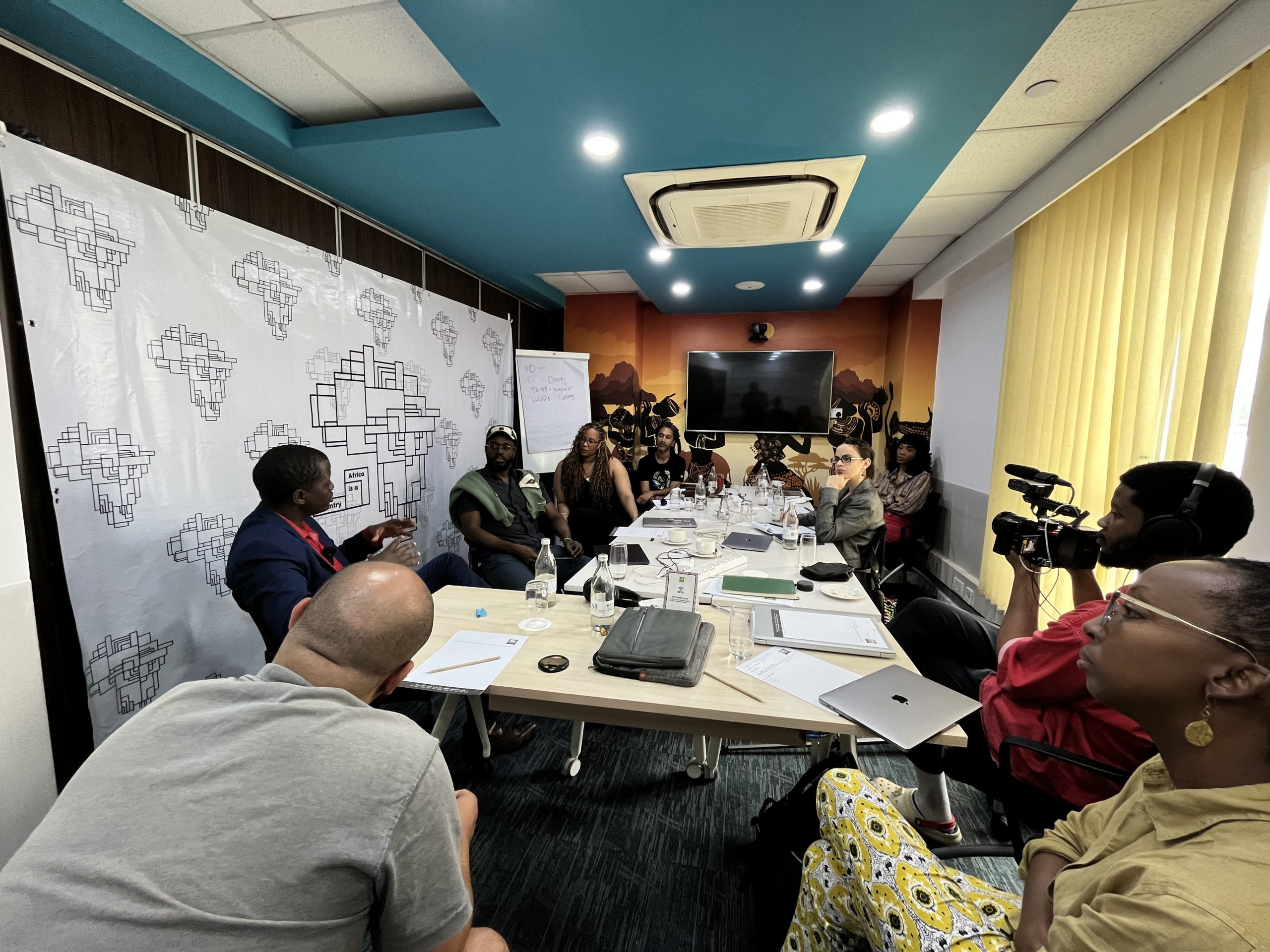
At our first workshop from our festival in Nairobi, The Elephant’s Joe Kobuthi, reflected on a year since #EndFinanceBill.
In June 2025, Africa Is a Country held its inaugural Festival of Ideas in Nairobi—a week of screenings, workshops, panels, and long, searching conversations about the future of political and cultural life on the continent. As part of the trip, our editorial team sat down with Joe Kobuthi of The Elephant, one of Kenya’s leading platforms for critical commentary and analysis.
Kobuthi has long been a trenchant observer of the Kenyan public sphere, and in this wide-ranging roundtable, he reflects on the country’s shifting political landscape: from the promises of the 2010 constitution and the disillusionment of Jubilee-era politics to the emergence of a new Gen Z–led revolt demanding a wholesale renegotiation of Kenya’s social contract.
As fellow travelers in the struggle to build a more critical, independent, and solidaristic media, we approached this conversation with Kobuthi not simply as observers but as participants. The crises facing Kenya—shrinking civic space, intensified repression, the return of theological-authoritarian rhetoric—are not unique. They resonate across the continent and beyond, including in our own work. What are our responsibilities, as editors and writers, in such a moment? What new forms of public imagination are needed? How do we hold space for resistance while sustaining institutions of critique?
This wide-ranging discussion explores those questions. From the ghosts of Kenya’s post-independence promises to the radical promise of Gen Z revolt, from the ideological decay wrought by structural adjustment to the shifting terrain of faith and power, Kobuthi offers a sobering and searching diagnosis of where things stand—and what might come next.
Listen on the podcast feed, watch the video and read the transcript below.
- Joe Kobuthi
-
To start, I think it’s important that we situate this conversation within a particular moment in history. To understand where we are today—in our newsrooms, in our societies—we have to locate ourselves historically. I remember being struck, maybe six years ago, by how much that November 9 moment—the fall of the Berlin Wall—shaped what came after. That moment ushered in what we now understand as the triumphalist American era. Reading Karl Marx suddenly became unfashionable. Wearing Reebok was good. We were watching Michael Jordan and not so much Stalin anymore. That was the ideological climate that framed the world we were stepping into.
Here in East Africa—and I’ll speak specifically about Kenya, since that’s my context—that liberal democratic dispensation coming out of America was met with a lot of joy. At the time, Kenya was facing an economic recession and grappling with the effects of structural adjustment programs signed in the 1980s. These programs were very similar to what we’re experiencing now, just under different names. Today we call it austerity, or debt-driven austerity, but the material consequences are largely the same—cuts to health, education, public services.
We were also living under an authoritarian regime at the time, under President Daniel arap Moi. And in a strange way, there are echoes of that moment in the present. His political disciple, if you like, is now president. So again, we’re seeing this uncomfortable familiarity—similar economic measures, similar political styles.
But what was really interesting then—and remains relevant now—was the youth, particularly the university population, and the energy they brought. Back then, we had a program called JAB: students were sponsored by the government and received a fair bit of financial support. That allowed people to spend time thinking, organizing, becoming leftist, becoming radical. There was space for that. But all of that changed when the graduate programs were restructured, and the space for political formation shrunk.
So then the question became: What do we do with all these young people coming out of university? The Kenyan state had no answer. Political elites and policy makers were caught flat-footed. What emerged in that vacuum was a kind of black market—an ideological one. Civil society as we know it today began to take shape during that moment, particularly in the 1990s. It was donor-driven, Western-funded, and heavily invested in pushing liberal democratic ideals and values.
But because of the conditions of Kenyan society at the time, this was a welcome intervention. You had people like Smith Hempstone, the US ambassador, actively championing these reforms. And you had local forces—religious leaders like Reverend Timothy Njoya—declaring that Kenya was ready for democracy. So there was this convergence of local and international actors, and for a while, it felt like a productive marriage.
In those days, it was cool to be in civil society. It was cool to be an anticorruption crusader. You had the backing of the West. You had funding. You had legitimacy. You were aligned with what was being sold as the American dream on a global scale.
So we went down that path—and we went deep. For a moment there, it felt like we had reached what they called “the end of history.” Everything was supposedly settled. All that remained was to apply technical fixes to our political problems. No need for ideological debate. No need for philosophical reflection on the moment. Just patchwork solutions.
If elections weren’t working, it wasn’t a political problem—it was a technical one. Was the issue at the ballot box? Was it the final tally? Was it the polling station or the national tallying center? Either way, the solution was to go to court, not to the people.
Now, the Makau Mutua ruling made it clear: The polling station is the final verdict. That became our rhythm, our dance. Even after we pushed out Moi, we kept moving in that groove—technical fixes. Authoritarianism was bad, democracy was good. We removed Moi. Then Kibaki came into power in 2002, and we continued with the liberal democratic agenda.
For our generation—those of us who had come of age agitating for change—it was a great time. Civil society was thriving. It was an intellectual space, full of energy, full of ideas, backed by Western donors and animated by this sense of political possibility. The liberal democratic model was ascendant. It felt like a good time to be alive. When Kibaki was elected, there was euphoria again. That moment meant something to us. People like the late Binyavanga Wainaina—very much a part of our generation—captured the mood. His essay “How to Write About Africa” wasn’t just a literary intervention; it was a kind of cultural valve. We loved it. Kwani? was launched. The literary scene was buzzing, expanding, coming into its own. We were living through a moment.
And in that moment, we contested narratives—like the idea that Africa is a country. That critique became its own cultural and political current, and you can see its traces even here, in the name of this publication. That was the energy of the 2000s. We were asserting ourselves intellectually, creatively, politically. Even when the 2007 post-election violence broke out, it felt like a tragic interruption—but still a blip in our broader liberal democratic trajectory. A dark cloud, yes, but in what we believed was otherwise a rainy paradise. And so in 2010, partly in response to that violence, we doubled down and passed a new constitution. It was a historic achievement. Things kept moving.
But history doesn’t move in a straight line—it rhymes. In 2013, something ruptured. Two ICC suspects—former President Uhuru Kenyatta and the current President William Ruto—teamed up and ran a highly effective campaign. They won. And suddenly, it felt like our entire liberal democratic project was under threat. By 2014, 2015, many of us who had spent our twenties and thirties fighting for these gains began to feel disillusioned. We saw signs of democratic backsliding. Civil society was no longer celebrated—it was under attack. The state began calling it “evil society.” There was institutional blowback, especially in health reform and devolution. A counterreform agenda was taking shape.
So what did we do? We started to gather. Small groups, late-night coffees, long conversations. The progressive wing of our generation—people who still believed—began asking what was next. And in 2016, The Elephant was born. It emerged as a platform for dialogue, for speaking truth to power, for responding to the emergencies we were witnessing in society. The civic space was shrinking fast, and we knew we needed to build something—to keep thinking, keep speaking, keep imagining.
You know, people like Denis Galava, Gado, and many other columnists and editorialists in Kenya’s newsrooms were being let go. I won’t say “fired” because firing suggests some HR problem—and this wasn’t that. There were no HR issues. These were political decisions. Many of the calls came from state operatives who felt the editorials were going too far, or that the cartoons were too pointed. So they were let go. Interestingly, one of the ways this happened was through scholarships. You’d be offered a scholarship to the UK—go study, broaden your horizons—and when you came back, your job would be gone. It was a soft kind of exit. The Peter Principle talks about promoting people to the level of their incompetence, but in this case, it was about giving people a kind of graceful exit while quietly removing them from the scene.
Those were exciting early days, not just for The Elephant but for Kenya’s public sphere. The platform helped spark an environment of critical reflection, encouraging…