
Abstract
Is the geography of armed conflict in Africa becoming more urban? To answer this question, I link georeferenced data on the timing and location of armed conflict and protest events to continent-wide geospatial data on human settlement patterns. Comparing rates of conflict and contention in rural versus urban areas over time, I argue that, contrary to conventional wisdom, claims surrounding the ‘urbanization of conflict’ in Africa are premature. I find that the urbanization of conflict hypothesis only holds in North Africa, where armed conflict and protest are both increasingly urban phenomenon. In contrast, while the frequency of urban protest in sub-Saharan Africa has also increased substantially, conventional armed conflicts in rural areas have also risen over the same period. My study provides a quantitative summary of key patterns and trends in protest and conflict in Africa contributing to ongoing debates surrounding the frequency and character of violent and non-violent political contests on the continent.
the ‘urbanization of conflict’ hypothesis implies a fundamental transformation in the nature, manifestations, and geography of social conflict in Africa. In short, it suggests that there has been a shift from conventional forms of armed conflict fought predominantly in rural areas between state-based and organized rebel groups towards new modes of contentious action in urban areas, including riots, protests, and ‘civic conflict’.1 However, this claim has not been subjected to systematic quantitative analysis. Despite a few notable exceptions, existing studies have largely ignored the rural–urban geography of conflict, in part due to a lack of the requisite geospatial data.2
This study aims to fill this gap by quantifying the patterns and trends in armed conflict and contentious action events across Africa. Building on earlier exploratory work,3 I analyse the location of riot, protest, and armed conflict events over the last two decades in combination with fine-grained data on human settlements. I classify events into urban, peri-urban, and rural locations and analyse trends in contentious events across the human settlement spectrum in Africa.
To classify events, I use georeferenced data from the Uppsala Conflict Data Programme Georeferenced Event Dataset (UCDP-GED)4 and Armed Conflict Location and Event Dataset (ACLED).5 These sources are combined with data on human settlement patterns derived from WorldPop, allowing me to distinguish between events located in urban centres, urban clusters (i.e. peri-urban areas and towns), and rural areas. I analyse trends in the frequency of conflict and protest events across distinct settlement classifications over time using descriptive statistics and regression analysis.
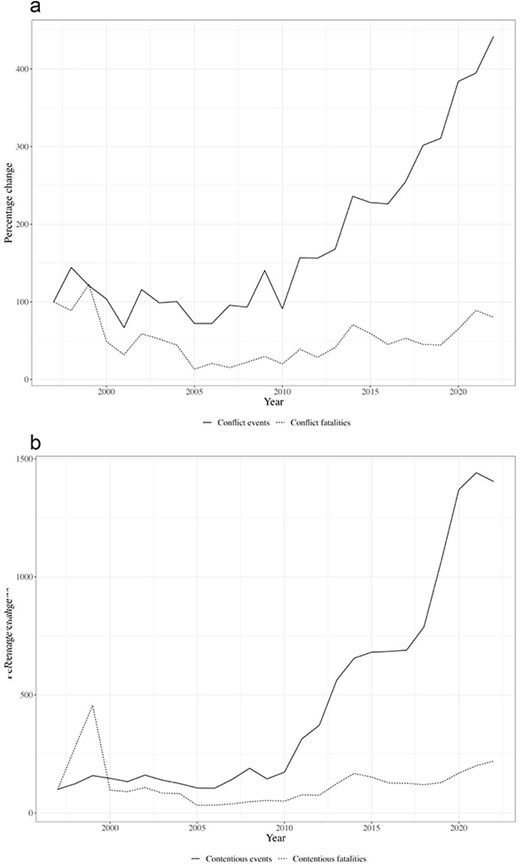
The descriptive findings indicate an increase in all forms of contentious action across the continent. However, despite rapid urbanization and urban growth, I do not find consistent support for the urbanization of conflict. Overall, the frequency of protests has risen sharply over the last decade. These events are predominantly urban. While armed conflict does appear to have urbanized in North Africa, it remains a predominantly rural affair south of the Sahara. My regression analysis provides further qualification to the urbanization of conflict hypothesis. Controlling for other factors, most forms of armed conflict have become more common in urban areas over time. However, this has not been matched by a concomitant decline in the frequency of conflict events in rural areas. Furthermore, while the regression results do suggest an increase in the frequency of armed conflict and protest events in the most recent years, these are constant across different settlement geographies. Rather than an urbanization of conflict per se, my results suggest that it is becoming generally more diffuse and less geographically concentrated in certain subnational regions.
The urbanization of conflict?
The urbanization of conflict hypothesis is based on the premise that there has been a shift in the nature, geography, and manifestations of conflict in Africa and the developing world more generally.6 For example, Jo Beall, Tom Goodfellow, and Dennis Rodgers have argued that traditional, rural-based civil wars, largely fought between the state and organized rebel groups, have given way to new modes of contentious action such as riots, protests, and ‘civic’ conflict taking place in predominantly urban areas.7 On the African continent, Clionadh Raleigh similarly argues that both the frequency and share of conflict are increasing in urban areas while falling in the countryside.8 Finally, Frederick Golooba-Mutebi and Anders Sjögren suggest that rural rebellions in Uganda have declined, giving way to the rise of urban riots, once rare in the country.9
Although the origins and leadership of rebellions are often found in cities, armed conflicts in Africa are typically framed as a rural phenomenon.10 Classically, African states are understood to have a limited capacity to project power and political authority over distant rural hinterlands.11 As such, they are characterized by a relative inability to provide infrastructure and public goods or engage in effective counter insurgency in these areas. This gives rebels a comparative advantage when operating in rural areas far from the urban-centred coercive power of the state.
There is some empirical support for this broad characterization. Civil wars, particularly secessionist conflicts, are more likely to occur far from a nation’s capital and are typically longer in duration.12 However, several studies also find that armed conflicts cluster around strategically important areas that are distinctly urban in character, including places with high population densities, good infrastructure, and where politically excluded but socially relevant groups live.13 This suggests that the geography of armed conflict may shift between rural and urban locations as the strategic interests and balance of power between state and non-state actors changes over time and space.
Several authors have noted a decline in the frequency and severity of rural-based armed conflicts in Africa between the 1990s and mid-late 2000s.14 A range of domestic and geopolitical factors have been advanced to explain this trend. Some authors cite the emergence of competitive multiparty elections, which provide previously excluded groups with non-violent channels through which to pursue collective goals and pressure governments.15 Others note that local elites and former rebel leaders now enjoy greater participation in national political life through various peace agreements and power-sharing mechanisms.16 There has been a marked decline in international support for rebel groups since the end of the Cold War and an increase in emphasis on the external mediation of armed conflicts through UN peacekeeping and intervention by African institutions, including the African Union and ECOWAS.17 Collectively, these factors may have reduced grievances and improved the counter-insurgency capabilities of African regimes.18
Nevertheless, some African regimes have adopted policies that mitigate the risk of rural armed conflict and rebellion but create conditions favourable to the formulation of urban grievances. The process of partial democratization—with elections that are not entirely free or fair—has reduced rural grievances but disenfranchised urban residents, contributing to widespread urban poverty and political exclusion.19 This has been compounded by a widespread failure to provide security, welfare, and employment in urban areas.20
Furthermore, the nature of cities prevents collective action on a scale characteristic of rural armed conflicts (e.g. mobilization of large ethno-regional groups in ethnically homogenous areas against the state) but is conducive to the manifestation of grievances through other forms of collective action, including demonstrations, protests, and riots.21 As a result, states face fewer large-scale security challenges in rural areas but more diffuse challenges in urban areas.
Against this backdrop, and in a context of rapid urbanization, conflicts are believed to increasingly manifest in cities as social violence, protests, and riots.22 The process of urbanization itself, often seen as inherently conflictual, is connected to these trends.23 However, urbanization and conflict share a complex and intimate relationship. Cities are seen not only as the passive locations of violence and armed conflict, but also as places that are active in its production and transformation, as well as being fundamentally transformed by it.24
The greater social proximity associated with more urbanized societies implies that actors will face lower space-time constraints on collective action, which may, in turn, lower the coordination costs associated with organizing a protest. Urbanization may also exacerbate existing challenges associated with providing basic public goods and services in urban areas, and bring antagonistic social groups, such as the rich and poor, into closer proximity, emphasizing relative inequalities and fuelling grievances.25 Large urban populations, particularly those comprising disaffected youths, may represent favourable recruitment pools for social movements and protest actions.26 Higher levels of urbanization may also increase the strategic significance of urban areas to armed groups, thereby increasing the probability that they will be the targets of violence.27 In short, rapid urban population growth is thought to create social strain and increased competition for resources.28
Yet empirical studies have failed to find convincing evidence linking either levels of urbanization or rates of urban population growth to increased contentious action. In part, this may be due to a lack of data. Only recently have…