



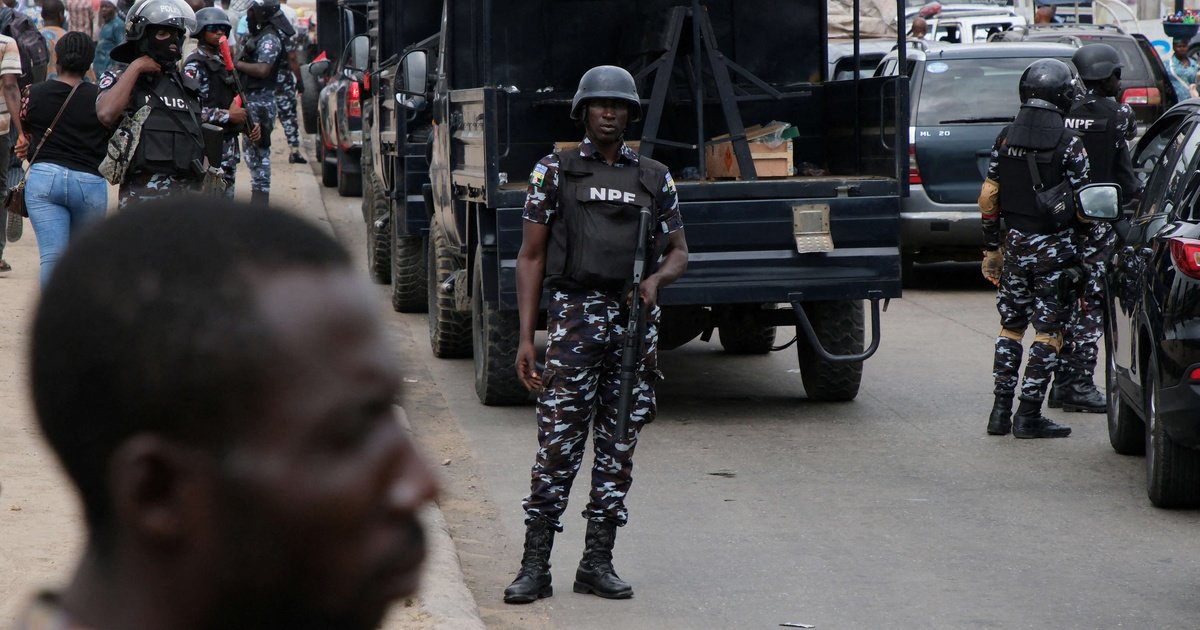
Last week, following public outrage and harsh condemnation by various civic-minded groups within and outside the country, the Speaker of the Nigerian House of Representatives, Tajudeen Abbas, decided to pull a bill that he first introduced back in July, and which had already passed its first reading in the lower legislative chamber.
Among other things, the so-called Counter Subversion Bill 2024 recommended a combination of severe fines and lengthy jail terms for “offenses” as specific—if absurd—as “failure to recite the national anthem or pledge;” and as ambiguous as “insulting, defaming, or bringing disrepute to (sic) community, religious or government leaders (sic),” “disobedience to authority,” “disregarding Nigerian sovereignty,” or “threatening national security.”
More on:
Sub-Saharan Africa
Nigeria
Demonstrations and Protests
Civil Society
To critics of the bill, it was clear enough that it had nothing to do with any of the justifications that Mr. Abbas had put forward and everything to do instead with what they saw as “an attempt to crack down on dissent,” especially in the aftermath of the recent nationwide #EndBadGovernance protests. Isa Sanusi, Director Amnesty International (AI) Nigeria, noted as much, describing the withdrawn legislation as “misplaced,” “ill-timed,” and liable to being used to “impose incredibly harsh punishments” on critics of the government. For the Take It Back Movement, one of the groups which coordinated the protests, the Counter Subversion Bill “contradicts the core principles of freedom of speech, freedom of assembly, and the freedom of demonstration, that underpin any democratic society.”
Considering the strength of the objection to the bill and, subsequently, the speed at which its sponsors were made to jettison it, it is understandable that its withdrawal is being celebrated as a victory for political opponents of the Bola Tinubu administration and civil society more broadly. Eager to make the best of an embarrassing situation, the Speaker of the House described his decision to pull the bill as both a “response to the voices (sic) and concerns of the people” as well as a “commitment to ensuring that the House of Representatives remains a true representation of the people’s will.”
While the abandonment of the bill is undoubtedly worth celebrating, it would seem more pertinent to ask why such legislations aimed at pacifying civil society and consolidating state power in the process enjoy such a high rate of resurrection, not just in Nigeria, but in other parts of Africa. The Counter Subversion Bill, it is worth underscoring, is merely the latest in a series of attempts by successive authorities since 1999 to put a gag on critical opinion and perceived “enemies of state.”
For example, at different times during his tenure, President Muhammadu Buhari (2015- 2023) tried to ram through an “Anti-Social Media Bill” designed to prohibit online statements “deemed likely to be prejudicial to national security” or “diminish public confidence in the government,” before finally getting his way with a seven-month Twitter ban between June 2021 and January 2022. In October last year, in what may be rightly regarded as a precursor to the Counter Subversion Bill, the Tinubu administration attempted to repeal and reenact the National Broadcasting Commission (NBC) Act of 2004 in order to “regulate digital platforms” and rein in a social media that Balarabe Ilelah, Director General of the Commission, had referred to as a “monster.”
What explains this massive appetite for repressive laws and egregious violations by civilian administrations? The conventional explanation is that it is a holdover from the previous military era, implying that it is natural for a society that languished for so long under successive military juntas to exhibit the idiosyncrasies noticed across Africa’s post-military landscape.
More on:
Sub-Saharan Africa
Nigeria
Demonstrations and Protests
Civil Society
Not only is the argument for post-military trauma apparently sound, it seems easily substantiated. Whether as witnessed by the institution of the First Lady, an office unknown to Nigerian law; the culture of entourage (Exhibit A: the first female student union president of the University of Calabar and her 50 odd “advisors”); the tendency of trade unions to “negotiate” through ultimatums; and perhaps most important, the sheer coarseness of everyday social intercourse, mediated by violent communication, democratic Nigeria continues to live in the shadow of military rule. From this perspective, the threat to normative excellence and social harmony flows from top to bottom, and any attempt at redress must take this as a departure point.
While not denying or downplaying the impact of military rule on Nigeria and other African countries, the importance of which is attested to by a vast literature, it seems justified to observe that the very hypothesis—that military rule as the repository of all contrary norms is the original problem, and hence a regimen of social detoxification is the solution—mirrors and perpetuates a certain state/society binary. According to this binary, because the state is inherently “bad,” society, the hallowed site of “resistance” to the state, must be inherently “good.” The extent to which social anthropologist Peter Ekeh’s influential theory of “the two publics,” with its central postulation of an “amoral civic public” permanently at odds with a “moral primordial public” may have unwittingly canonized this mode of apprehension is an open question.
But what if it was the other way around? What if the military, once you discount the irremediable violence of the institution, learned its worst habits from society? What if, as illustrated by a wealth of examples, the boorishness that we now reflexively assign to the military actually predates the coming of the military to power, and was the prime reason it was able to rule and maintain its hold on power for so long in various African countries? What if, contrary to Ekeh, the “primordial public” was always “amoral”?
No matter how one answers these questions, it is impossible to deny that the well-documented prevalence of antisocial norms and habits (a persistent authoritarian temper being just one dimension) constitutes a challenge to the idea of a virtuous society innocently put upon by a vicious state. Until now, this reality has been largely ignored, partly due to the influence of the aforesaid framing, and partly on account of an otherwise legitimate focus on “institutions.”
It’s time we brought society back in.
