




“………for the 59th edition of the event, Uganda made its first appearance. For a country that has been accused of having no art, this was an unprecedented. And for a country where the National Theatre was put up for sale by the unscrupulous of its putrescent government in favor of an investor erecting a shopping mall!
Matt Kayem on his country at the Venice Biennial
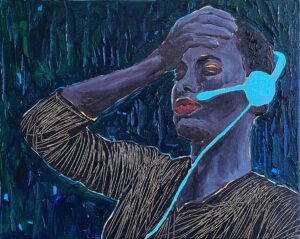
Collin Sekajugo, Stock Image 020 – Too Late, 2022. Ⓒ Collin Sekajugo Studio
For the Ugandans at home, the mysterious art world has its own “World Cup”, which is the Venice Biennale. The bi-annual international exhibition has countries fielding teams inform of pavilions and exhibiting their top artists. And for the 59th edition of the event, Uganda made its first appearance. For a country that has been accused of having no art, this was an unprecedented. And for a country where the National Theatre was put up for sale by the unscrupulous of its putrescent government in favor of an investor erecting a shopping mall! It is a miracle for such a country to get a spot at the coveted La Biennale di Venezia, a gathering of nations that hold contemporary art like a newborn. These are nations that invest heavily in the sector and thus understand it’s significance. For our country’s story, it was all in the air, that the officials from UNCC, a Ugandan cultural body, can’t fathom what is happening. There speeches all shallow with the usual regurgitated tourism gospel, “come and visit Uganda to see the gorillas”, they blabbered, instead of talking about art. Maybe those who conclude that there is no art in Uganda are right. They base this on the ignorance floating around. But should it be like this for a country that sits on a foundation of the oldest art institution in East and Central Africa, the Margaret Trowell School of Industrial and Fine Art? Perhaps culture and art has no place in Uganda but it found one in Venice. Sad.
Shaheen Merali, a Tanzanian-British, was chosen as the curator of the pavilion by Stjarna.art, a fine arts bureau that now manages Collin Sekajugo and Acaye Kerunen, the artists representing Uganda. Well, it’s another case of a foreigner waving a stick and herding Ugandan artists. Simon Njami has been doing this for the home-based Kampala Biennale. Are Ugandan curators not equipped enough to lead their fellow fellow citizens most especially at a stage like this? For one, it felt like the exhibition was in need of a Ugandan conductor for the whole piece to sound more Ugandan, with some Luganda or Runyakitara tones. Stjarna.art occupies an important position on this project and seems to have an interesting partnership with the naïve Uganda National Cultural Centre and the Ministry of Labor, Gender and Social Development with whom it’s head, Juliana Akonyo Naumo is credited as the Commissioner of the project.
Well then, let’s shelve the politics for later and give most room to the art now. The exhibition, titled “Radiance, They Dream In Time” opened a day earlier from the official opening of the main show, “The Milk of Dreams” at the Giardini. Shaheen, a well-decorated curator/writer does well at keeping with the theme of dreams in his exhibition trickling down from the main show. He extracted the title from James Baldwin’s quote, “I know a lot of talented ruins. Beyond talent lie all the usual words: discipline, love, luck, but, most of all, endurance”. Shaheen confides in me that he feels like ‘radiance’ could have been another word Baldwin could have added. He also picks his initial sparks of inspiration for this from the Created Crane’s crown which is often golden yellowish. We see this radiant color used in the poster as well. Genius. Maybe we should be very grateful as a country to have an intellectual and professional like Mr. Shahen curate our debut at Venice. The catalogue is well-put together, giving a broader perspective about Uganda’s history and contemporary issues. Maybe I would have loved to see more about the contemporary art scene.
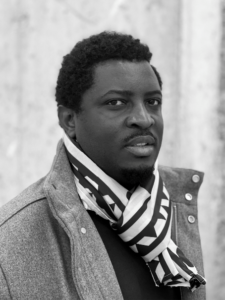
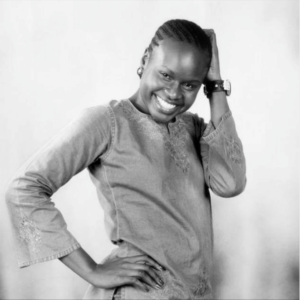
Collin Seka and Acai Kerulen
At the Palazzo Palumbo Fossette, the white walls and Venetian floors of the palace hold together strange objects from the Pearl of Africa – the wares of Collin Seka jugo and Acai Kerulen. In the initial room of the show, we are greeted with Collin’s figurative works on the wall and Acai’s tapestries and installations dancing around, utilizing the three dimensions of the room, their browns and creams captivatingly matching with the dots on the floor. You are then ushered into other rooms and corridors with the two artists’ works side by side or opposite each other. It is a beautiful clash with the abstracted from Acai and the figurative from Collin but yet a symbiotic one. The works seem to talk to each other, lure the other into some sort of marriage, which should be successful. It is the feminine energy from Acai’s weaving and craftwork together with the masculine touch from Seka jugo’s brush strokes, dancing together and showing how it’s done in the East African nation. They dream together in time, as both painting and sculptural traditions advocate a holistic approach to the twenty first century global canon. One room breaks the dual interplay of the artists’ works we are enjoying. The Call Centre Room has a desk with study lamps and Ugandan history books. It sort of says to the predominantly European visitor to the exhibition, “acquaint yourself about Uganda”. The room pays homage to the hardworking individuals at our service centers of telecommunication or online companies. They deal with recurring complaints of that which is seemingly broken.
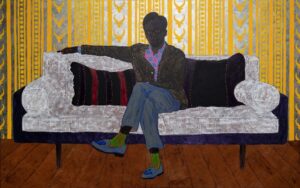
Collin Sekajugo, Stock Image 017 – I Own Everything, acrylic, barkcloth and mixed media on canvas. 2019/2022, 190cm X 300cm (74 3/4” X 118” inches). Photo credit: Maximilien de Dycker Ⓒ Collin Sekajugo Studio
The figure from one of Sekajugo’s works, dressed in bark-cloth, thumbs up, looks familiar. It’s not until I open the catalogue of the show that my memory is choked, it was that image of Richard Branson. Collin makes him a black man in his collage-painting, Stock Image Richard Branson. Collin appropriates from the stock image which usually has white people. He darkens the figures to possibly say that black people deserve to fill these spaces and places too. Since 2012, Sekajugo has worked with the manipulation of the common stock image to reveal its inherent biases of entitlement and privilege largely modelled on the Western self. Sekajugo’s artistic practice highlights a contemporaneous anthropological reversal of this mainstream culture through the lens of a decidedly African sense for irreverence and play on the ad-hoc. Conceptually, the works of Sekajugo become pure theatre, a hacking of identity that exposes some truths behind these stock images that quietly continue to colonize the entire globe by the weight of their own popularity.
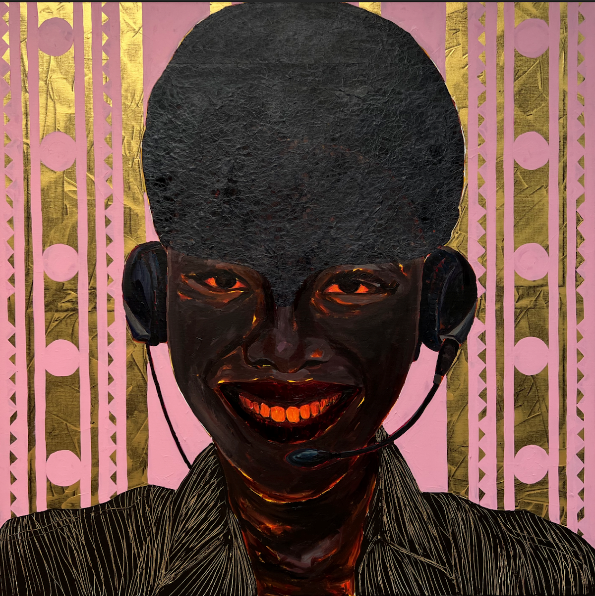
Collin Sekajugo, Stock Image 013 – Engaged, acrylic and mixed media on canvas 2018/2021, 140cm X 120cm (55 1/5″ X 47 1/4″ inches). Photo credit: Maximilien de Dycker Ⓒ Collin Sekajugo Studio
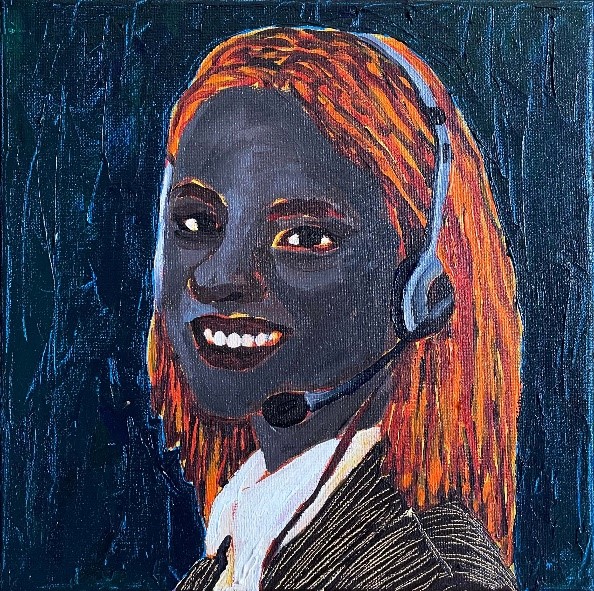
Collin Sekajugo, Stock Image 021 – CALL 1 800 VERMEER, acrylic, 2022, 30 x 30 cm Ⓒ Collin Sekajugo Studio
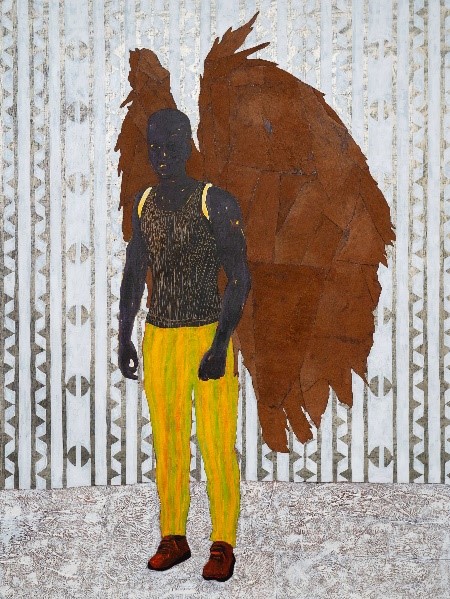
Collin Sekajugo, Stock Image 019 – Party Monster, 2021 Ⓒ Collin Sekajugo Studio
For those who have known Sekajugo for a while, most of the work on show here is simpler to take in, less forgiving to the eye and the brain. Sekajugo’s earlier stuff, which I’ve always loved, consists of abstracted silhouetted figures with stripes, often over-lapping each other. But with this, he paints more, keeps the portraits close to naturalism even though they are still abstracts, appeasing the spirits of the now hot-cake black figure. They are still assemblages though, created using material collected from marketplaces, including gunny and sisal sacks, as well as more elegant fabrics including bark cloth and handwoven fabrics, denim too makes a presence. Also new to this work are the patterned backgrounds, which complete the staged setting ushering in the aura and spirit of calmness, organization and aristocracy. In I Own Everything, a large painting of a metrosexual looking man lounges on a couch, legs cross-legged in a manner suggesting his contentment and confidence. What does he own? Anyway, for the day-one fans, Collin caters to your stuck tastes with a return to his earlier context from 2012 in one of the rooms. He conjures up compositions, which alter identities present in stock images. The stripes are back, the silhouetted figures and image transplants too, an awesome sight for a complex eye.
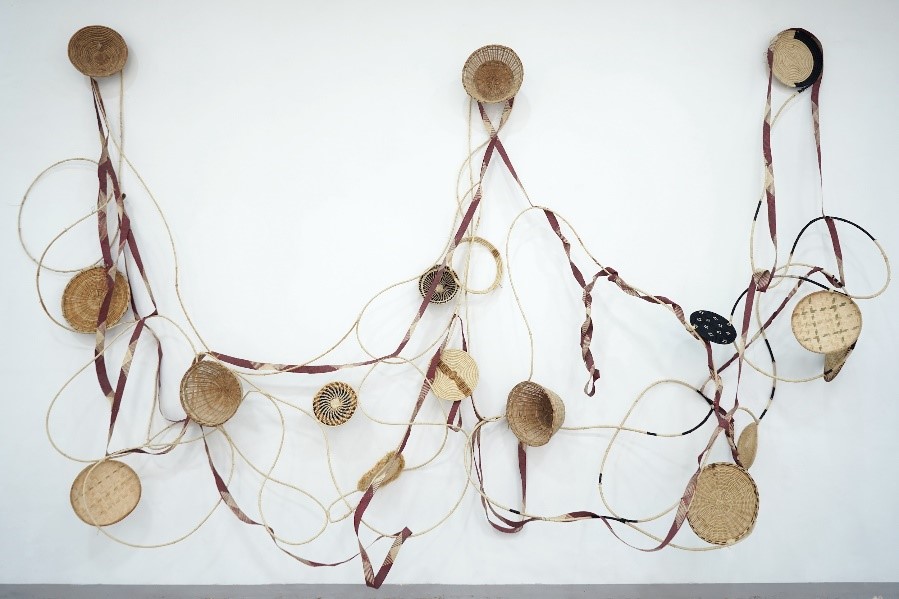
Acaye Kerunen, Kakare, 2021, Mixed media, 370 cm H x 860 cm W x 50 cm D (145 5/8″ H x 338 1/2″ W x 19 3/4″ D inches). Photo courtesy: Ⓒ Acaye Kerunen Studio
Acaye Kerunen’s work has an environmental and sustainable angle to it, tick! If there are any pressing issues to be addressed in the Ugandan spheres, wetland reclamation should be on top of the list. Some of the plants with which Pamela and her gang of women assistants source their raw materials from are only found in Uganda, the fishes too. Acaye Kerunen’s process as a socially engaged artist therefore foregrounds the work of these local and regional Ugandan craftswomen, celebrating them as integral collaborators and elevating the artistic practices of local artisans who are the gatekeepers of their local wetlands, drawing upon a sacred and unspoken knowledge of ecological stewardship. Acaye places the handiworks of these women in elite circles, in white walled galleries and now Venice to tell us, the ‘high’ class that these people are actually smarter than we are. We are the number one barrier to their source of livelihood but also greatly to the environment we destroy because we want a block of flats. She tells the European crowd in Venice, the descendants of colonizers that our great grands were…
