




Dar es Salaam. Navigation towards exploiting Tanzania’s advantage as the most strategic gateway to eastern and central Africa has been slow. It has been sailing through surely and steadily, though, as a panamax vessel sails towards the entrance of the Dar es Salaam port in a warm evening.
The decades-long cries of concerns and calls of “something should be done” made many blind to the progress being made to realize Tanzania’s potential as a maritime country.
A number of plans and strategies that were initiated, as stipulated in various government documents, and various projects are taking shape and eventually unfolding to position the country as the main gateway in the region.
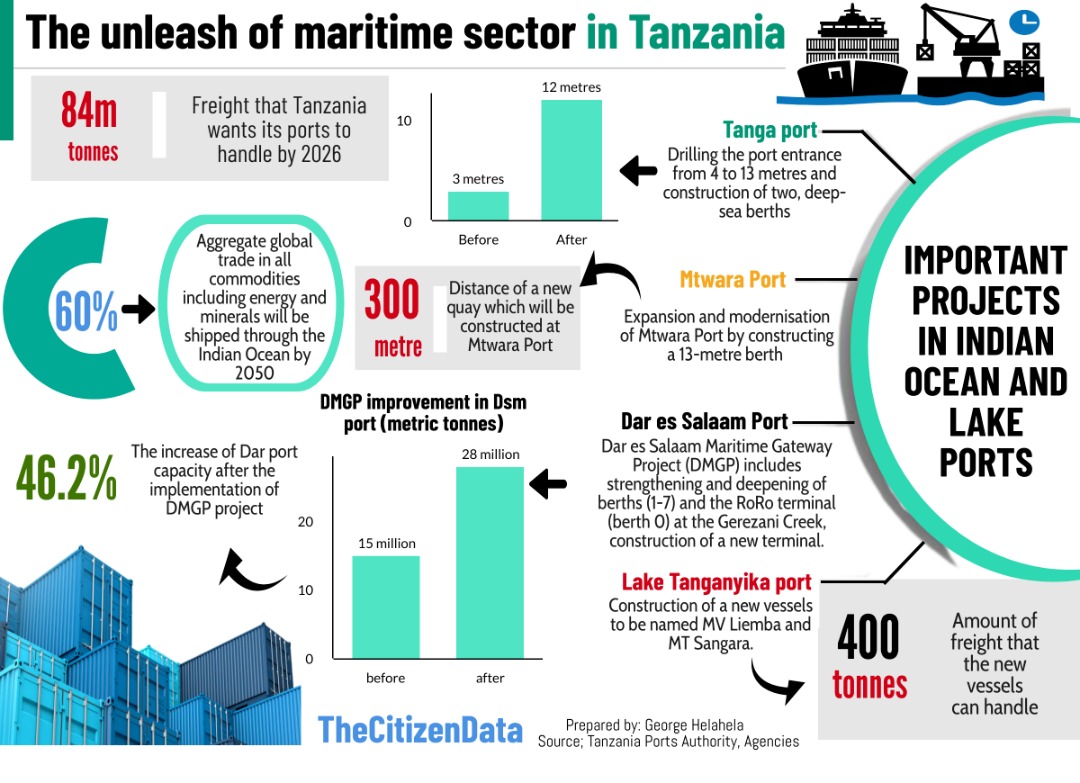
Tanzania wants its ports to handle 84 million tonnes of freight per annum by 2026, according to its 2015-2021 five year plan. This is an ambitious goal with the current implementation of the projects. There would be no wind strong enough to prevent the country from reaching there.
In setting such ambitious goals the government is acutely conscious of Tanzania’s strategic geographic location. “Having direct access to the Indian Ocean with a long coastline (about 1,424km) and located at the centre of the east coast of the African continent, Tanzania has the potential to become the least-cost trade and logistics facilitation hub of the Great Lakes Region as it links up with global markets,” reads part of the 2015-2021 Five-Year Plan.
The document further says that Tanzania is, by its location, a traditional bridge, and a place of physical intersection of the transport corridors which link the markets of the Tripartite EAC, Sadc and Comesa regional economic groupings.
It is estimated that by the year 2050, about 60 percent of aggregate global trade in all commodities including energy and minerals will be shipped through the Indian Ocean.
The government says it is determined to seize on that unfolding opportunity by positioning the country among emerging maritime economies using its competitive advantage of a long coastline.
In addition to developing the basic transport infrastructure, starting with the ports, the government is also developing economic and trade corridors that ensure maximum benefit from the gateway position.
“Tanzania is naturally poised to become the leading multi-modal transportation and logistics hub with wide scope for regional and global trade facilitation, presented with advantages for shipping, warehousing and bulk storage, serving a number of countries in the hinterland,” the Five-Year Plan says.
It adds; “The logistics cluster would act as a natural magnet to attract manufacturing and processing industries that would readily supply the co-located trading enterprises for transportation and distribution of goods to markets.”
The most important projects currently at different stages of implementation include expansion and modernization of the Indian Ocean ports of Dar es Salaam, Tanga and Mtwara, as well as the lake ports of Mwanza and Kigoma. The establishment of Kwala Dry port, the construction of the Standard Gauge Railways, paving trunk roads and overhaul of the operations of the Tanzania-Zambia Railways Authority (Tazara).
Completion of these projects will cement and deepen the multimodal transport system essential to unclogging the efficiency of the ports.
Overhaul of the North-West Corridor of Tanga Port would have the following projects: modernization and expansion of Tanga port (drilling the port entrance from 4-to-13 metres and construction of two deep-sea berths); development of Tanga special economic zone; rehabilitation and revitalization of operations in the Ruvu–Tanga–Moshi railway line; construction of the Arusha–Musoma Road and the construction of Construction of the Uganda–Tanga oil-pipeline.
Development of the Mtwara Development Corridor involves expansion and modernization of Mtwara Port by constructing a new 300-metre quay, with 13 metres water depth; plans for construction of Mtwara–Liganga-Mchuchuma railway to standard gauge; and Mtwara Petrochemical Special Economic Zone, among others.
In the lake transport the government has had ambitious projects in the Lake Victoria that include; construction of vessels (New Butiama Hapa Kazi Tu, New Victoria Hapa Kazi Tu, MV Mwanza Hapa Kazi Tu); rehabilitation of MV Clarias and ML Wimbi; establishment of a modern shipbuilding yard that can handle vessels weighing between 1 tonne and 40,000 tonnes, with a rail system that can leverage more than one vessel at Mwanza port.
Lake Tanganyika activities include construction of a new vessel that can carry 600 passengers and 400 tonnes, rehabilitation of MV Liemba and MT Sangara. In Lake Nyasa construction of two barges each with capacity to carry 1,000 tonnes; and construction of MV Mbeya II.
Expansion and modernization of Dar es Salaam port under the Dar es Salaam Maritime Gateway Project (DMGP) is much more impactful. It includes strengthening and deepening of berths 1-7 and the RoRo terminal (berth 0) at the Gerezani Creek, dredging of entrance channel, turning circle and harbour basin, strengthening and deepening 8-11, and construction of a new terminal jet. The RoRo terminal is for offloading vehicles and other moveable equipment.
After the DMGP is completed it’s possible the government could develop a modern terminal with two berths (13 and 14) to match the increased traffic. “The terminal will include the quay of minimum 750 meters length,” reads the Five Year Plan.
The DMGP will increase the Dar es Salaam port’s capacity from the current 15 million metric tonnes annually to 28 million tonnes annually.
Another impactful project is the $10 billion Bagamoyo port. President Samia Suluhu has given the green light for the project after initial hesitations by the late President John Magufuli. Once completed the port will be the largest in eastern Africa and will help transform Tanzania into Africa’s main gateway.
What makes the current undertaking of all these marine transport strategic is the fact that the government is also overhauling the railway and road infrastructure. The construction of the first phase of the Standard Gauge Railway is in advanced stages. The rehabilitation of the Metre Gauge Railway (MGR) is also in advanced stages.
Key decisions taken over to allow private train operators in the Tazara is coming off as the secret to unlocking the Cape Gauge Railway’s potential that connects the country all the way down to South Africa by rail. The improvement of the maritime hard infrastructure has gone hand in hand with the overhauling of the soft infrastructure. The government has already introduced electronic systems that have made cargo processing and clearing easier. These systems include; the Electronic single window, which has reduced paper work and has also removed the need to go physically to multiple government agencies and regulatory bodies to lodge documents as all that can be done digitally; the Tanzania Customs Integrated System (Tancis) that has taken over the functions of Asycuda ++ and has facilitated electronic customs clearance; the Integrated Electronic Payment System (IePS) that is connected to the Government Electronic Payment Gateway (GePG) to enable port customers access their invoices and make payments through multiple payment channels even at night and during the weekends and public holidays.
All these systems have made the 24/7 port operation arrangement possible, according to officials. The construction of the 36- floor skyscraper was meant to create a One Stop Centre (OSC) by bring together all key port operators; port managers; freight forwarders, customs officials; government agencies and regulatory bodies, and so forth, under one roof to facilitate consultation and engagement as well as reducing the need for customers to travel long distances to process documents.
