
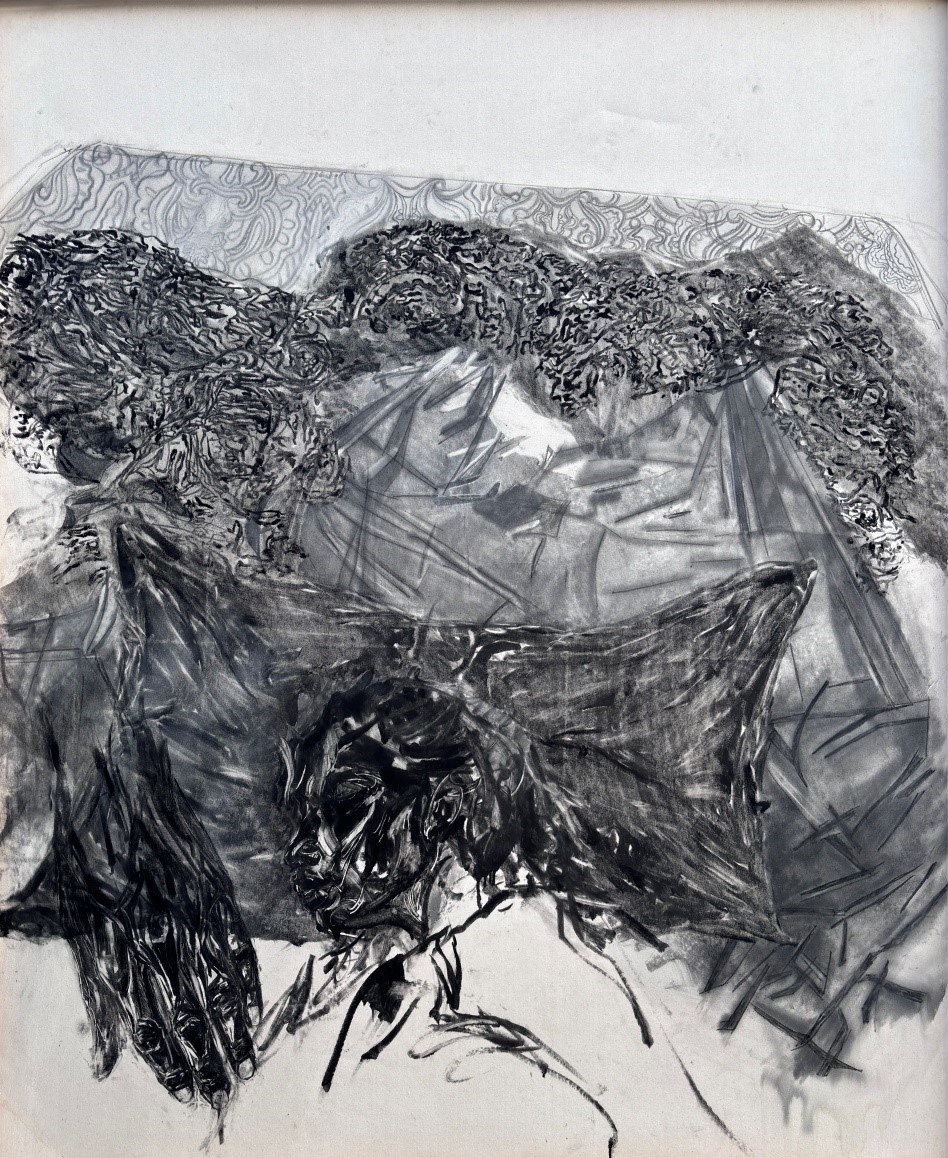

Tiemar’s work redefines printmaking, challenging its conventional boundaries while infusing it with new layers of meaning that resonate deeply with both the personal and collective experience.
Dagim Abebe on the work of the Ethiopian artist Tiemar Tegene
Tiemar Tegene and the New Vanguard of Ethiopian Printmaking
Tiemar’s art is a bold and uncompromising fusion of intellectual depth and raw emotional power. The meticulous care with which she prepares her plates reflects an unwavering commitment to technical mastery, while the visceral energy of her prints transcends experiential representation through what Deleuze and Guattari (1987) might call a ‘line of flight’ – a rupture from conventional visual language (p. 9). Watching her at work, whether in the solitude of her studio or amidst the intensity of an exhibition, is to witness an artist engaged in an urgent act of self-expression. There is an unspoken intensity in her process, a fusion of intellectual clarity and unfiltered emotion that gives her work its unique potency. Her prints command attention, demanding deep reflection and challenging viewers to engage with the complexities of memory, identity, and history-contested sites of meaning (Nora, 1989, p. 12).
Having had the privilege of observing Tiemar’s artistic evolution since our fine art school days, I can attest to the remarkable clarity and power of her artistic voice. Each piece, from her earliest explorations to her most recent works, is a bold declaration of intent. Her approach to printmaking far from a technical exercise; instead, she transforms it into an intellectual and deeply personal investigation that echoes Homi Bhabha’s (1994) notion of ‘cultural hybridity’ (p. 38), where traditional techniques collide with contemporary critique. Her work straddles the line between abstraction and figuration, between personal narrative and universal truth, and between historical excavation and contemporary reinvention.
Her work is deeply enmeshed in Ethiopia’s cultural memory, serving as both a reflection and a provocation. By pushing the boundaries of materials, techniques, and abstraction, she compels both herself and her audience to rethink the layers of meaning that shape personal and collective histories. Negative space, textures, and the layering of ink become an intricate visual language, a method of excavation that unearths both suppressed narratives and emergent possibilities. Her printmaking is can be seen as an act of resistance-an assertion that history is not static but an evolving dialogue.
Tiemar’s fearless engagement with printmaking as a medium of personal and social inquiry positions her at the forefront of Ethiopian contemporary Print Making. Her work becoming a testament to her creativity but also an emblem of the dynamic potential of a new generation of Ethiopian artists. She challenges conventions, redefines the role of printmaking, and creates work that lingers in the viewer’s mind long after they have left the gallery. Each mark, each layer, and each calculated decision carries the weight of memory and the urgency of reinvention embodying Stuart Hall’s (1990) concept of ‘cultural identity as becoming’ (p. 225).
Printmaking as Subversion: A Medium Reimagined
Printmaking, historically regarded as secondary maybe even tertiary to painting within Ethiopian art, since painting has long held a dominant position deeply rooted in traditional church iconography and extended into modern and contemporary art movement, is radically repositioned in Tiemar Tegene’s practice. Her unwavering dedication to printmaking is not just an artistic choice but a revolutionary act. By claiming this medium as her own, she challenges established hierarchies, asserting printmaking as an equally potent language for articulating the complexities of identity, memory, and transformation. Her work dismantles the traditional perception of printmaking as subordinate to painting, proving that it is not just a process but a conceptual and expressive force capable of shaping contemporary discourse.
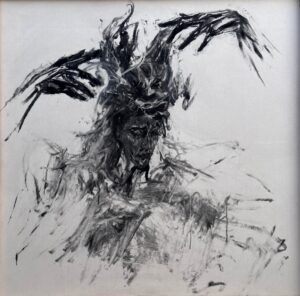

© Tiemar Tegene, 2025. Image courtesy of the artist
Her printmaking is an act of defiance against the constraints of tradition. Typically seen as a medium of reproduction, printmaking in her hands becomes a site of disruption and reinvention. She transforms it into a vessel for intricate storytelling, layering meaning beyond the purely visual. The interplay between absence and presence, permanence and transience, underscores her commitment to excavating forgotten or suppressed personal histories. By engaging with the limitations of the medium, she turns them into strengths – experimenting with unconventional materials, non-traditional printing techniques, and compositions that resist easy categorization.
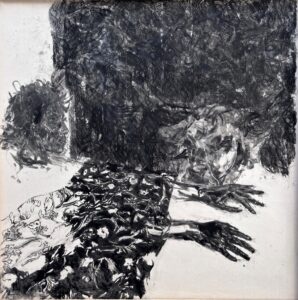

© Tiemar Tegene, 2025. Image courtesy of the artist
Tiemar’s work disrupts the expectation of printmaking as static or formulaic. She pushes the limits of printmaking’s physicality, creating works that are as much sculptural as they are graphic. Through bold compositions and layered surfaces, she creates prints that appear almost to breathe – each layer offering new depth and interpretation. This approach reflects the unstable nature of memory itself, capturing the fragmented and shifting narratives of personal and collective history. Her manipulation of texture, ink saturation, and scale forces the viewer to confront the medium on new terms; challenging the assumption that printmaking is about replication.
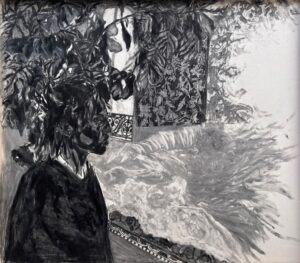

© Tiemar Tegene, 2025. Image courtesy of the artist
Through a process-oriented approach, Tiemar turns each mark, layer, and texture into a deliberate act of meaning-making. The physicality of etching, inking, and pressing parallels historical excavation – her hand becoming both a recorder and an interpreter of the past, Her textured surfaces enact Stewart’s (2007) notion of “ordinary affects” (p. 15), where materiality itself communicates cultural memory beyond representation. These marks are not ornamental; they are coded messages, revealing and obscuring in equal measure, engaging the viewer in an unfolding dialogue. The layering within her work does not simply build form; it creates a tapestry of meaning, where the past is always present, yet never fully knowable. Through this practice, she realizes what Oguibe (2004) envisioned for contemporary African art: “a medium becomes revolutionary when artists weaponize its marginality” (p. 59).
By reclaiming printmaking as a subversive and radical medium, Tiemar reshapes its place within Ethiopian contemporary art. Her work is not just about creating imagery but about questioning artistic hierarchies, reclaiming lost narratives, and forging new ones. In doing so, she transforms printmaking from a historically overlooked discipline into an essential means of cultural interrogation and resistance.
Themes of Memory and Her Surroundings
At the heart of Tiemar Tegene’s art lies a rigorous engagement with memory and place, both of which function as essential building blocks for her creative inquiry. Her prints serve as visual palimpsests, layered with forms and textures that evoke the fragmented and shifting nature of recollection. In this way, her works not only depict memories but embody Connerton’s (1989) concept of “embodied memory practices” (p. 72), intertwining the past with the present and illustrating the complexity of human experience over time. These layered compositions suggest that memory is both a repository of past events and an active, evolving force that continues to shape identity and perception.
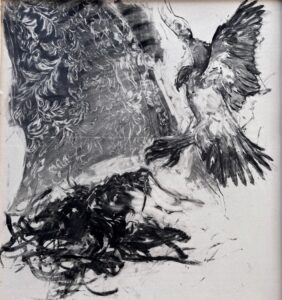

© Tiemar Tegene, 2025. Image courtesy of the artist.
Tiemar inscribes time itself into her work, reflecting its dual nature – simultaneously permanent and fragile. This tension is evident in the ways she explores how memory can endure while also dissolving or transforming with each passing moment. Her fusion of abstraction and figuration visually articulating Hall’s (1990) notion of identity as “a production which is never complete” (p. 225). In doing so, she presents identity as a fluid, dynamic concept, constantly reshaped by time, place, and experience.
Her ability to distill complex emotional states – such as loss, nostalgia, and hope – into tangible visual language is a testament to her mastery of printmaking as a medium for emotional and intellectual expression. Through each stroke, texture, and imprint, she creates a poetic meditation on impermanence. Her prints, though grounded in the personal, transcend individual experience, inviting viewers to reflect on their histories, emotions, and the transient nature of human life. The physicality of her medium – its tactile, layered qualities – adds a depth of resonance to her exploration of these themes, making the intangible nature of memory and emotion something palpable.
Beyond personal introspection, Tiemar’s practice serves as a broader inquiry into Ethiopia’s evolving cultural consciousness. By interrogating the cultural shifts and transformations that have taken place in Ethiopia, her work prompts a critical examination of how traditions, histories, and identities are continuously reshaped by the forces of time and societal evolution. Her prints become not only a reflection of cultural memory but also a catalyst for dialogue about cultural identity in a time of flux. Through this lens, Tiemar’s work challenges viewers to reconsider the way they understand the intersection of history and culture, urging them to engage with the complexities of change, continuity, and the ongoing negotiation of national and personal identity.
Tiemar Tegene’s artistic evolution has been marked not only by fearless experimentation but also by the profound influence of collaboration – an element central to the richness of her work. While her vision has been a driving force in her career, it is…