
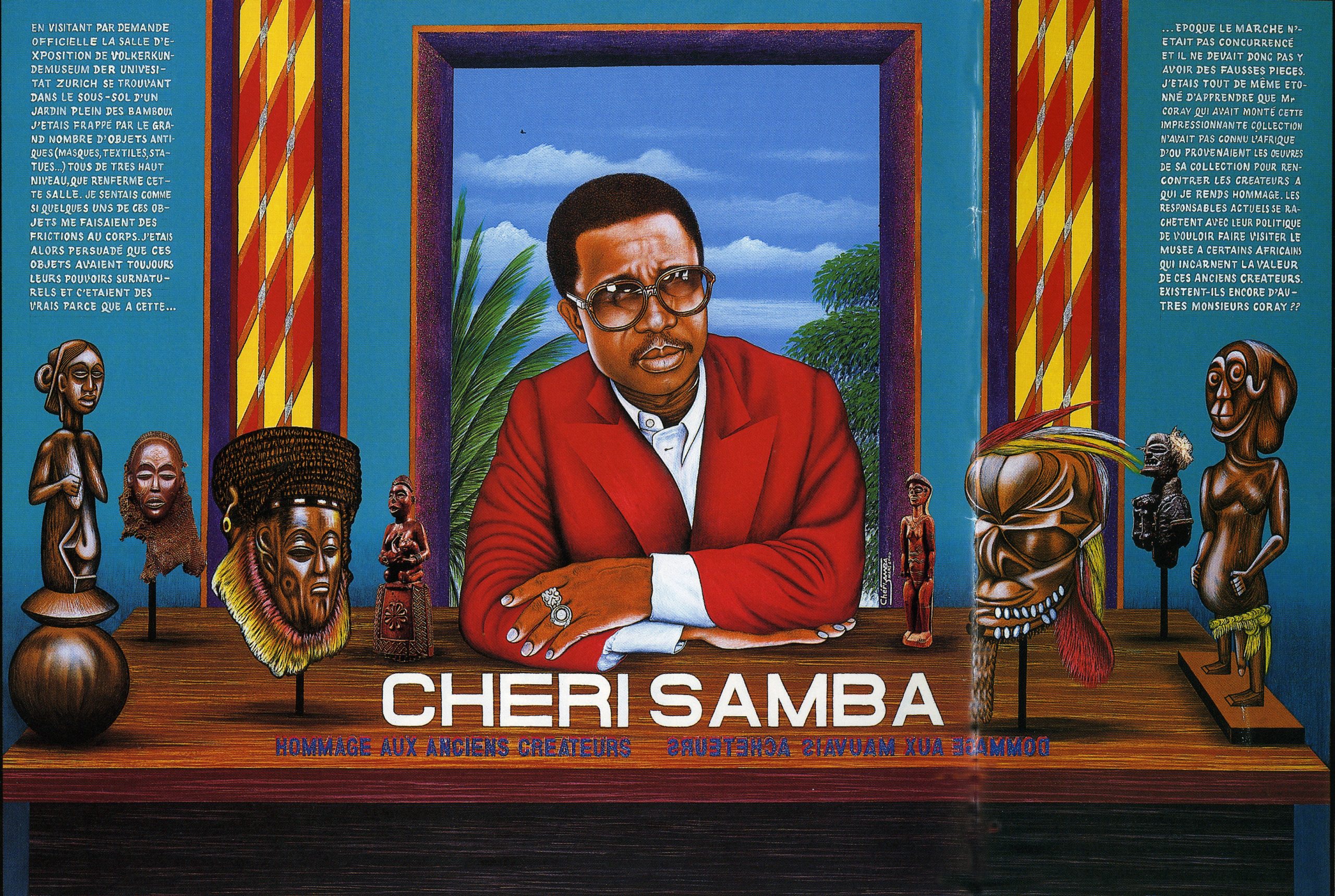
Across five decades, Chéri Samba has chronicled the politics and poetry of everyday Congolese life, insisting that art belongs to the people who live it.

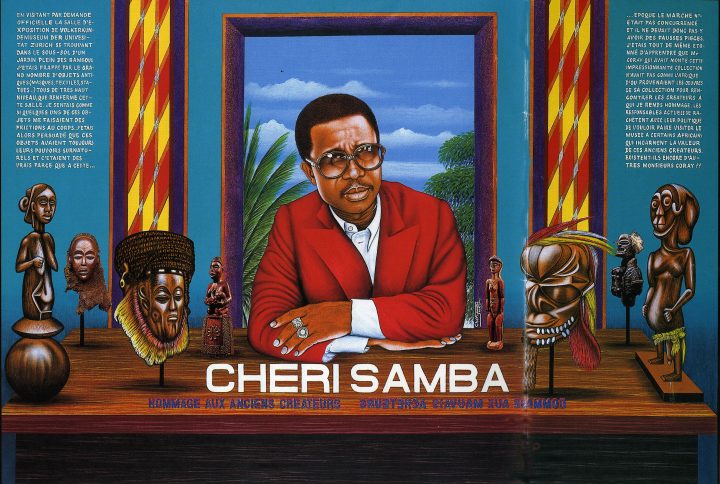
Chéri Samba is the undisputed king of popular painting from the Democratic Republic of Congo. Over the last 45 years or so he has been depicting the everyday concerns of his countrymen and women, reflecting on everything from education, morality, sexuality, and corruption in his paintings, using himself as a subject to comment on the social and political realities in his country. These scenes are depicted in his trademark style of humor, in vivid color, and often accompanied with text in his native Lingala or French.
Born in 1956, Samba’s artworks first came to international attention in the 1989 exhibition Magiciens de la terre (Magicians of the Earth) at the Centre Pompidou and the Grande Halle de la Villette in Paris. Since then, his artworks have been exhibited at the Museum of Fine Arts in Houston; the National Museum of African Art in Washington, DC; the Guggenheim Museum Bilbao; the Tate Modern in London; the Cartier Foundation for Contemporary Art in Paris; the Louis Vuitton Foundation in Paris; the Museum of Modern Art in New York; the Venice Biennale; Documenta; and other places. Riason Naidoo met up with Chéri Samba in Paris in 2020 at galerie Magnin-A in Paris.
- Riason Naidoo
-
This painting is fun, J’aime le jeu de relais (I Like the Relay Game), 2018.
- Chéri Samba
-
The relay game, yes. I like it because you don’t want old people to spend all the time in the positions they hold. They would still have to have the spirit of wanting to leave room for young people too. If we have to appropriate places from young people all the time, why then do young people study? Why have children if we do not allow time for them to move on in life as well? That’s why I like the relay game. Let children take the place that adults have previously occupied.
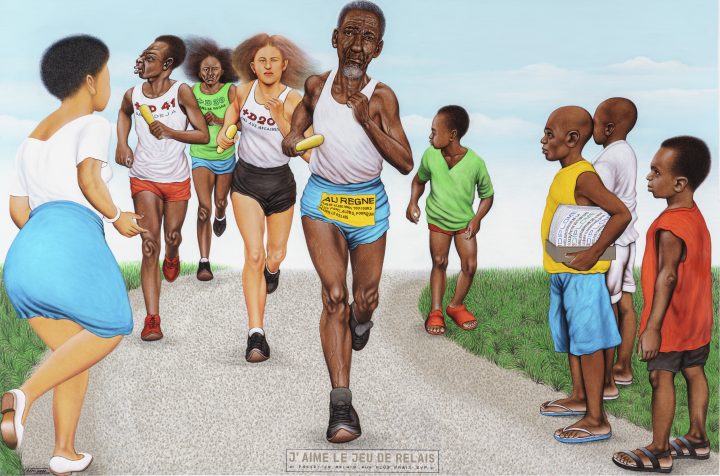
J’aime le jeu de relais, 2018. (I like the relay game) © Florian Kleinefenn. - Riason Naidoo
-
You say you were born an artist. Can you expand on that?
- Chéri Samba
-
When you come into the world, you don’t choose what you should be; it’s like, in a curious way, doing a job you didn’t choose. When I was a child, I saw myself drawing something in the sand; like everyone else, every child needs to play, to play in other skies. I had no materials. I used my fingers to scribble something in the sand, and little by little when I was in school I started to have some white paper with the ballpoint pens. With pencils, I was making drawings. I copied comics from the entertainment magazines that were all the rage at home in Kinshasa. I would keep them in notebooks; it was my hobby. My fellow students bought it. That’s why I said later I was born an artist. I didn’t choose it, it just happened.
- Riason Naidoo
-
You’ve been in Kinshasa ever since you moved there from your village as a young man. What is so special about Kinshasa?
- Chéri Samba
-
Kinshasa is the city to which I am drawn, but I was born in Kinto M’Vuila in lower Congo eighty kilometres from Kinshasa. We do not choose the place of birth. After dropping out of school, I preferred to go to Kinshasa because almost everyone wanted to live in the capital of the Congo. It is a desire. I changed my studio recently [after many years] from the corner of Avenues Birmanie and Cassa Boubou to 250 Avenue Commerciale, and that is where I am, until now.
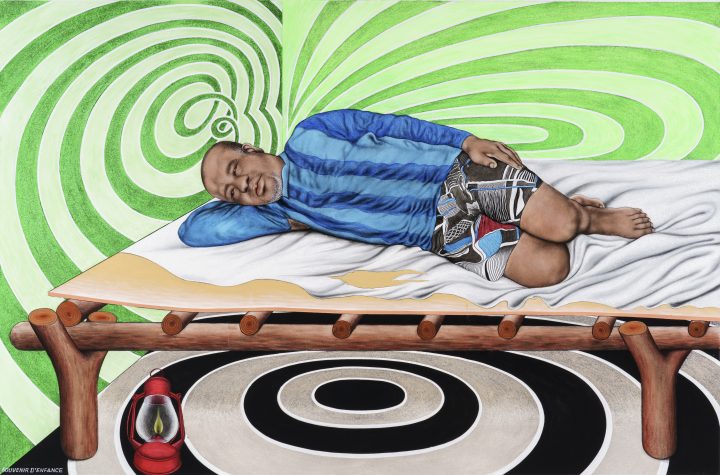
Souvenir d’enfance, 2020. (Childhood memory) © Florian Kleinefenn. - Riason Naidoo
-
Who were the artists that inspired you in then Zaire?
- Chéri Samba
-
Frankly, I didn’t have a role model. At the beginning, it was as if I existed all alone in the world. It was just after several years [of being an artist] that I heard about others. I thought I had to try to see what these artists were about. We got together, we rubbed shoulders, but I wanted to be true to myself. As we are at the show of three artists [now in Paris], the other two being Bodys Isek Kingelez and Moké; they were my colleagues, my friends. They came on stage before me, and I appreciated their work. I met them; they accepted me. Each one was different.
- Riason Naidoo
-
What makes your work different from theirs?
- Chéri Samba
-
Isek Kingelez, he was a model maker, so that was a big difference between painting and models; Moké, a painter. We can see very well that the processing of my images is not the same. I preferred to do a little realism … even if it could have a little flaw. There is another difference: I wanted to put some text in my paintings, because before I set out on this adventure, I didn’t believe it. I couldn’t see a painting that bore text, and I almost suffered for it.
The people from the Academy of Fine Arts [in Kinshasa], the teachers from that school (who wanted to take care of my work, while I was not their student) said, “But how can this artist afford to put texts, to write on his paintings? Maybe he doesn’t know how to make his images understood.” I said, “Let me do what I want to do.” My desire is to hold the attention of people in front of my work so that they take time to contemplate my work. There are people who read and understand very quickly everything that is written. I read slowly, word by word; it takes time. I told myself that there might be others like me [who take time to read]; [the text] will delay people in front of my painting. This is what I wanted. This was not the case with my colleagues. That was the difference.
- Riason Naidoo
-
I’ve read that you make up to three versions of the same painting. If that is true, it is very unusual in modern and contemporary art that relies on a unique painting.
- Chéri Samba
-
Sometimes they ask me, “Why make the painting in several versions?” Before Chéri Samba, there were also other painters who did paintings in a series. In my case, if I paint the picture several times, it’s because there are paintings that I don’t want to sell.
If I paint a subject, I would like everyone to see it so that it circulates all over the world. I, myself, would like to keep a copy so as not to take photos or make prints, as you say. Sometimes, I wanted to do it again for myself. It happened to me that a painting that I might reserve for myself ends up in someone else’s home. There is already an existence of this subject, which is already gone. I think to myself that it is not good that I repeat the same subject for someone else who is interested. But the person concerned tells me, “No, I want that,” and there are some who asked me for the third, fourth, fifth, sixth version of the painting, and I said to them “No!” In this case, I like to limit myself to three versions, so it was not me who chose, but it is the requests that I receive that resulted in the additional versions. I was surprised that there were back-and-forth requests, demands from so-called art connoisseurs who asked me to make another version of a painting for them. So, finally, I said to myself, in order for people not to miss the work, I would have to continue. It’s not my choice to reproduce all the time, but what should I do?
I’m talking about the painting, such as I Love Color, also the subject. I think a lot of people liked it, and it hurt me that it was only found at someone’s friends place while everyone wished to see it.
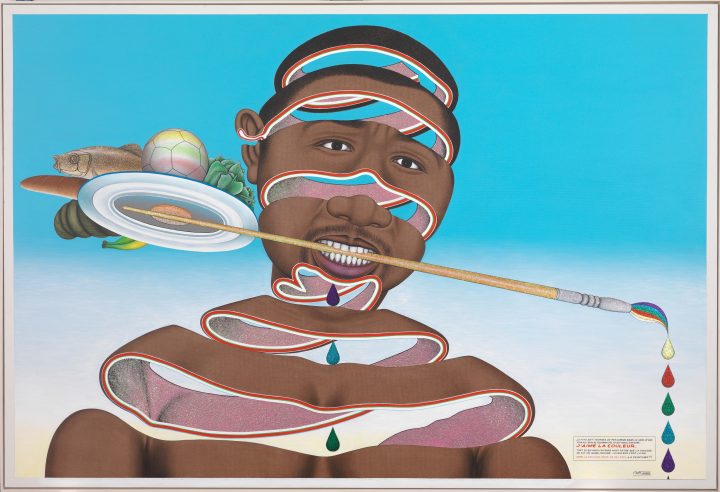
J’aime la couleur, 2010. (I like colour). - Riason Naidoo
-
Could you describe for me the Art partout exhibition in Kinshasa in 1978 and the atmosphere around it?
- Chéri Samba
-
I think it’s one of the exhibitions that also shed a lot of light on the thought that if art did not exist only at a given point in the world, it did not exist. The idea was to show that there are artists everywhere in the world; that they are not only in the West, as we used to say in the past. And what was a little ambiguous is that we thought that where there are no galleries, museums, there are no artists, and it was a false discussion. Whether there are galleries or museums, artists are everywhere, and art is everywhere in the world; that was the idea behind the exhibition [that took place in the streets].
- Riason Naidoo
-
What do you mean by “paintings with no soul”? What are your thoughts on contemporary art you see in museums around the world when you visit?
- Chéri Samba
-
I was just saying that there are things you can easily understand and things you don’t. I compared a little the work dictated by the so-called connoisseurs in the fine arts schools and there, I said, there are works, which sometimes, the people for whom the works are intended had difficulty understanding the message. It’s not to say it was well done or that it was bad—no. The message is only for initiates, art connoisseurs, insiders.
If someone wants to challenge the conscience and wants to talk with these…


