



In September 2021, Ghanaian filmmaker King Ampaw’s feature film “They Call It Love” (1970) was part of a curated series of films set in Germany by “migrant” filmmakers at Frankfurt’s Film Museum. The film follows Paul (William Donald Powell), a former American GI, who gets by as lead singer of a band in the wake of the 1968 cultural revolution in Munich. The band regularly plays in a hotel bar frequented by former GIs and their white German girlfriends. Paul is simultaneously engaged in an affair with Linda, a sales assistant at a record shop he frequents, and the wife of the friendly, oblivious record shop owner (Linda’s boss). Paul’s monotonous life plays out between the hotel bar, his adjacent studio apartment, and the rare night out on the town or a visit to the suburbs. He secretly despises his lackluster, loveless life, muttering “let’s go somewhere else” to one of his bandmates in the pensive closing dialogue of the film, after which they both leave the bar for an undisclosed location.
This particular screening was probably only the second time that “They Call It Love” has ever been seen publicly anywhere in the world. Its 2018 premiere was at Berlin’s Zeughauskino almost 50 years after the film was produced. At the Frankfurt screening, excerpts of an interview with Ampaw—which is available online—were shown instead of his presence. Ampaw speaks about his experiences in both Germanies and neighboring Austria.
Arriving in the German Democratic Republic in 1962, he enrolled at the Babelsberg film academy to study directing but was soon forced to relocate to Vienna’s University of Music and Performing Arts because the national educational agreements between East Germany and Ghana were discontinued. When the first Film Academy opened in 1966 in Munich, West Germany, King was accepted into the first film direction cohort and can be counted among the pioneers of New German Cinema alongside Wim Wenders, Werner Herzog, and others. His thesis film “They Call It Love” was the second film by an African filmmaker to be shot in Germany (the first being Ibrahim Shaddad’s “Jagdpartie” in 1964). Ampaw worked in film production in Germany for a few years before returning to Ghana in 1977 to establish a film production company. He subsequently produced “Kukurantumi: Road to Accra” (1983), “Juju” (1985), and “No Time to Die” (2006), among many others.

The most striking passage of the above interview is when Ampaw reveals that after submitting “They Call It Love”, and receiving his degree, he never saw his film again. It would only resurface in the mid-2010s, finally being shown to an audience five decades after it was produced. Ampaw, who maintains professional and personal connections to Germany, happened to be around and was in attendance. Three years later, another one of Ampaw’s films was shown at the aforementioned Frankfurt screening for the first time. In 12 minutes, “Black Is Black” (1968) explores the challenges of Black people in Germany’s Housing sector. Ampaw’s film creatively documents landlords’ responses to the question of whether they would rent to a Black tenant, which ranges from explicitly racist takes to well-meaning, problematic clichés. Despite their incredible historical and aesthetic value, Ampaw’s films, certainly not the only ones to have suffered this fate in Germany, seem to have simply been “swallowed” by the archive.
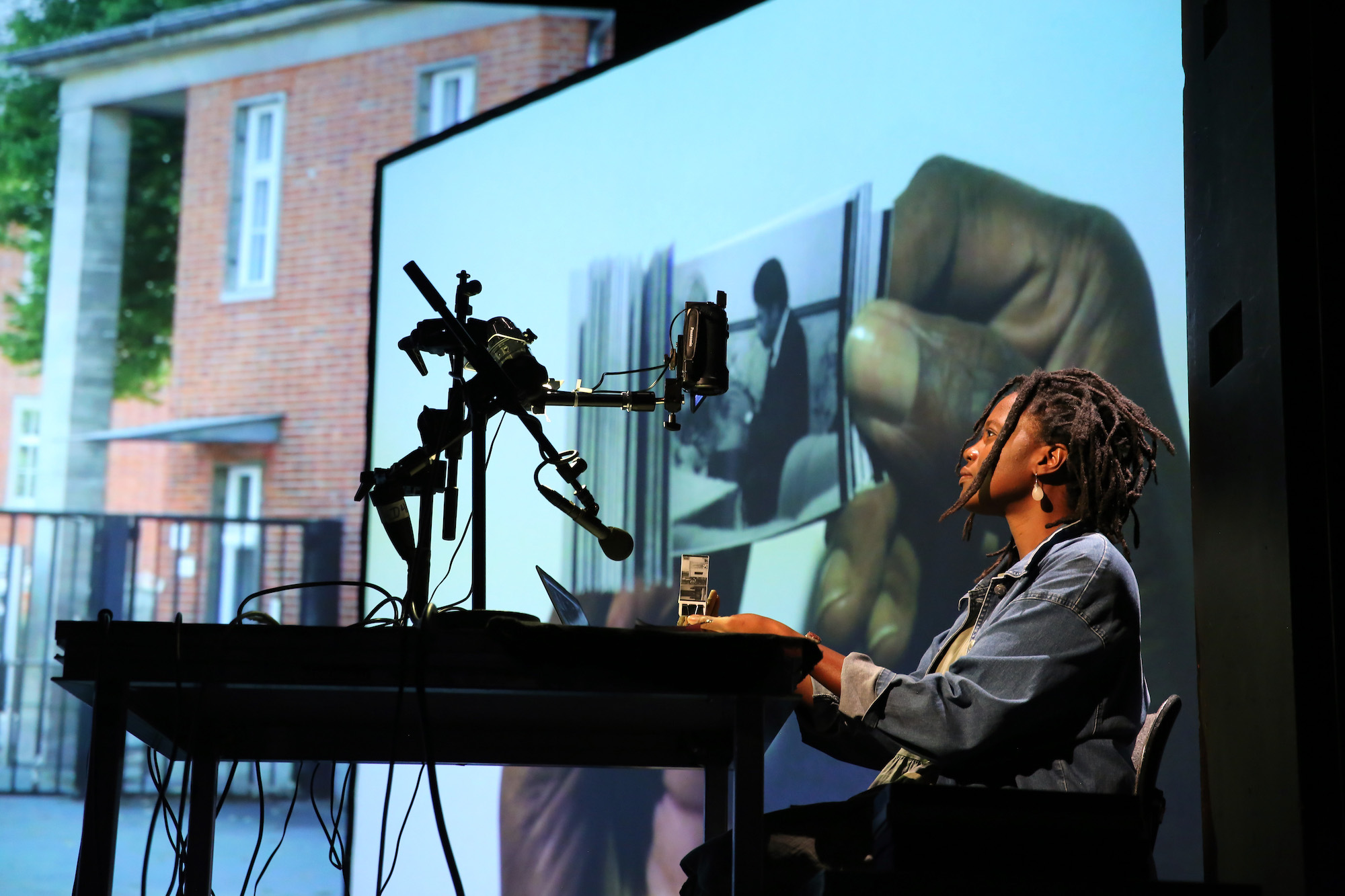
The panel Looking Back 1930 | 2020: Building on Fragmented Legacies at Berlin’s HAU theater, which I moderated in September 2020, discussed how cultural producers can build on overlooked work after painstakingly extracting it from the archive. The panel was preceded by “We Call It Love: An Oppositional Screening” (2018), a performance by filmmaker and film scholar Karina Griffith. Seated at a table covered in assorted film equipment, Griffith was flanked by two huge screens, one of which showed her fingers flipping through hundreds of film stills from “They Call It Love.” Meanwhile, the larger screen showed film material from a camera that Griffith had installed in front of the Federal Archives, Berlin-Lichterfelde. Since 2017, Griffith had unsuccessfully attempted to gain access to “They Call It Love” for her Ph.D. research, but her efforts had been repeatedly frustrated by the Film Archive and Ampaw’s Alma mater, the HFF Munich. To symbolically represent the archive that readily takes but rarely gives, the large screen showed footage of the closed gates of the archive intercut with excerpts from an interview that Griffith did with Ampaw in 2018.
