

With Ellah Wakatama; interview by Doseline Kiguru.
Date: 9 December 2024.
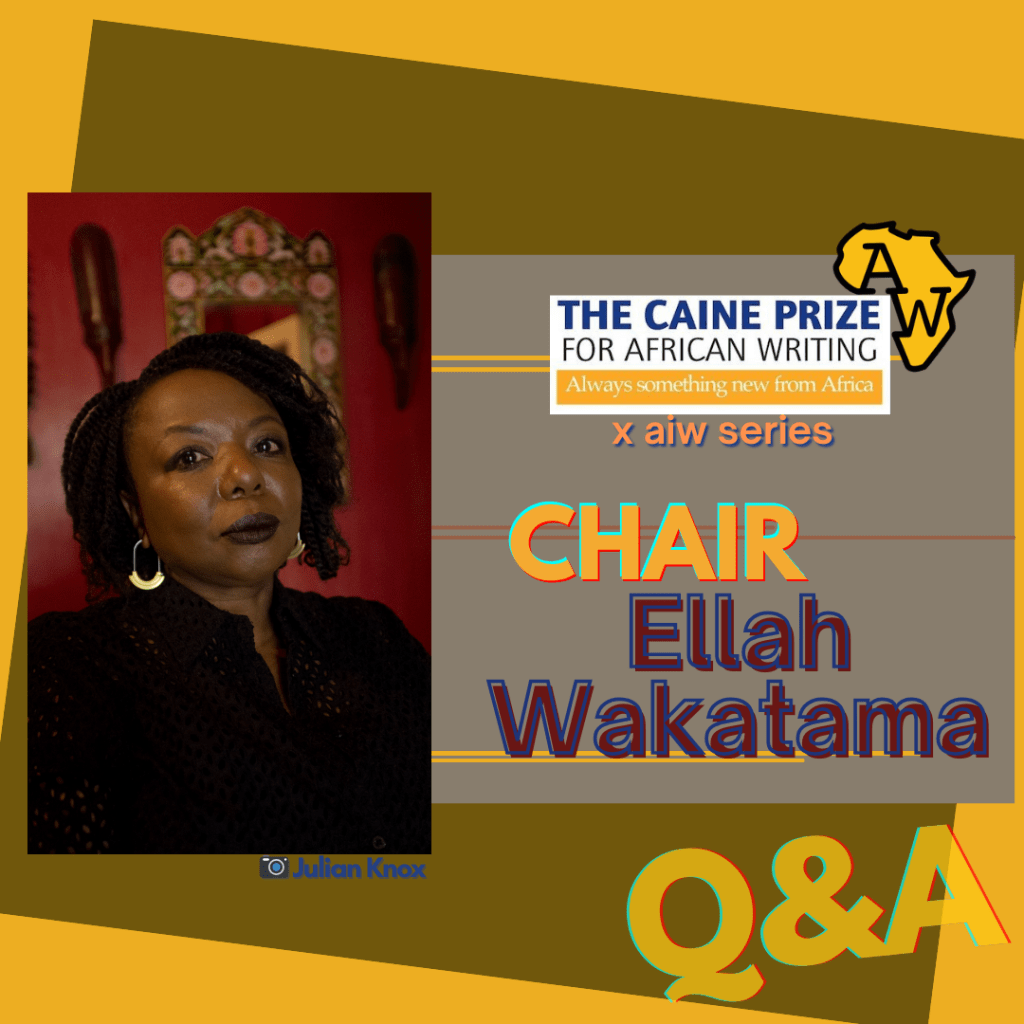
On the publication of the latest Caine Prize for African Writing short story anthology, Midnight in the Morgue and Other Stories (Cassava Republic Press), our focus on the 2024 edition of the Prize turns to look forward into 2025, the Prize’s anniversary year, as we extend our attention to the behind-the-stories, administrative level of this award.
In this interview, Africa in Words spoke to the Chair of the Prize, London-based editor and critic, Ellah Wakatama, OBE, Hon. FRSL., currently Editor-at-Large at Canongate Books and a senior Research Fellow at Manchester University.
Through this conversation, our aim was to extend our discussion beyond the literary text, and explore the different cultural and social contexts that continue to shape this Prize and platform that has become so significant for contemporary African literary production.
In “Once Upon a Time Begins a Story…” (the editorial article of the 2013 special issue of the journal African Literature Today, ‘Writing Africa in the Short Story’), the literary critic Ernest N. Emenyonu demonstrated the importance of the Caine Prize, arguing that no other contemporary cultural institution had a greater impact in foregrounding individual African writers at the global literary marketplace. Here, with AiW’s Doseline Kiguru, Wakatama takes us through her background and inspirations as a cultural producer, as well the focus and dreams for this prize body, one of the main canon producers of African literatures today.


Doseline Kiguru, for Africa in Words: Thank you so much, Ellah, for speaking with Africa in Words. We have a longstanding interest in, and have been doing a series of interviews with African literary producers, and today we’re thrilled to speak with someone heading the Caine Prize for African Writing, such a prestigious prize in African literatures.
But before we dive into that, let’s start with you: you are prolific in your field as a cultural producer, as an editor, and a critic. Can you tell us what drove you into this field? What are your passions and the background that led to this point?
Ellah Wakatama: I love that term, “cultural producer”. I think I’m going to steal it from you and use it myself — it could be my on my business card! Thank you very much to you, Doseline, and to Africa in Words, for your continued interest and support of the Caine Prize.
Starting with me… I’m the daughter of a journalist, novelist, and publisher, and in my house, books were really important. But the book I first fell in love with was The Lion, the Witch and the Wardrobe, by CS Lewis; at the time, I was having speech therapy and we were reading that book, so it’s one of those foundational experiences and moments.
In that book, I discovered a place to escape, a place for adventure. Ever since then, reading has been my go to. Throughout my childhood, I was a “book a day” person. I always found time to read, even when I had homework to do. And I read everything; I mean, just everything. Our house was well resourced in terms of books and there was a great library in Harare.
So, I have always been in love with literature. It’s something that is very personal to me, beyond my professional work. And now, being able to reach points in my life where that personal passion is entirely immersed in my work — and not just in the books that I produce and the job that I’m paid for, but also in the work that I help support in my pro bono ventures, as in Chairing the Caine Prize – I’m very fortunate.
Also, apart from having been involved in something myself, so closely, for so many years, I like giving money to writers. I know what a difference it can make when writers are paid properly. So, being the person who is heading up something as significant as this Prize in that regard – it feels really important to me. It is something that I intentionally build in to my work life; I make time so that I can afford to be involved.
But I’m also not only excited and challenged by the reading of the works. Since I started in publishing, I’ve always wanted to be part of the decision-making processes. For too long, others decided which of our stories would be published and how they’d be disseminated. But over the last 15 years, African storytellers and cultural producers have been able to take more control over the production of our works: the editing, the publishing, the distribution of our own stories. Everything that we’re doing at the Caine Prize is born out of that passion, but also the knowledge that the behind-the-scenes work is as important as the book that you’re reading in front of you.
Doseline Kiguru: You’ve touched on a few issues that I would like to pick up on, especially about how we produce literature – the processes that bring us to the actual book. Because before we see an actual text, that you can hold and call it a novel, a short story, etc, it’s gone through a lot of production processes. A body such as the Caine Prize, along with other literary prizes, act as literary producers by influencing the canon formation process.
In the midst of those other producers, like publishers of contemporary African literatures, for example, where do literary prizes place or fit in terms of the hierarchy of canon formation bodies? – and that’s for those prizes that would be open to African writers, whether they are local African produced and funded, or whether they’re external to the continent.
Ellah Wakatama: That’s an important question. I actually think prizes rank pretty highly because that is where writers get their work amplified. And that is where we, as readers and as critics, and as anybody who has any kind of decision-making power, are able to valorise the work.
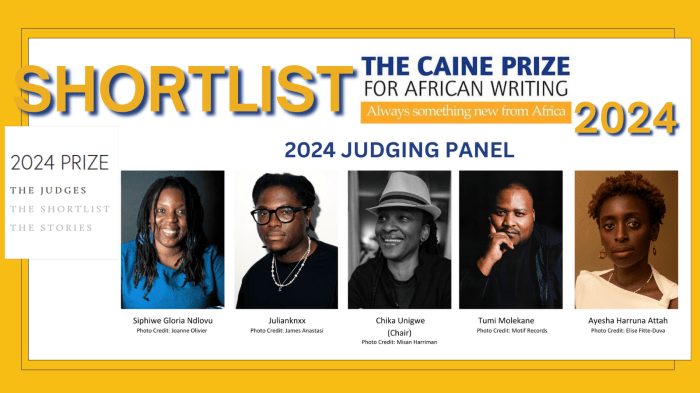
For example, for me, the most crucial part of the Caine Prize process is the selection of the judges. We strive to make that selection as varied as possible. And, to directly address your question about canon formation, when you look to the past at traditional literary canons, say, the English literary canon, those are books that were sanctioned by a very specific demographic. So I believe we have to be very conscious and intentional about what we are creating or calling our own canon, and given the continent’s vast diversity, we need to have a wide variety of voices in the room.
Under my tenure at the Prize, we’ve always made sure the judging panel includes an academic, a writer, and somebody who is from somewhere else in the artistic space, be it visual arts or dance, music, or whatever else. And we try to vary in terms of ages, and where people are living and what countries they’re from. The reason we take so much time and care over it is because it means that every year’s shortlist will reflect something different, depending on what the Chair of the judges, and each of the judges themselves, are looking for. This is why the stories on the Caine Prize shortlist can vary so much from year to year.

And so, it’s always really interesting to me when we get this conversation about what a Caine Prize story ‘is’. My hope is that, over time, people can look at the early years of the Prize and see how it has evolved, as it has been influenced by the different judges. It’s not just me or the team at the Caine Prize saying these are the stories and the writers we should all be reading. The background of how a prize is organized is really important to me in this regard.
And, let’s not forget that even a modest prize, like $100, that’s money a writer can use, whether to help pay for essentials or feed their kids, or buy themselves more time to write. So, beyond the confidence boost, the financial support is just as vital.
Even in countries where the publishing industry is well developed, only a very small percentage of writers ever make money or make a living out of writing. If a prize can offer even a small contribution to their financial well-being, it becomes important, because money matters. I think often we can get lofty when we’re talking about culture, but those beautiful stories are written by people who need to eat, take care of their families, they need lights, to pay bills – all of those things. So, for me, supporting writers financially is a huge part of what we do. And raising the money, so we can give it to the writers, that’s important.
Lastly, prizes serve as a guide to readers, a kind of pointer that we all need. I’d like to think I’m pretty good at finding quality writing on my own, but a prize will tell you, this year, this group of judges thinks that these are among the best submitted stories – and we then present them to our readers.
The publication of anthologies and otherwise sharing the stories, and the work such as that done by organizations like Africa in Words does mean that more people are aware of the writers. For us at the Caine Prize, we absolutely use the Prize as a mechanism to introduce our writers to agents and publishers. Many people have gone on from short stories to become novelists, thanks to the exposure the Prize gave them. It’s not the only way to do it, but it is a path to a wider readership. And that’s something every good writer—and some bad ones too—want, and certainly that every good writer…