




That South African political parties across the spectrum were quick to venerate the politician and Zulu prince Mangosutho Buthelezi, who died last week, demonstrates that the country is still attached to Bantustan ideology.
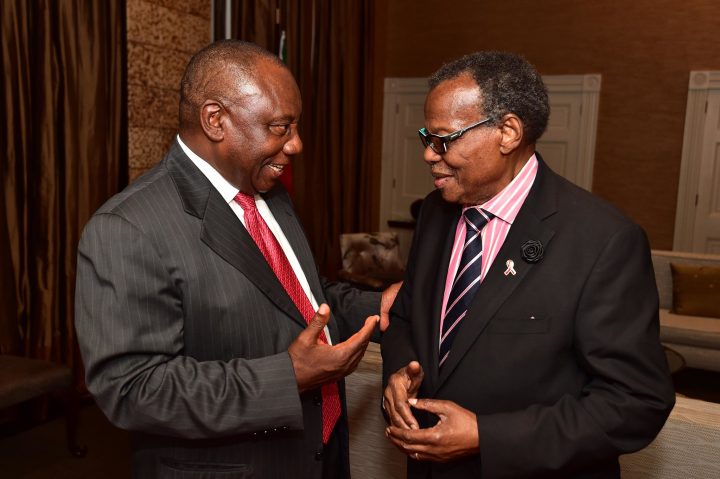
In the days since the passing of Prince Mangosuthu Buthelezi, Mntwana wakwaPhindangene, South African government officials and party leaders from across the political spectrum have descended on KwaPhindangane to honor the late leader—and to position themselves among the custodians of Zulu nationalism.
Buthelezi’s Inkatha Freedom Party organized his memorial service in Ulundi. African National Congress leaders and ANC members serving as provincial officials paid their respects to the Buthelezi family with reminders of the party’s long history with him. Economic Freedom Fighters MP Mbuyiseni Ndlovu hailed him as a “man of peace.” uMngeni Local Municipality Mayor Christopher Pappas spoke in isiZulu as he offered three cows on behalf of the Democratic Alliance. Buthelezi will receive a Special Official Funeral, a funeral category reserved for those of “extraordinary credentials.”
What were those “extraordinary credentials”? South African President and ANC President Cyril Ramaphosa described Buthelezi as “an outstanding leader in the political and cultural life of our nation, including the ebbs [sic] and flows of our liberation struggle, the transition which secured our freedom in 1994 and our democratic dispensation.”
Unlike the media coverage of Buthelezi’s retirement from the leadership of the IFP in late 2017, when City Press editor Mondli Makhanya was the exception, in the days since his death journalists have been quicker to remind readers of the leader’s responsibility for deadly violence. There have been no holds barred as Makhanya, Justice Madlala, Kay Sexwale, and others recall intimidation, political assassinations, and massacres. Between 1983 and 1996, a devastating civil war—enabled by Buthelezi’s relationship with the apartheid regime—raged in KwaZulu-Natal and the townships of today’s Gauteng. Conservative estimates suggest 20,000 were killed and another 200,000 displaced. The violence divided communities and families. Victims and perpetrators in the war included the unaligned, ANC/UDF supporters, and Inkatha Freedom Party members. State support for the latter gave Buthelezi’s fighters access to training, intelligence, weapons, and police partiality.
Ramaphosa and Roelf Meyer—as heads of the ANC and National Party negotiating teams, respectively—planned to forge a new nation without Buthelezi. They hoped his boycott of the first democratic elections would relegate him to obscurity. National Party operatives bypassed the ANC in a behind-the-scenes deal that secured Buthelezi’s participation. Last-minute legislation constitutionally protected the Zulu monarchy and installed Bantustan land in a trust under the name of the king (Bantustans, or “homelands,” were racially segregated territories in apartheid South Africa, designated for different black ethnolinguistic groups and designed to strip non-white South Africans of their citizenship and rights.) Depending on one’s inclinations, one might say that Buthelezi found a way to preserve his homeland or that he revitalized the Zulu kingdom defeated by the British in 1879.
And yet, nearly 30 years later, Ramaphosa trod carefully in the announcement of the death, with respect to not only Buthelezi but also to a deeply divided Zulu royal house and a rival political party that stands to gain from high levels of dissatisfaction with the ruling ANC in the next elections. With the advent of democracy, Bongani Ngqulunga has argued that Buthelezi successfully transformed his image into that of an elder statesman. He softened his militant Zulu nationalism to participate in new government institutions as other political parties began to embrace Zulu nationalism to competitively pursue votes in KwaZulu-Natal.
The cross-party political attention to Buthelezi this week could be interpreted as the latest incident of nostalgia for senior Bantustan leaders, but it also speaks to the malleability of Zuluness and the embeddedness of the “customary” in contemporary South African politics and the history of the ANC.
The ANC has long been a big tent, including African nationalists, communists, and economic and political elites, and adapting over time towards a racially inclusive nationalism. Some of the founding leaders of the ANC (then the South African National Native Congress-SANNC) counseled traditional leaders and were related or married to royals. The early SANNC included a body of chiefs. Leading figures of the body sought to preserve oral accounts and customs of their people via organizations such as the Zulu Society, founded by Albert Luthuli, the president who oversaw the party’s expansion into a mass organization. Even from exile, the ANC maintained relationships with Thembu King Sabata Dalindyebo. It gave Buthelezi the go-ahead to found Inkatha, though ANC President Oliver Tambo would later rue not doing enough to shape it into the organization the ANC envisioned.
As war unfolded and negotiations stalled, Buthelezi’s militant Zulu nationalism served as a useful foil that gave the ANC the moral high ground. Congress organizers, with the help of a rebellious Zulu chief, built the Congress of Traditional Leaders that today advocates for greater powers and remuneration for traditional leaders across the country, often at the expense of democratic rights. And of course, there was the rise and deadly fall of President Jacob Zuma, fueled by the KwaZulu-Natal ANC. Recent attention to political assassinations among ANC councilors and of Abahlali activists in KwaZulu-Natal shows the ruling party has clearly co-opted the methods of Inkatha and the National Party. The ruling party hired IFP hitmen such as Romeo Mbambo to train police. ANC councilors eliminate whistleblowers and their opponents within and without the party.
Since Ramaphosa’s ascension to the presidency, he has struggled to placate the Zulu monarch, whose power and land Buthelezi secured despite their animosity, when it comes to the Ingonyama Trust Board. In 1988, the ANC’s “lost prince,” Jabulani “Mzala” Nxumalo published Chief with a Double Agenda and denied Buthelezi’s claim to the role of prime minister of the Zulu. But in the last two years, as the Zulu king’s family contests the throne, not one in the ANC has questioned Buthelezi’s role in shepherding that process as they attended pandemic-era funerals and hosted lavish installation ceremonies for King Misizulu Zulu.
Our liberation struggle. Our democratic dispensation. Ramaphosa may have been speaking to the South African nation, but in using the collective he reminds us—as Buthelezi himself would have done—that Buthelezi and ethnic nationalism are no strangers to the political life of the ANC. Anthropologist and violence monitor Mary de Haas noted how Buthelezi’s political career was defined by his connections with apartheid ministers and Zulu nationalism. Ramaphosa’s announcement suggests we should not exclude the ANC from the definition of Buthelezi’s career, and not just because Buthelezi would have wanted it that way—but because Zulu nationalism has never solely been the domain of the late leader’s party.
