



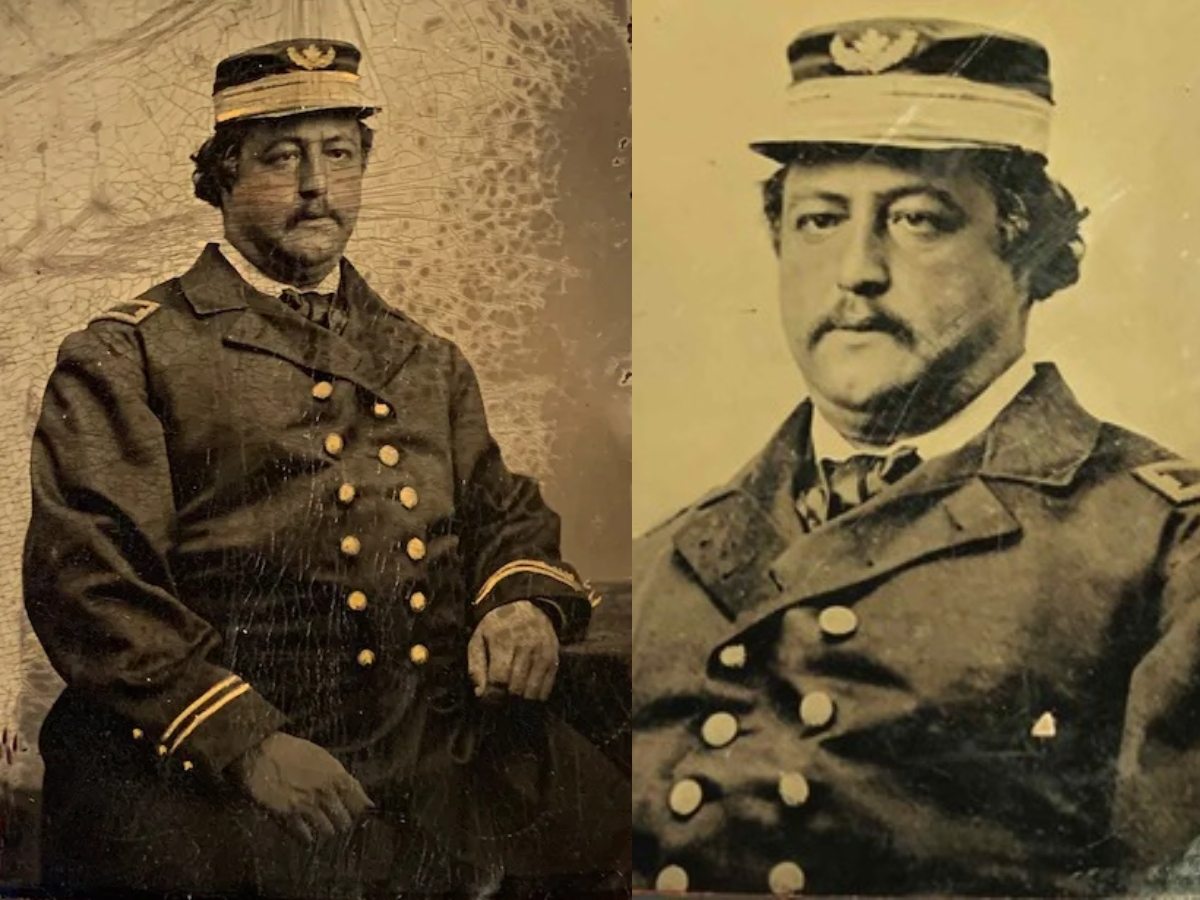
Richard Henry Greene made history as Yale University’s first Black graduate and later served as a physician during the American Civil War.
Born in 1833 in New Haven, Connecticut, Greene was the son of Richard Green, a bookmaker living four blocks off the Yale campus, and his academic achievements and contributions to medicine during the Civil War has marked him as a pioneer in 19th-century America.
Greene entered Yale in 1853, however, he studied Greek, Latin, and mathematics under Lucius Wooster Fitch, a Yale graduate and pastor’s son prior to his admission to the University, to prepare him for what lay ahead.
READ ALSO: Meet Richard Theodore Greener, Harvard’s first Black graduate who was accepted into the school as an “experiment”
Greene lived in New Haven’s Black neighborhood, known as “Negro Lane,” and commuting in the early morning darkness, he fortunately saw his tardiness to the mandatory 6 a.m. prayer service excused by the faculty who happened to be strict on all campus rules.
At the time, students were penalized for lateness or absence, but he mostly found himself excused due to his personal situation, as he was not a resident on campus.
While at Yale, Greene ventured into grabbing opportunities geared towards his growth and became a member of the Brothers in Unity literary society and the Sigma Delta fraternity, which helped him broaden his understanding of different races and cultures.
He graduated with a Bachelor of Arts in 1857, becoming Yale’s first Black graduate as a 24-year-old.
According to a Yale Alumni Magazine, Greene then later ventured into educating and impacting young students and taught in Milford, Connecticut, and at Bennington Seminary in Vermont. In 1861, he changed the spelling of his last name from Green to Greene.
Greene’s ambition did not stop there. He further pursued his education in medicine at Dartmouth College, earning his M.D. in 1864.
Then shortly before completing his medical studies, Greene joined the U.S. Navy in November 1863, during the American Civil War.
Greene served as an assistant surgeon aboard the USS ‘State of Georgia’, where he participated in the Union blockade off the coast of North Carolina under Admiral David Dixon Porter. After the ship was decommissioned, Greene married Charlotte Caldwell of Bennington, Vermont, and was reassigned to the USS Seneca.
While aboard the ‘Seneca’, Greene played a key role in the Union’s capture of Fort Fisher and other Confederate fortifications along North Carolina’s Cape Fear River. He also dealt with outbreaks of yellow fever and smallpox during his service.
In a letter to his wife, Greene described the somber atmosphere in Norfolk, Virginia, then under Union occupation as such: “all the young men have gone out of the place with the Confederates and a kind of gloom hangs over the city,” he wrote, adding that Southern women, staunch supporters of secession, would avoid acknowledging Union officers.
He expressed doubts about the nation’s future unity, stating, “Words can hardly express the bitterness of the Southerners toward the North.”
In September 1864, Greene was granted military leave to marry Charlotte Caldwell. He left military service in 1865, shortly after the war ended. After the war, Greene resumed his medical practice in New York but also considered returning to teaching or entering the Christian ministry.
READ ALSO: Nigerian Priest Cyprian Michael Iwene Tansi Poised to Become Britain’s First Black Saint
His exploits were soon halted as he died in 1877 at the age of 44 in Hoosick, New York, from heart disease, a condition some have linked to the intense social discrimination and racism he faced during his life.
Richard Henry Green is buried in Bennington, around the border from Hoosick. An 1897 book, Landmarks of Rensselaer County, tells the story of the doctor as a man who was “fond of the study of natural history and spent much time collecting plants and objects of interest in that department. He was a gentle, relentless and knowledgeable man, and many believe his efforts and beliefs were of that of a practical Christian.”
