

In 2017, Precious was approached by a woman in her neighbourhood who offered her an incredible opportunity: leave her corner of southern Nigeria for Italy, where she could work as a seamstress and send money back to her family. Precious had seen people on social media seemingly living the high life in Europe and witnessed what the money they had sent home had done for their families. The journey would be easy, the woman assured her, and then she could help her family.
“She deceived me,” says Precious, sitting on a couch in Benin City, Nigeria’s fourth-largest city and a major hub for human trafficking and migration to Europe. “And I suffered.”
Far from an easy journey, Precious, who is now 22 and who did not wish to share her surname, was passed from middleman to middleman in Nigeria, and then, in Niger, piled into the back of a Toyota Hilux truck with 25 other people for a three-day drive across the Sahara desert. She was beaten and starved, others died. But it was when the truck arrived at the border with Libya that her real suffering began.
For more than a year, Precious was held in forced prostitution with dozens of other women from across sub-Saharan Africa. She wasn’t allowed outside and was subjected to abuse and starvation. “Libya is a bad place — there are no laws there,” says Precious, who escaped in 2019 and returned home on a UN charter flight. “They say that since he died, everything has changed.”


“He” is Muammer Gaddafi. Stories of brutality and abuse are common among the hundreds of thousands of people who have passed through Libya in the decade since the dictator was overthrown and the oil-rich north African country descended into chaos and conflict. Libya had long been an entrepôt for migrants heading north, but after the 2011 revolution which toppled Gaddafi their numbers soared as it became the most important conduit for Africans seeking to reach Europe, where their arrival helped fuel the rise of the populist right. More than 700,000 migrants are currently stranded in Libya, according to the International Rescue Committee, which calls the journey that Precious took “the world’s most dangerous migration route”.
Ten years on, observers say the unintended consequences of the toppling of Gaddafi — a dictator whose 42-year rule was marked by corruption and systematic human rights abuses — in August 2011 and his assassination two months later can be seen far beyond Libya: in migrant deaths in dinghies on the Mediterranean Sea, slave camps and brothels on land; and in the collapse in security across the western Sahel that has killed thousands, displaced millions and sunk France into what some consider its own “forever” war.
“Libya became a kind of ventre mou — a vulnerable point — for all the neighbouring countries,” says Mathias Hounkpe, head of the Mali country office for the Open Society Initiative for West Africa. “Mali, Niger, Chad, all these countries to some extent are having problems because we do not have stability in Libya.”

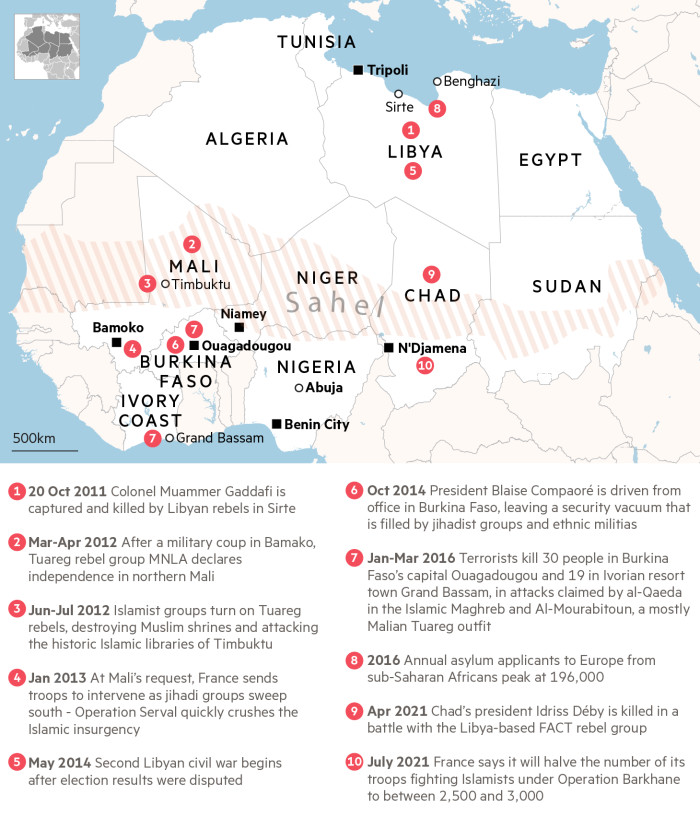
In Libya, the impact has been devastating. It has been blighted by violence and chaos since disputed elections in 2014 as rival factions carved the country into fiefdoms, while armed groups, criminal gangs and people smugglers exploited the weakness of the state. In March, a unity government was sworn in as part of a UN-backed process to end a two-year civil conflict that sucked in regional powers and foreign mercenaries from the likes of Chad, Russia, Syria and Sudan. The new administration is supposed to lead the country to elections in December.
The foreign ministers of Libya’s neighbours — including Egypt, Tunisia, Sudan, Chad and Niger — met last week to discuss the situation, and called for overseas mercenaries and fighters to pull out of the country. “Libya is the first victim of these irregular elements,” said Algeria’s foreign minister Ramtane Lamamra. “And the risk is real that neighbouring countries also become victims if the withdrawal [of mercenaries] is not handled in a transparent, organised way.”


How troubles flowed from Libya to Mali
The Sahel, the semi-arid strip below the Sahara that is home to some of the world’s poorest countries, has long been a region of instability. So it is useful to think of Gaddafi’s fall not as a direct cause of its current turmoil but as an accelerant of dynamics long under way in the region, says Yvan Guichaoua, a Sahel specialist at the UK’s University of Kent.
“These insurgencies in Burkina Faso, Niger and Mali were somehow just ready to break out and just needed a sort of push, a trigger,” he says. “And Libya was this trigger.”
Mali had been the subject of numerous rebellions over the years, but it was fighters — both Tuareg rebels and jihadis — who cut their teeth in Libya, armed with Gaddafi’s arsenal and flush with cash, that finally captured northern Mali, helping to cripple the government in the capital, Bamako. France intervened in 2013 and has been there ever since, an intractable military entanglement that has become a vulnerability in President Emmanuel Macron’s 2022 re-election campaign.
Jihadi groups have since embedded themselves deeper and deeper into the region, turning it into one of the most important fronts for al-Qaeda and Isis. Extremists in neighbouring Burkina Faso took inspiration from their Malian counterparts and mounted their own domestic insurgency that has shattered the country’s security. Jihadis exploited existing ethnic tensions in both countries and filled governance vacuums left by a neglectful state.


Sahelian leaders in turn have used the chaos in Libya as an excuse for their own inability to secure their nations and “muscular strategy toward their own people”, says Guichaoua, adding that the country’s importance has sometimes been overstated as a driver of insecurity.
That is echoed by Corinne Dufka, west Africa director for Human Rights Watch, who says Libya’s link to insecurity in the Sahel “has been totally exaggerated”. The “vast majority” of weapons in circulation now, she says, “are from attacks that [jihadis have] waged against the security forces . . . or are just buying on the open market”.
What is not in dispute is that migrants have long travelled through the Sahara desert to get to Europe. In his latter years Gaddafi had acted as a regulator — turning flows on and off as a way of extracting concessions from the EU and Italy. But with the despot dead, traffickers and militias filled the void. Post-revolution, “the smuggling economy [was able] to expand its capacity and logistical latitude, and operate with greater impunity than ever before”, according to a 2018 report by the Global Initiative Against Transnational Organized Crime.
The EU in effect set its border in the middle of the desert in Niger by paying that country €1.6bn in aid between 2016 and 2020 to stop migrants from travelling on centuries-old routes through the Sahara. It set them on to more dangerous desert routes, where thousands have since died.
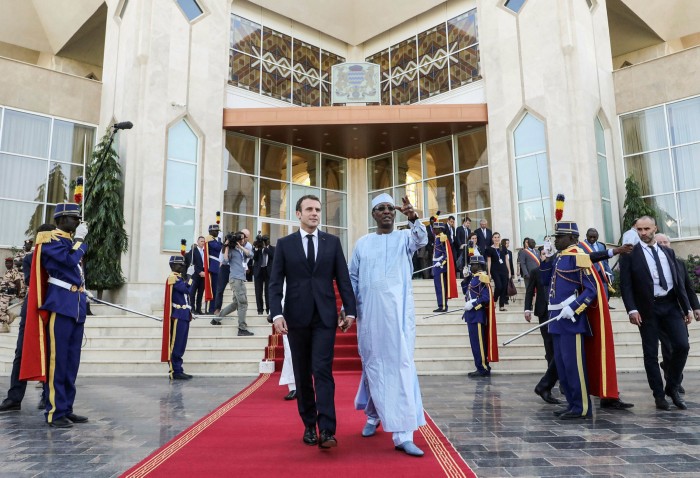
In neighbouring Chad, authoritarian leader Idriss Déby had faced down rebellions for years, many launched from Libya. The Chadian group that ultimately killed him had worked as mercenaries for the France-backed rebel general Khalifa Haftar in eastern Libya and emerged equipped to mount a serious offensive on the capital N’Djamena, say regional experts. Déby, who had served as president since taking power in a 1990 coup, had become further entrenched because of the political and financial support he received from Europe, which saw him as its most important bulwark against jihadis in the Sahel.
“A lot of things have happened since [2011],” says Daniel Eizenga, a research fellow at the US defence department’s Africa Center for Strategic Studies. “But . . . the fall of Gaddafi is really a key moment for at least unleashing that set of crises — it’s just a cascading set of events from there.”

Guns for hire
In February 2011, as the Arab uprisings swept across the Middle East and north Africa, young Libyans inspired by the crumbling of regimes in Egypt and Tunisia used social media to organise a “Day of Rage” against Gaddafi’s brutal rule.
The west, led by France, intervened, bolstering the popular uprising. It was a highly-contested decision — opposed by Joe Biden, the then US vice-president — but Nato fighter jets were streaking across the skies over Libya by March. In August, the rebels had taken Gaddafi’s compound. On October 20, rebel forces found Gaddafi outside the city of Sirte and summarily executed him.
His death left a vacuum and sent the country spiralling into disarray. US president Barack Obama said in 2016 that his “worst mistake” was “failing to plan for the day after” in Libya. Biden said in a 2016 interview: “My question was . . . ‘He’s gone. Doesn’t the country disintegrate? What happens then? Doesn’t it become a . . . Petri dish for the growth of extremism?’”
