



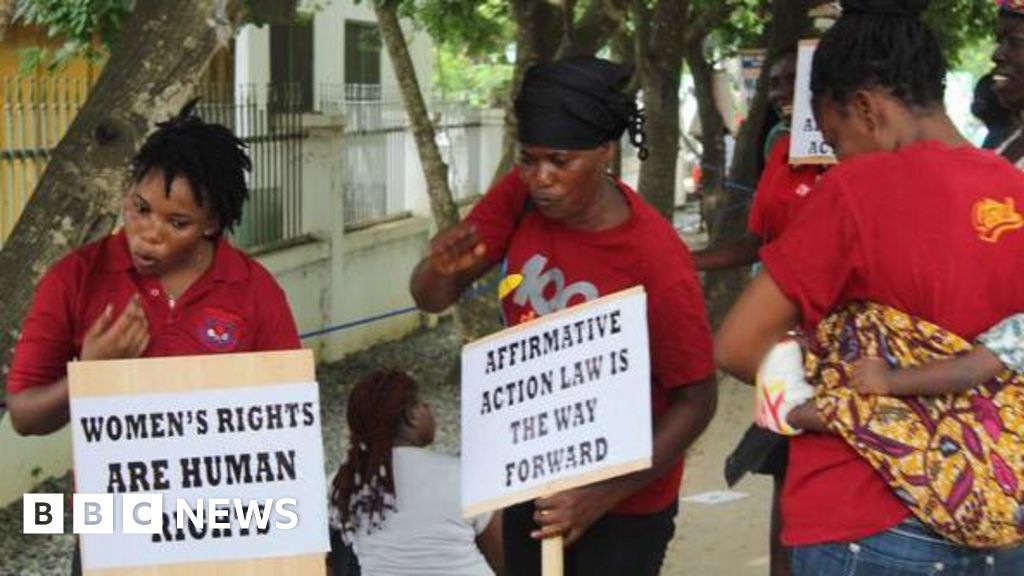

 ABANTU FOR DEVELOPMENT/FACEBOOK
Women’s rights advocates are demanding the immediate implementation of a nearly 30-year-old gender equity bill which Ghana’s president signed into law on Thursday.
This ends a process which began in 1998, with the bill shuffling between parliaments until the legislature passed it in July this year. Many campaigners faulted Ghana’s law-making body for the long delay.
Ghana now joins Rwanda, Uganda, Burundi, Mozambique and others in Africa that have working affirmative action laws.
These countries have a 30% quota for women in decision-making bodies, in parliament and other state agencies.
What changes does Ghana’s new law bring in?
Ghana’s Affirmative Action (Gender Equality) Act 2024 is expected to ensure a critical number of women hold key positions in government, security, commerce and other decision-making spaces.
The law promotes the progressive and active participation of women in public life from a minimum of 30% to 50% by 2030, in line with the UN’s Sustainable Development Goal of achieving gender equality by 2030.
The country’s trade unions are mandated by this law to ensure gender balanced representation on their executive boards, while private industries which enforce provisions of this law to employ women would benefit from tax incentives.
After the law passed in July, Speaker of Parliament Alban Bagbin said he hoped lawmakers would commit to the reforms and “do more to create a free and just society to liberate more women to support us develop mother Ghana”.
What happens if people break this law?
Subjecting an employee to gender-specific verbal attacks, stereotyping, hate speech or harsh rhetoric as well as discriminating against, intimidating or seeking to disqualify a candidate on grounds of gender are all banned under this law.
Penalties include fines, and jail terms of between six and 12 months.
Any act that victimizes, obstructs or exerts “undue influence on a person” in a way that undermines the new law is deemed an offence.
Trade unions who fail to comply could lose their registered status.
What are people saying about it?
Female lawmakers have described the law as a strong statement for the empowerment drive.
Abla Dzifa Gomashie MP, whose constituency is in south-east Ghana, told the BBC she hoped it would “cure the cultural, political and economic discrimination against women and minority groups – especially that of the disability community.”
“We must kick in the advocacy as soon as possible to ensure that state agencies and institutions get on board and educate the populace on the expectation that this law carries,” she added.
But some advocates and activist groups who welcome the law worry that it will not be properly enforced.
“In the midst of the joy, there are fears – we fear that for example where political parties are required to play a role, they may not necessarily do what they have to do,” Dinah Adiko, a technical consultant who previously worked with Ghana’s gender ministry, told the BBC.
“We fear that the supervision of it, regulation… What are the biting powers to actively implement this law? Those are some of the reservations. But for the moment we are excited to see this come to light.”
Has there been a backlash?
There has been little public criticism of the law.
At a recent press conference, a journalist asked if “pursuing equality by discriminating in favour of women” was the wrong thing to do.
But a senior minister dismissed that as a “misconception about the bill fuelling tokenism”.
“Ghanaian women are qualified to hold positions of authority and influence,” Minister for Gender, Children and Social Protection Dakoa Newman told reporters.
Why has it taken so long to become law?
Many blamed both of Ghana’s two main political parties – the NDC and the NPP – for failing to ensure passage of the law, despite repeatedly using it as a campaign promise.
It was final re-introduced to parliament by current Gender Minister Newman earlier this year.
Last year Ghana’s parliamentary speaker said he wanted the bill to be passed but said it was not ready in its current form, and needed “critical stakeholder consultation for a well-defined and crafted law.”
Recalling her stint as a technical advisor at the gender ministry in 2014, Ms Adiko said: “We saw the bill all the way through to cabinet, got the approval until elections and the change in government in 2016 meant it went back several steps again.”
How will this affect elections?
With the Ghana’s general elections approaching in December, there are expectations that it could encourage more women to apply for political office.
At present, two women have successfully submitted nomination forms for the presidency. One less than in the 2020 vote.
With this new law, the electoral commission is mandated to ensure political parties comply with quotas for women at various levels.
The commission is also expected to “put measures in place to increase participation of women in the electoral process as candidates and voters”.
Gomashie MP said she expected “political parties to engage vigorously in ensuring that they create spaces for our women to participate in electoral processes and also be able to contest in a free and fair environment”.
More BBC stories on Ghana and its diaspora:
 Getty Images/BBC