
The Everest Base Camp (EBC) trek is a spectacular high-altitude trek in the mountains of Nepal. Prepare for jaw-dropping scenery and a unique cultural experience exploring the challenging trekking routes around the highest mountain in the world. Doing the Mount Everest Base Camp trek, hiking on the Khumbu glacier through small villages over many suspension bridges looking at Mt. Everest and the Khumbu Valley is a fantastic round trip. This fascinating EBC trek combines both Buddhist and Tibetan culture following in the footsteps of Sir Edmund Hillary. Local culture can be seen in sherpa villages and Buddhist monasteries. Don’t miss the fascinating Tengboche Monastery.

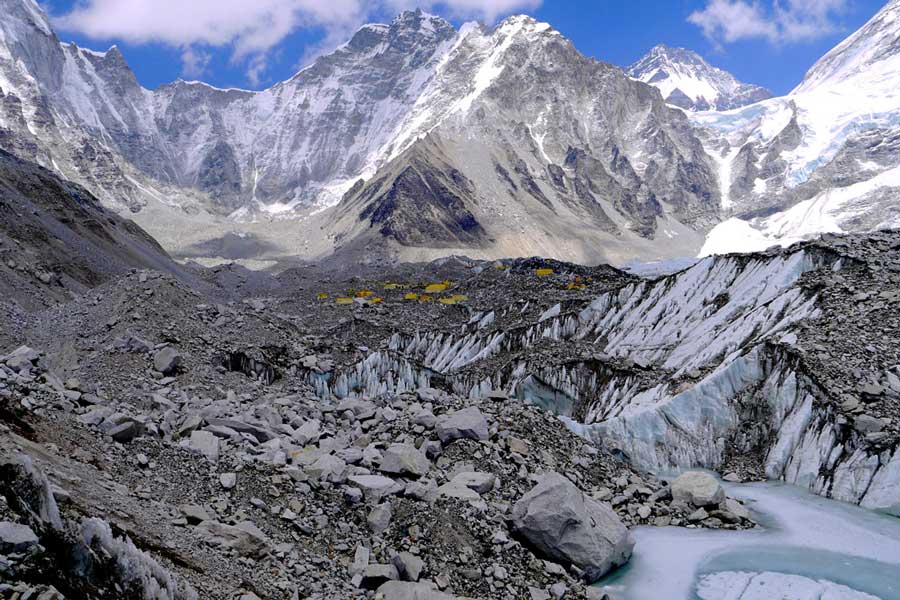

We have done a lot of trekking in Nepal including two treks to Everest Base Camp (EBC). In this post, we discuss cost, itinerary, guides, porters, altitude sickness, how to get to EBC, and give packing and money-saving tips.
Everest Base Camp Trek Overview
- Distance – 120 km/75 mi
- Days required – 12 days
- Total ascent – 6015 m/19 734 ft
- Total descent – 5821 m/19 097 ft
- Highest point – 5640 m/18 500 ft Kala Patthar
- Difficulty – difficult
- Permits – Local Government fee (NPR 2000/US$17 pp.) and Sagarmatha National Park permit (NPR 3000/US$25 pp.) is required. No TIMS card is needed for the trek.
- Cost per day – US$29 (without flights) $58 per person per day including permits and transportation.
- Guide – compulsory from 1 April 2023
- Accommodation – guest houses
Important Updates – There have been some important announcements regarding guides 2023.
Is a Guide Mandatory to Trek to Everest Base Camp in 2023?
The Nepal Tourism Board (March 2023), announced that all tourists visiting Nepal will be required to hire a licensed guide or porter before trekking. However, the municipality under whose jurisdiction the Everest region falls subsequently decided not to comply with this decision and that solo trekking will still be allowed in the Everest area. See The Kathmandu Post Article – Nepal ends solo trekking era. Everest region is an exception. So the additional cost of hiring a local guide is not compulsory.
Where is Everest Base Camp (EBC)?
Everest Base Camp is a camp where climbers stay and prepare before starting to climb the world’s highest mountain. There are actually two base camps for climbing Mount Everest, the North Base Camp in Tibet and the South Base Camp in Nepal. The Nepalese camp is the Everest Base Camp that most people refer to. Mount Everest and EBC are located in Sagarmatha National Park, a UNESCO World Heritage Site preserving Himalayan flora and fauna.
EBC is located about 150 kilometers (90 miles) northeast of Kathmandu in the Khumbu region of Nepal at an altitude of 5,364 meters
How to hike to Mount Everest Base Camp?
You have three main options on how to do the trek to Everest Base Camp, you can either do a package tour through an agency, do it by yourself (no group or guide) but hire a porter or guide, or do it completely independently.
- Doing an organized tour through an agency is a good option if you are alone or not confident to do the trek unassisted, it is an easier but more expensive option.
- Finding porters and guides in Kathmandu is easy, just go to any local agency they will assist you to organize staff for your purposes. The Sherpa guides usually know the trail, best views and area very well.
- Doing it yourself is not hard and plane, bus, or jeep tickets from Kathmandu to Lukla are the only thing that you have to organize. You follow a very clear main trail, everybody stays in the same little “towns” with many tea houses enjoying sherpa culture, and it is not necessary to book anything.
We have done the EBC trek independently twice, trekking independently on a fairly frugal budget our cost was $645 (including the flight) beginning and ending in Kathmandu in March 2020. You can see our optimized Everest Base Camp Trek Itinerary we recommend.
Organized Everest Base Camp Trek
For some great treks with reputable international companies take a look at these great tours.
If you are trekking in season escape the crowds by hiking the more quiet way and experience unreal views of famous mountains such as K 43, Taboche, Cholatse, Nuptse, and Everest. Climb the tough Gokyo Ri peak for spectacular panoramic views, and check out this awesome 16-day trek itinerary, hiking to EBC via Gokyo Lakes!
How Much Money Do I Need for Everest Base Camp Trek?
For a complete cent-by-cent cost breakdown of our trek to Everest Base Camp in 2020. Cost of trekking to EBC in different ways in a nutshell:
- Package tour EBC trek with international agency $1700
- Package tour EBC trek with local agency $1600
- Independent EBC trek with a guide and porter $1370
- Independent EBC trek with a guide $1085
- Independent EBC trek with a porter $930
- EBC Trek completely independent $645
If you budget around $700 for an independent 12-day EBC trek you should have sufficient money for the trek including flights, food, water, tea, snacks, and accommodation. The biggest possibility to save money is to go to Lukla overland instead of flying, we discuss this later in the post.
There are only 2 places where you will find ATMs on the Everest Base Camp hike that is Lukla and Namche Bazaar.


Accommodation on the Everest Base Camp Trek
Accommodation on the Everest Base Camp trek is in Teahouses. Teahouses are bed and breakfast lodges designed to host trekkers. EBC teahouse accommodations in Nepal are simple, clean, and comfortable. It is great that you can check in and have an early start the next day with a good breakfast hassle-free.
Cost of tea house accommodation – price varied between free and $3 as long as you order food at the teahouse.
The walls are thin and the outside and inside temperatures are about the same. You do get blankets at the teahouse and sleeping in a thin sleeping bag in our clothes under the blankets provided was sufficient at the higher altitudes when it got very cold at night.
Shower on EBC Trek – Everything gets more expensive as you ascend. From Namche Bazaar we had to pay for hot showers. The average cost of a hot shower was NPR 500 and after a long day walking it is definitely worth it! If you trek early in the season the water is often frozen in the pipes and you can only have a bucket shower, a bucket filled with hot water, which is fine, but in February at Gorkshep it is just too cold. We packed Wet Wipes and did a ‘dry shower’. Pack hand sanitizer for washing hands when water or soap is not available.
Charging – there are lights in the rooms, but no plugs at most tea houses and you have to pay for charging in the communal area, usually 200 NPR per item or per hour.
There are no electricity sockets in the bedrooms, charging is available in the dining room at extra cost.
The tea house usually has a large dining hall where you eat and relax with other guests. In the center of the dining room is a fireplace that burns wood and yak dung.
At all the lodges we stayed there were now Western toilets. You have to take your own toilet paper.
There are nice lodges available in some of the villages ($20 -40) see the itinerary later in the article.
Food on the Everest Base Camp Trek
The tea houses sell nice meals and most people eat 2 or 3 meals per day at the tea houses where they stay. It is expected that you will eat dinner and breakfast at the tea house where you overnight, if you don’t you are charged a lot more for accommodation ($15 instead of $3).
You can eat well if you budget about $25 per day ($8 per meal).
See our detailed article on Food on the Everest Base Camp Trek.
Dhal Bhat is the staple many people live on during the trek and the porters always eat this. At most places it is ‘bottomless’, when your plate gets empty they will refill your dahl, rice, and potatoes if they don’t offer just ask!
We usually had a late lunch when arriving (15:00) and not too long after a fairly early dinner (19:00), leaving the following day. We do not drink the water from the taps on the EBC trek, you can buy a water bottle at each teahouse, we prefer to use our Lifestraw Bottle to make tap water potable.
Flights to Lukla, the start of the Everest Base Camp Trek
Book your flight from Kathmandu to Lukla with Tara Air Here.
The easiest way to start the trek is to fly from Kathmandu to The Tenzing-Hillary Airport in Lukla.
Flights from Kathmandu to Lukla were suspended in 2022 due to maintenance with only flights from Ramechap being available. Flying from Ramechap Airport to Lukla is still possible and is a very short flight. Tara Air is flying again from Kathmandu to Lukla at the time of writing, in July 2023. Changing the flight dates is easy and free even while trekking. Our return date changed during our trek and we phoned Tara from a tea house on the way to change our date. I will always recommend you reserve the first flight in the morning since flights from Lukla get canceled due to wind very quickly, we have been stuck here for days due to weather conditions.
You are allowed only 10kg of luggage, hopefully, you were not planning to carry more! If you are traveling with more luggage check that you stay somewhere in Kathmandu that will store your luggage safely without charge.
The sloping Tenzing Hillary airport in Lukla is considered by some as the most dangerous runway in the world.

Hiking to Lukla from Kathmandu
Lukla is high in the Himalayan mountains with no roads reaching all the way here, most people fly from Kathmandu to Lukla to start the EBC trek….