
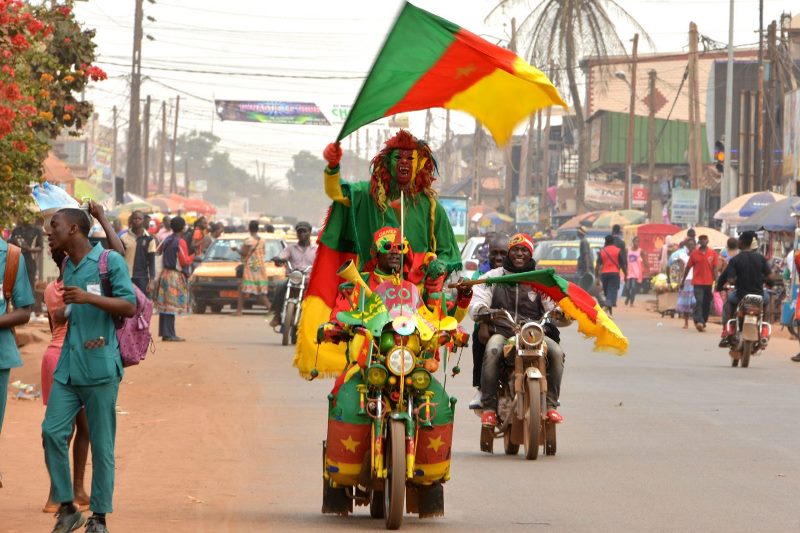
The Republic of Cameroon is a west African country bordered by Chad to the northeast, the Central African Republic to the east, Equatorial Guinea, Gabon, and the Republic of the Congo to the south, and Nigeria to the west. The country’s coast, on the Bight of Bonny, is part of the Gulf of Guinea and the Atlantic Ocean. Due to its geological and cultural diversity, it is called “Africa in miniature.” Cameroon has beaches, deserts, mountains, savannas, and rainforests. Mount Cameroon is the highest point. Douala, Yaounde, and Garoua are the largest cities. The country has 200 different languages. Native music includes makossa and bikutsi, among others. Cameroon’s football team is also successful. Official languages are English and French.
The Sao civilizations were early inhabitants around Lake Chad as were the Baka in the southeastern rainforest. Explorers from Portugal reached the area in the 15th century and named it Rio dos Camaroes, or the River of Shrimp. In the 19th century, Fulamo soldiers founded the Adamawa Emirate. Other groups founded chiefdoms as well. In 1884, the country became a German colony.
The territory was divided between France and Britain after World War I as mandates by the League of Nations. The Union des Populations de Cameroun party pushed for independence until the French outlawed it in the 1950s. It fought the French and other forces until 1971. In 1960, part of Cameroon became independent as the Republic of Cameroon. Its president was Ahmadou Ahidjo. In 1961, a part of British Cameroons united with it to become the Federal Republic of Cameroon. In 1972, it took the name the United Republic of Cameroon and in 1984, the Republic of Cameroon.
Cameroon has high social and political stability compared to other African nations. Its industries include agriculture, railways, roads, as well as timber and oil industries. Many Cameroonians do live in poverty as subsistence farmers. The president, Paul Biya and his party, the Cameroon People’s Democratic Movement, control the country. There is increasing alienation of English speaking parts of Cameroon from the rest of the county. Some leaders in these areas have called for separation or decentralization from remainder of Cameroon.
Neolithic settlers were the first in modern-day Cameroon. The Baka are the longest continuous inhabitants. Around 500 AD, the Sao culture arose near Lake Chad. The Sao gave way in favor of the Kanem and then the Bornu empire, its successor state. In the west, other kingdoms arose.
In 1472, Portuguese reached the coast and noted an abundance of mud lobster, Lepidophthalmus turneranus in the Wouri River. They renamed it Rio dos Camaroes, or the “River of Shrimp” in Portuguese. The Portuguese established coastal trade and Christian missionaries moved inland. In the 1800s, Fulani soldiers, led by Modibo Adama, fought a jihad against non-Muslim people in the north. They established the Adamawa Emirate. People fled the attacks and caused population redistribution.
In 1884, the Germans claimed the area and called it Kamerun. They moved inland and started improving infrastructure relying on forced labor. After World War I and the German defeat, Kamerun was split between the British and French in 1919. France improved Cameroon’s economy, which it called Cameroun, and made infrastructure improvements. France also continued the forced labor the Germans used.
British Cameroon was administered from Nigeria. Natives felt this led to neglect. The migration of Nigerians into the British portion angered local people but ended forced labor. In 1946, the League of Nations Mandates changed to United Nations Trusteeships. Independence became an important issue in French Cameroun. The radical Union des Populations du Cameroun (UPC) was outlawed by the French on July 13, 1955. A guerilla war followed. While traveling in Switzerland, the party’s leader, Ruben Um Nyobe, was assassinated. Around that time, British Cameroon was debating whether to join the French Cameroun or Nigeria.
French Cameroun became independent on January 1, 1960. Ahmadou Ahidjo became the first president. The British Cameroon joined it on October 1, 1961 and the country became the Federal Republic of Cameroon. During the war with the UPC, the president used the conflict as a reason to consolidate his power. This continued even after the UPC was suppressed in 1971.
The Cameroon National Union (CNU), the president’s party, became the sole one permitted by law on September 1, 1966. In 1972, the government abolished the federal system and established a United Republic of Cameroon out of Yaounde. Ahidjo’s liberal policies included giving oil exploration and cash crops priorities. Oil money created a national cash reserve, financed development projects, and paid farmers. Unfortunately, the appointment of unqualified advisors led these programs to failure.
On November 4, 1982, Ahidjo stepped down. Paul Biya, his successor, took power. Ahidjo stayed as the CNU’s head and tried to control the country from that position. Biya and his allies forced Ahidjo to resign. Biya then starting moving Cameroon toward a more open, democratic government. However, a failed coup moved him to adopt a governing style similar to his predecessor.
Economic hardship took place from the mid-1980s to the late 90s. This was caused by multiple factors, including international economic conditions, drought, corruption, low oil prices, cronyism, and mismanagement. The country was forced to turn to foreign aid. It also cut spending and privatized industries. In December, 1990, multi-party politics were introduced again and the former British areas of the country sought autonomy or secession.
Cameroon’s president has powers to administer the government, create policy, negotiate and ratify treaties, command the military, and declare emergencies. The president has the power to appoint the prime minister, provincial governors, urban council members, and divisional officers. The country elects its president every seven years by popular vote. The public also elects mayors and councilors in smaller areas.
Corruption is a major problem, leading to the establishment of anti-corruption agencies in 1997, Of the 29 ministries proposed, only 25 percent ever started. President Biya started another anti-corruption drive on January 18, 2006 under the National Anti-Corruption Observatory.
Cameroon recognizes the power of local rulers and respects their authority if in line with national law. In Bana, West Region, there is a statue of a chief showing the prestige they are given.
The legal system is based on the French civil law system with some features of British common law. The judiciary is nominally independent, but the branch falls under the Ministry of Justice, part of the executive. Judges are appointed by the president. The lowest courts are the tribunals. There is a court of appeals and the supreme court. A Nine-member High Court of Justice is elected by the National Assembly. The court judges the government’s high ranking officials if charged with treason or other national security crimes.
According to human rights organizations, police and military mistreat criminal suspects, including torture. Ethnic minorities, homosexuals, and political activists are alleged to be similarly treated. Overcrowded prisons have insufficient food and medical facilities. Those operated by traditional rulers are said to hold the government’s political prisoners. Police have been prosecuted for misconduct demonstrating some progress.
Legislation is made by the National Assembly, which consists of 180 members elected to five year terms. The body meets three times per year. Majority vote is required to pass laws. The president’s proposed legislation is rarely blocked or modified. While a second house of parliament was established by the 1996 constitution, it has never been put into place. The government recognizes the authority of local rulers provided their actions are within the nation’s laws.
Biya’s Cameroon People’s Democratic Movement (CPDM) was the only political party allow by law until December 1990. Other groups have formed since. The main opposition if the Social Democratic Front (SDF). It is based in the Anglophone area and John Fru Ndi is its head. While Biya’s party has maintained the presidency and control of the National Assembly, the opposition claims the elections were flawed. According to human rights groups, the government suppresses opposition demonstrations, disrupts their meetings, and arrests their leaders. Specifically, Freedom House declared the country as “not free.” On July 22, 2007, the latest parliamentary elections were held.
Cameroon is a member of international organizations, including the Commonwealth of Nations and La Francophonie. Cameroon’s foreign policy is aligned with France, on whom it relies heavily for its defense. Biya has fought Nigeria over the Bakassi peninsula. There have also been personal fights with Gabon’s president, El Hadj Omar Bongo.
State run schools are free and available to most children. There are also private and religious schools. Most instruction is in English or French and follows those countries’ traditions. The country has one of Africa’s highest attendance rates. Girls attend less often than boys. This is due to cultural attitudes, early marriage, domestic duties, sexual harassment, and pregnancy, In the south, the attendance rates are higher. The northern schools are understaffed.
Cameroon has six state-run universities with over 60,000 enrolled. A vice-chancellor leads a council of deans, directors, and state representatives in governing the universities. The state funding is low and student registrations make up 25 percent of budgets. Universities have been reluctant to increase admission standards due to fears of losing student…