



In her active days as an athlete specialising in 100 metres sprint, Endurance Ojokolo-Akpeki won eight gold medals for Nigeria at continental and inter-continental level, and competed at six editions of the World Athletics Championships, amongst many other competitions. However, one achievement which she greatly desired but which did not materialise was making the final of the 100 metres event at the Olympics.
The seven-time national champion had competed at the Athens 2004 Olympics where she reached the semis, and this motivated her to make a promise to coach an athlete that would compete in the final of the Olympics.
While making this pledge, Ojokolo-Akpeki, who went into coaching in 2010, two years after her last competition for Nigeria, knew it was going to take a lot of sacrifice, hard work and dedication to fulfil. However, she did not reckon that some of the sacrifices she would have to make to remain at the top of her game as an athletics coach in Nigeria would literally involve a lot of pain and tears while embarking on a mission to change the narrative that coaching is strictly a man’s job, as there is lack of female representation in sports coaching in the country.
Where are the female coaches?
According to the International Olympic Committee (IOC), only 13 per cent of coaches at the Tokyo 2020 Olympics were women, compared to the number of female athletes (48 percent). It is estimated that there are over 133,386 head coaches currently employed in the United States, with 33.7 percent of them being women. Focussing on Nigeria, this reporter decided to use one of the country’s leading sports, Athletics, to highlight the challenges restraining women in the coaching terrain.



The Athletics Federation of Nigeria (AFN) was established in 1944 as the Amateur Athletic Association of Nigeria. The federation has had only one Head Coach in its nearly 80 years of existence, who also happens to be female. Amelia Edet spent nearly three decades as a coach and served as AFN’s Head Coach from 1999 to 2006 when she retired from active service.
The AFN is one of about 40 sports federations in Nigeria, and is among the top five, falling just behind the likes of the Nigeria Football Federation (NFF) and Nigeria Basketball Federation (NBBF) in terms of popularity and influence. Athletics is important to Nigeria as one of its major medal spinners at global competitions. Fourteen of the 27 medals won by the country in its Olympic participation from 1952 to 2021 came from Athletics.


Nine of the 14 medals Nigeria won in Athletics were secured by women, highlighting the pivotal role female athletes have played in uplifting the image of the country over the years. So, providing an enabling environment for women to thrive ought to be paramount in the Federation’s decision-making process.
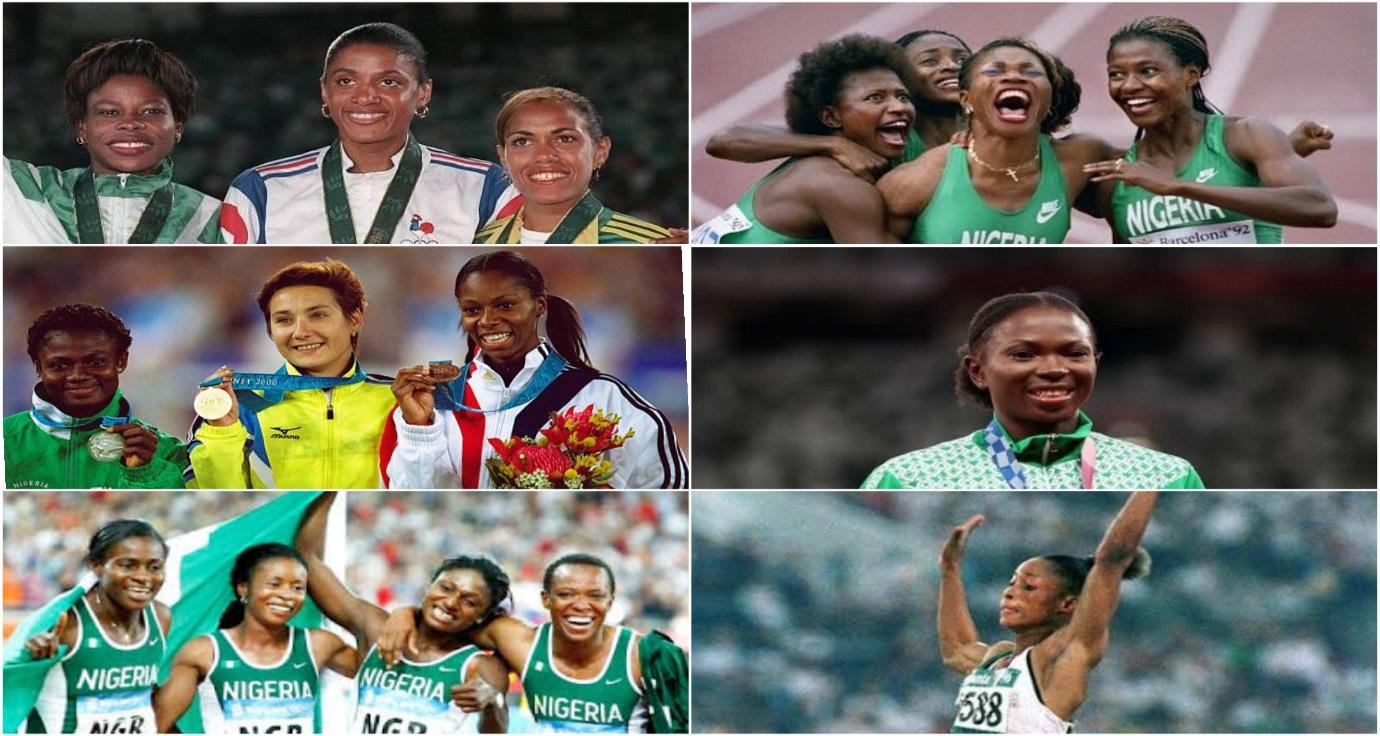
Some of Nigeria’s female Olympic medallists include Falilat Ogunkoya (top left) who won a bronze medal in the women’s 400m at the Atlanta ‘96 Olympics; the quartet of Christy Opara-Thompson, Faith Idehen, Beatrice Utondu and Mary Onyali who took bronze in the women’s 4×100 relay at the Barcelona ’92 Olympics (top left); Glory Alozie claimed a silver medal in the 100 metres hurdles at the Sydney 2000 Games (centre left); long jump bronze medallist at the Tokyo Olympics in 2021, Ese Brume (centre right); the team of Damola Osayomi, Halimat Ismaila, Franca Idoko and Gloria Kemasuode won silver in the women’s 4×100 relay at the Beijing 2008 Olympics (bottom left), and Chioma Ajunwa (bottom right) who struck gold in the women’s long jump at Atlanta ’96 to become the only Nigerian athlete (male or female) to win an individual gold medal at the Olympics.
Others are Mary Onyali (women’s 200 metres bronze, Barcelona ’92), Blessing Okagbare (long jump silver, Beijing 2008), and the squad of Ogunkoya, Fatimat Yusuf, Charity Okpara and Olabisi Afolabi (women’s 4×400 silver, Atlanta ’96).

There are currently 124 coaches registered with the Athletics Coaches Association of Nigeria (ACAN), which is the umbrella body for Athletics coaches in Nigeria, and affiliated to the AFN. But the coaches are not on AFN’s payroll, as they are mostly engaged by the sports associations of the various states. Of that number, only 24 are women – less than a third of the total number of registered Athletics coaches in Nigeria.

As one of the top sports in Nigeria, the AFN presents national teams for several international competitions every year, ranging from continental outings such as the African Senior Championships, African U-20 Championships, African Games, to global events like the Commonwealth Games, Olympics and World Athletics Championships. In recent years, invitation to any of these international competitions has been the major reward system for athletics coaches in Nigeria.

Of the national teams selected for 21 international competitions between 2015 and 2023, (both continental and global), there were only seven female coaches, compared to more than 45 for their male counterparts.
Six of these coaches – Ojokolo-Akpeki (sprints coach), Emily Osakwe (jumps coach), Emilia Oyase (sprints and jumps coach), Olapade Lawal (sprints coach), Rachael Oguntona (long distance) and Nene Akudo, are based in Nigeria, while Pat Itanyi-Williams (sprints, hurdles and jumps), lives in the US.
The duo of Ojokolo-Akpeki and Oyase received the most call-ups (nine), Osakwe got three, while the rest were selected only once each.
Too high a price to pay
Ojokolo-Akpeki’s most prominent athlete, Usheoritse Itsekiri, was men’s 100 metres national champion in 2019 and 2023, and has represented Nigeria at several international competitions, winning continental medals in the process, and also making it to the semifinals at the Tokyo Olympics in 2021.
![Ojokolo-Akpeki and her athlete, Usheoritse Itsekiri at the 2019 World Championships in Doha, Qatar. [Photo Credit: Usheoritse Itsekiri]](https://media.premiumtimesng.com/wp-content/files/2023/07/image6.jpg)
And while she has received accolades for the achievements of her athletes, the former African champion has paid a very high price to be where she is today. She said: “In my first marriage, my husband wasn’t really supportive of me being a coach. But I am stubborn; coaching is what I do and what I love, and so I went for it. One of the major reasons that marriage failed was because of my career.
“We were together for 12 years, but there was a lot of quarrelling going on, especially when I had to travel for competitions or when I had to go to the stadium to train my athletes. I wasn’t ready to give up my career as a coach, so I formally ended the marriage in October, 2021. When you hear that a lot of women had to quit coaching because of the lack of support of their spouses, that’s actually the truth.”
Ojokolo-Akpeki’s story mirrors the experiences of her counterparts who have faced similar challenges.

Lawal has coached since 2002 and currently trains Kayinsola Ajayi, a two-time gold medallist at the 2023 African U-20 Championships held in Zambia back in April, amongst other athletes. In fact, the selection of her athlete for that competition earned Lawal an invitation to the team that travelled to Zambia – her first call-up for an international competition. There were six coaches in attendance, with Lawal and Osakwe the two women in the team.
![Coach Olapade Lawal (centre) and two Nigerian medallists at the 2023 African U-20 Championships in Zambia. It was Lawal’s first outing with Team Nigeria. [Photo Credit: Olapade Lawal]](https://media.premiumtimesng.com/wp-content/files/2023/07/image10.jpg)
“One of the key challenges we face as female coaches has to do with our husbands. A lot of men don’t understand the challenges that come with being a female coach. Each time we had to travel for competitions, my husband would say all sorts of demeaning and degrading things, insinuating that I had other reasons for travelling, meanwhile not every woman is like that. I couldn’t quit my coaching career because that’s where my happiness lies, so we had to get a divorce,” added Lawal who is raising her four children alone.
Oyase has been a coach for about 17 years now and has received several invitations to international outings, underscoring her depth. Some of the events she’s been to include the African U-20 Championships in Botswana and African Games in Maputo, Mozambique, both in 2011; the 2014 World U-20 Championships in Oregon, USA, and the 2018 African Youth Games and Youth Olympics which took place in Algeria and Argentina, respectively.
![Coach Emilia Oyase (left) during a training session with some athletes. [Photo Credit: Emilia Oyase]](https://media.premiumtimesng.com/wp-content/files/2023/07/image8.jpg)
Making it to these competitions did not come without a huge cost for Oyase too, who is Head Coach, Athletics, at Oyo State Sports Council. She said, “A lot of men do not understand how sports work, and do not support their wives’ or girlfriends’ careers as coaches, because it is a male-dominated field. It’s easier for female coaches who are unmarried, as they can go wherever they want to and whenever, without being accountable to anyone. She can get back home at 7 p.m. after a training session or attend two training sessions in a day and it wouldn’t be an issue. However, it’s not so simple for the married because some of their husbands want them to be in one place or assume that a woman is up to all sorts of things once she’s away.”
For former national champion in the heptathlon, Itanyi-Williams, navigating the coaching terrain whilst birthing kids is quite a tricky business. The 1999 African Games silver medallist said: “I used to coach at West Virginia University, but when I got married and became pregnant, I realised that I couldn’t coach anymore, because I did not want to take my child to a daycare centre. I chose not to take my daughter there, but what I did was to start private coaching, which I scheduled around home. When my husband is home, I can go and coach.
![Pat Itanyi-Williams stepped away from demanding coaching roles in order to raise her daughter. [Photo Credit: Pat Itanyi-Williams]](https://media.premiumtimesng.com/wp-content/files/2023/07/image7.jpg)
