


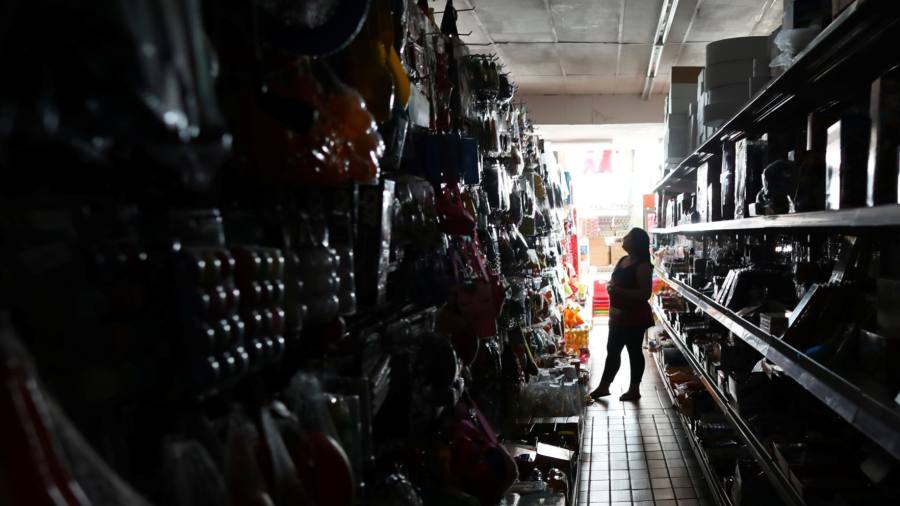
South Africa’s rolling blackouts have ruined a hot summer for Soweto Creamery, a gourmet ice cream business in Johannesburg’s largest township praised by President Cyril Ramaphosa as a start-up forged in the pandemic.
Despite high demand for sweet treats such as the Chocolate Overload and Caramel Canyon, owner Thando Makhubu has burnt cash running a generator for up to 10 hours a day. It is needed to replace the power lost when Eskom, the stricken electricity monopoly, cuts off swaths of demand to prevent a total grid collapse, a process known as load-shedding.
“Our overheads have grown, we need to spend a lot on petrol . . . it’s killing profitability,” said Makhubu, who must decide whether he can afford solar panels and batteries to better withstand the outages.
“We don’t really have hope in Eskom and our government at this point, because load-shedding has been around since 2007. That’s 16 years — it’s just crazy,” he said.
Businesses throughout South Africa, from the biggest miners and retailers to roadside operations, face similar dilemmas due to the collapse of Eskom, whose ageing coal plants are the main power source in the continent’s most advanced economy. The government has insisted the worst outages could be over in a year, although economists say the crisis is only likely to escalate.
“When you’re running a business, you have to consider not just your stock, but the diesel you have to purchase. It’s very difficult for these businesses to survive,” said Thabi Leoka, an independent economist. Even phone calls or internet access were ordeals as mobile tower batteries ran out, she said.
South Africans have for years waited for the African National Congress that has governed since 1994 to fix the power crisis. But as Eskom teeters to the brink, companies are seeking to address the power problem by leading a surge in investment in their own supplies, mostly renewables.
Shoprite, the grocery chain and South Africa’s largest private employer, is running out of space for solar panels on the roofs of its supermarkets and warehouses.
The company, which is also turning to renewables to pursue a goal of net zero carbon emissions and keep costs down, hopes to buy more private supply through the national grid on top of the more than 26MW its solar panels already generate.
“That translates to roughly 2 per cent of our electricity supply that’s sourced from renewables. This year our target is 5 per cent . . . we know it’s not going to be enough to get that from rooftops,” said Sanjeev Raghubir, its group sustainability manager. In particular, South African big mining companies are planning projects of more than 100MW in size that could eventually supply others.
Renewable projects capable of generating 1,650MW were registered last year, after the government ended the requirement for companies to secure a licence to produce their own power, according to Gaylor Montmasson-Clair, senior economist at the Trade and Industrial Policy Strategies think-tank. This compared to just 86MW in 2021.
“Before, it was quite difficult to put forward any private project. It really shows the impact policy changes can have,” Montmasson-Clair said. “We’re likely to see in 2023 an even greater number of projects.”
Ramaphosa said last year there were already 100 such “embedded” power projects in the works that could supply 9,000MW. This is in addition to a government programme to buy renewable power for direct supply to Eskom. The utility officially operates more than 45,000MW of its own capacity but this has effectively shrunk to about 25,000MW.

Yet efforts by South Africa’s private sector to escape the blackouts are being hampered by serious constraints on the capacity of the transmission network that connect the nation.
In areas such as the Western Cape that receive the best sun and wind, but which are far from South Africa’s industrial hub and most of Eskom’s plants in the coal-rich north-east, the grid is running out of space to connect more solar farms and wind turbines.
This hobbled what should have been the government’s biggest ever renewable drive late last year, which was doubled in size in response to the blackouts. The procurement secured less than a fifth of its 5,200MW target after bids to supply wind power from the Western and Eastern Cape could not find grid space.
The problems are compounded by divisions in the ANC over the break-up of Eskom, which led the utility’s chief executive to quit late last year. Eskom is ready to launch a separate transmission company that could leave grid investment free of the burden of the troubled power plants but a board has not yet been appointed.
The government also needed to procure some fossil fuels to meet bedrock demand when private renewables might not produce enough to avert rolling blackouts, Leoka said. “The transition needs to happen in a way that does not compromise the economy . . . you need electricity that can run the smelters, that can run the big factories,” she said.
In the meantime, companies must still fall back on generators as a stop-gap to keep normal life going. Shoprite runs about 1,500 generators, allowing some of South Africa’s poorest families who make up its customer base to access food during the blackouts.
Yet the company admits this is not sustainable. “That accessibility is important . . . but the diesel costs are still quite expensive and that level of diesel consumption impacts our ability to decarbonise,” Raghubir said.
As Soweto Creamery’s own generator thrums to keep the freezers going, much more is at stake than spoiled dessert. Township businesses such as Soweto Creamery create jobs in high-unemployment areas, and help to bridge a post-apartheid economic divide. Most of its customers come from outside Soweto, bringing money into the community.
“If the load-shedding problem continues . . . we’d have to close,” Makhubu admitted. If this happened, he said, “I’m going to be without hope”.
