


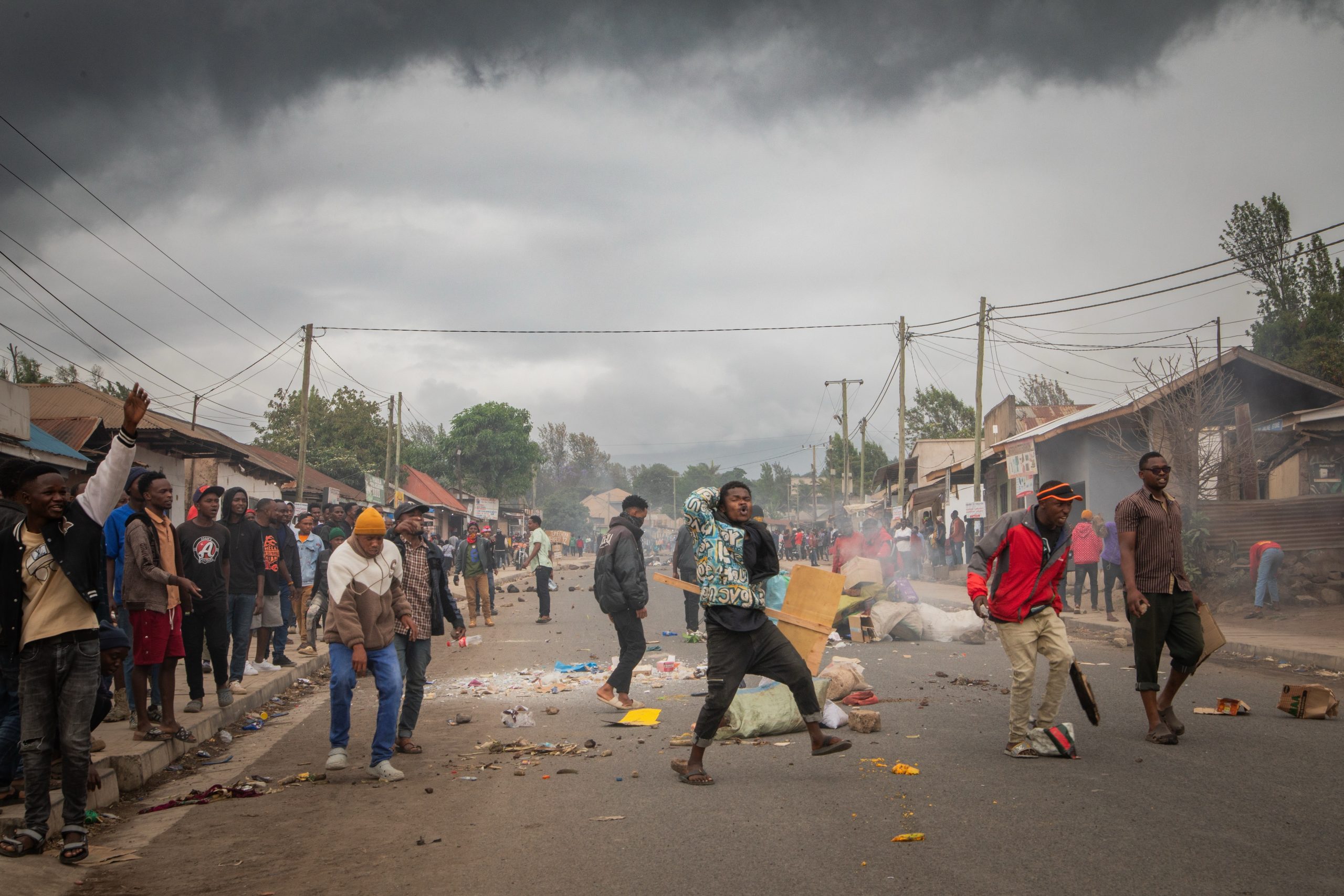
“This is our money, our taxes, take them all, burn the station.” So says the voice of a man filming a crowd carrying away gas canisters from a petrol station in Mwanza, Tanzania’s second largest city. The station—reportedly owned by a politician from the ruling party, Chama Cha Mapinduzi (CCM)—is one of many similar targets in protests that swept the country following elections on Wednesday, October 29.
In Dar es Salaam, the commercial capital, some 1,100 kilometers away, a young man films the burning offices of a bus company, again, owned by a prominent CCM politician and financier. “Gen Z hatuelewi,” he says. Gen Z does not understand, does not agree, and now, Gen Z has taken the streets in cities and towns across Tanzania.
On election day itself, polling stations were ransacked and burned in many areas. Through the following days, protesters erected roadblocks and targeted government buildings, private businesses, and infrastructure, like Dar es Salaam’s increasingly inadequate and much-decried Bus Rapid Transit system.
This wave of protests is unprecedented in mainland Tanzania, as is the violence that has followed. Although the semi-autonomous archipelago of Zanzibar has its own history of disputed elections and often deadly protests, the mainland population of nearly 70 million is seen as protest-shy, especially when contrasted with neighboring Kenya. Meanwhile, CCM has also long presented itself—with some justification—as the party of “amani na utulivu,” peace and tranquillity.
No longer. Saturday’s announcement that incumbent CCM President Samia Suluhu Hassan was re-elected with 97.66 percent of the vote—more than founding President Julius Nyerere running unopposed during one-party rule—did little to calm the situation.
Come Sunday, protests and counter-mobilizations by security forces, principally the police, were reportedly still ongoing in some areas. The internet remained down and phone lines were inconsistent heading into Monday, November 3rd. The internet came back only after Samia was formally sworn in for a second term.
At the time of writing, unverified numbers of dead range from 10 to 800, or more. Friends in Dar es Salaam report being trapped, sheltering at home. There is no food, prices have spiked, people cannot move, cannot reach hospitals, and the borders between regions remain closed.
One friend based in the working-class neighborhood of Manzese reported that police continued to patrol the streets, especially after evening curfews. “If they see someone, they are not shooting in the air,” she insists. “They are shooting to kill.” In Tabata, the relative of another friend was killed while out to find food. Until now, her family has not buried her for fear of going out.
How did we get here? How did protests—much called for in the past, especially by the formal opposition—actually materialize? And how to begin explaining the violence of the response? The most obvious answer is the nature of the election itself, which critics are calling a “coronation” due to the elimination of any meaningful opposition. Then there are the clear parallels with global “Gen Z” mobilizations. Be it in Africa or further afield, young people—especially in rapidly growing cities with few jobs and steep inequalities—are challenging corrupt and unresponsive governments. Even so, Gen Z protests are not automatic. They filter through the contingent political histories and alignments that characterize specific country contexts. So why Tanzania? Why now?
These are not straightforward questions, nor can there be straightforward answers. The following analysis is nevertheless an attempt to identify key dynamics that, together, can help build towards a clearer understanding.
Beyond rigged elections, Tanzania’s CCM is arguably experiencing a triple legitimacy crisis. Since economic and political liberalization in the 1980s and 1990s, the party’s leadership has ensured its continued political dominance—uninterrupted since independence—through three key legitimacy “fixes,” whether consciously deployed or not.
They include (1) managed electoral competition, (2) intra-party competition and renewal, and (3) efforts to achieve a post-socialist economic consensus. This last “fix” has involved blunting the hard edge of “free market” reforms, dispossession, and unequal wealth accumulation initially unleashed by donor-backed structural adjustment.
While the party has not relied on all three “fixes” at once, or not in equal measure, it has alternated and balanced between them. A credible opposition, fresh CCM candidates, or a more populist (and popular) economic agenda have variously compensated for failures to achieve meaningful political inclusion or a socially acceptable economic order.
In 2025, though, all three “fixes” have failed, hence engendering the triple crisis. Unpacking how we got here can help make sense of the deadly protests, and their significance.
First, on credible opposition competition, Tanzania’s multiparty transition was itself a response to a crisis within CCM. Nyerere—not only Tanzania’s founding president but also its chief ujamaa (socialist) architect—responded by pronouncing the party “dead,” detached from the people and corrupt. Although no longer president at the time, he led calls for multiparty elections, and this, precisely to strengthen CCM. The party could revitalize itself through competition, or so the thinking ran.
To some extent, this logic has worked. Even staunch CCM supporters will talk about the relevance of the opposition as a “check.” However, whereas opposition parties long posed little genuine threat, their rising popularity and organizational strength have tested CCM’s willingness to tolerate competition.
The 2015 elections were a watershed. The opposition reached an all-time high of over 40 percent of the presidential vote share and a cumulative 45 percent of the parliamentary vote share. The 2020 elections then saw unprecedented restrictions on opposition competition contributing to a dramatic electoral reversal whereby CCM won 84 percent of the presidential and 76 percent of the parliamentary vote.
Yet what was unprecedented in 2020 has been far surpassed in 2025. At least in 2020, a credible opposition presidential candidate was allowed to campaign. In 2025, that same candidate—CHADEMA’s Tundu Lissu—is in jail facing charges of treason. As has been well documented elsewhere, CCM, under the leadership of President Samia, worked to systematically eliminate any competition in the years and months preceding election day. As for opposition parties and candidates that did eventually appear on ballots, “we’d never heard of any of them,” as one friend observed.
What about the second legitimacy“fix”—i.e, renewal within CCM? This, too, has proven effective. Yet the extent of intraparty competition, candidate renewal, and tolerance for dissent has similarly declined in recent years.
Going back to the 1995 elections—the first multiparty contest since the 1960s, an insurgent opposition did take nearly 30 percent of the presidential and 40 percent of the parliamentary vote share. But the ruling party also brought in a new leader, in line with CCM’s two-term limit on presidential candidates.
President Benjamin Mkapa (1995–2005) put a new face on the party and set a fresh course, launching a “war on corruption.” Although little came of this effort, a relatively scandal-light first term and the collapse of the then leading opposition party—undermined by internal divisions and state interference—helped propel Mkapa and CCM to a comfortable victory in 2000.
Controversies nevertheless escalated in Mkapa’s second term. These included mounting concerns about an accelerated, bribery-filled, and fiscally damaging privatization drive. Mkapa himself was entangled in several related corruption scandals, which left his personal standing much diminished.
However, when the 2005 elections arrived, it was time for a new round of presidential nominations within CCM, a chance for another new face. While the opposition remained weak, the relatively young Jakaya Kikwete emerged victorious from the nominations and the ensuing election, winning a then record-breaking 80 percent of the presidential vote.
Indeed, prior to the election, a kind of “Kikwete mania” had built up. Yet to build up his momentum, Kikwete relied on his mtandao (network), masterminded by long-time ally Edward Lowassa and businessman-turned-financier Rostam Aziz. This alliance nevertheless rapidly dissolved, with Lowassa forced to resign the premiership amidst one of many corruption scandals to dog the Kikwete government.
By 2015, rival Kikwete and Lowassa-aligned factions knocked each other out of the race for the CCM presidential nomination. Lowassa subsequently defected to CHADEMA. He boosted its electoral chances with his name recognition and campaigning infrastructure even as he tarnished its anti-corruption credentials, at least in the eyes of many. This left CCM’s candidate—the relatively little-known but long-serving minister of works, John Pombe Magufuli—to brand himself the anti-corruption candidate and edge to victory in the presidential vote.
As president, Magufuli was another new face—but proved to be much more. He turned on the leaders who helped secure his victory, consolidating power within the ruling party and significantly reducing intraparty competition leading into the 2020 polls. His own presidential nomination was renewed for a second term—as is CCM custom, even if a custom often disputed. What stood out, though, was the heightened control over CCM parliamentary nominations, which in recent elections had become increasingly competitive via open primaries, partly to enable party leaders to diffuse intraparty factionalism and partly to ensure popular candidates capable of beating…
