



I travelled to Merzouga in east Morocco three years ago, hoping to photograph some wall drawings and writings I had seen there earlier – markings that showed the distance from the village to Timbuktu, in Mali, by camel. But when I arrived, the markings had vanished. Faced with this absence, I found myself seeking a new story, something unplanned.
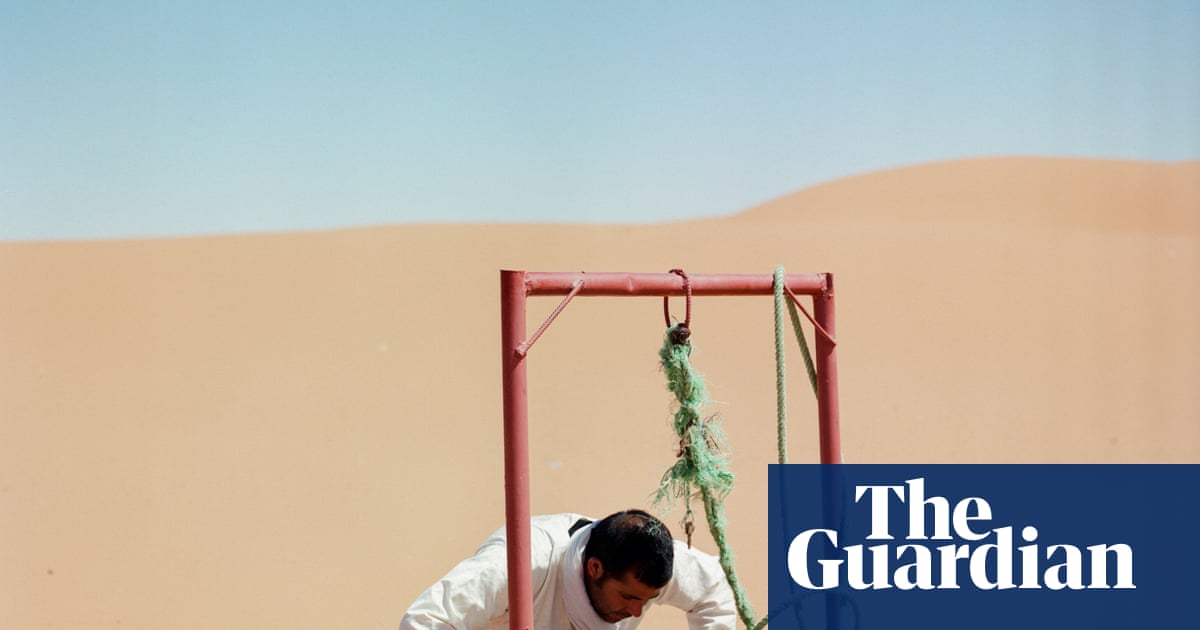
Mustapha was my guide that day. At first, he took me along the typical tourist trails, which didn’t speak to my photographic interests. Then he suggested we explore the sand dunes. Initially, I wasn’t particularly interested in these either, but then we came across this old well. I set up my camera, a 1972 Hasselblad 500, and my tripod. As I started to photograph the well, Mustapha stepped forward, instinctively leaning in to look inside. I hadn’t imagined him in the picture but he didn’t pay attention to me. That spontaneous gesture – part ritual, part desperation – transformed the scene completely. It felt sacred, as though he were praying for the return of something essential: water.
This unplanned moment encapsulates the core of my wider project, Before It’s Gone: the fragility of ecosystems, the human struggle for survival, the quiet persistence of memory in the face of environmental loss. I began the project in 2018, driven by my growing awareness of how dramatically oasis environments were changing in Morocco. I started noticing patterns: rising temperatures, shrinking water sources, abandoned palm groves and increasing rural exodus. What was once a source of life and resilience for entire communities was slowly being erased. I felt an urgent need to document this transformation – not just ecologically but socially and culturally.
Over the years, the project has taken me to dozens of oases and expanded to include Tunisia, Egypt, Saudi Arabia and Mauritania. It has unfolded through travel, extended conversations and long-term engagement with the people who live in these spaces. What drives me is the conviction that these are not just local stories – they are global warnings. The climate crisis is often framed in abstract or future terms. Through this work, I want to make it visible, human and grounded in the present.
Including the human figure was essential. Oases are not just geographic features: they are homes, livelihoods and cultural reservoirs shaped over centuries. In this photograph, Mustapha embodies that deep connection. His gesture of looking into the well is both literal and symbolic – it speaks to dependence, resilience and vulnerability, but also to hope and remembrance. This reflects my work, which explores the complex relationship between people and their environments. Whether I’m documenting oases’ decline, Moroccan youth, or the sociology of work and migration, I’m interested in how individuals navigate change.
Water scarcity is no longer just an environmental issue. It’s a humanitarian crisis, especially in regions such as the Sahara, where life has always depended on fragile water sources. I hope images like this can serve as visual testimonies – simple, powerful reminders of what is at stake.
Photography has taught me to slow down and pay attention to people, landscapes and silence. This shot is a portrait of loss but also of quiet resistance. Communities are being forced to leave the only homes they’ve ever known, not because of war but because the water is disappearing. I hope the image evokes empathy and awareness. I want viewers to connect emotionally – to see the climate emergency not as a distant headline, but to recognise the urgent need to protect natural resources and the cultures and communities that depend on them.
This was a fleeting moment, entirely unplanned, yet it now speaks to so much. Seeing it enlarged today as a poster in underground stations across London, advertising the Wellcome Trust exhibition Thirst, is humbling. It shows the importance of staying open, of letting the story find you.
M’hammed Kilito’s CV
Born: Lviv, Ukraine, 1981
Trained: Master in Political Science, University of Ottawa
Influences: Alec Soth, Hakim Belabbes, Carlos Reygadas
High point: “Becoming a National Geographic explorer, having my photo on the cover of Nat Geo magazine, and winning the World Press Photo prize.”
Low point: “At a time when I was experiencing financial hardship, a gallery in Marrakech with which I’d planned an exhibition let me down.”
Top tip: “Believe in yourself, do your research, understand your niche, carve out your own path.”
