



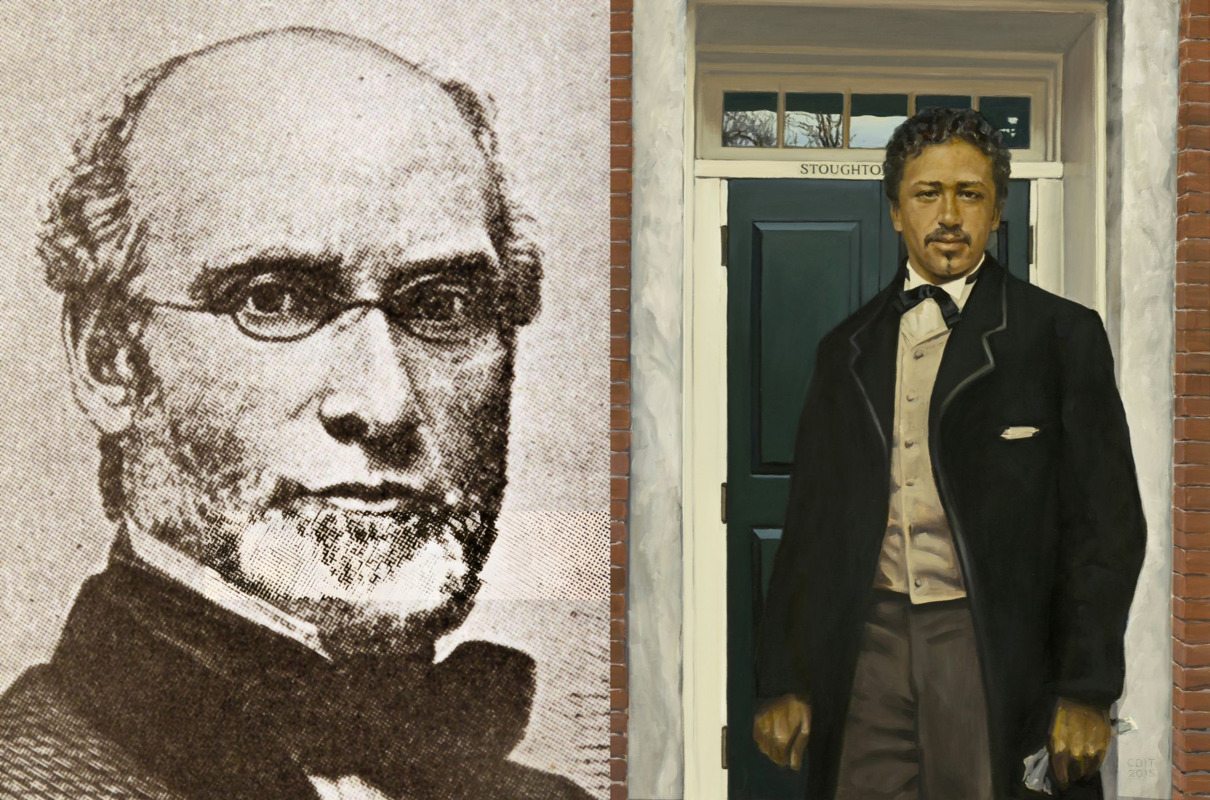
Richard Theodore Greener, the first Black graduate from Harvard University, made history in 1870. An African-American scholar, diplomat, professor, and lawyer, Greener broke numerous barriers throughout his life, including becoming the first Black member of the American Philological Association and the first Black diplomat to serve in a white country.
Greener was born in Philadelphia, Pennsylvania, in 1844 but moved with his family to Boston in 1853. Life in Boston was far from easy. At the age of nine, Greener’s father, Richard Wesley, left to join the California Gold Rush and never returned. Greener was homeschooled for a year before enrolling at Broadway Grammar School in Cambridge, Massachusetts.
However, financial hardship forced Greener to drop out of school two years later. He took a job as a clerk while educating himself in libraries, driven by his passion for anti-slavery and women’s rights activism.
In 1862, seven years after leaving school, Greener received financial assistance from his employer, August Batchelder, and attended the Preparatory Department at Oberlin College. He eventually completed his final year at Phillips Academy, graduating there before enrolling at Harvard University.
Greener’s admission to Harvard was considered an “experiment” at the time, as African Americans were barred from many prestigious institutions. At 21, he became the first Black student to earn a bachelor’s degree from Harvard in 1870.
While at Harvard, Greener faced rumors that he had escaped slavery to join the university, but he remained steadfast in his studies. He lived in a college house known for housing the “poor and struggling,” yet these challenges did not deter him. After his second year, Greener was awarded the Bowdoin Prize twice in elocution and was recognized in the Rochester Daily Democrat newspaper.
Greener continued to break new ground after graduation. In September 1870, he became principal of the Institute for Colored Youth in Philadelphia, and in April 1873, he joined The New National Era as associate editor. He later became an associate editor for the National Encyclopedia for American Biography.
Greener’s academic career flourished when he accepted a professorship at the University of South Carolina, becoming the university’s first and youngest African-American faculty member. He served as librarian and assisted in Greek and Latin studies and research.
In 1875, Greener was elected as the first Black member of the American Philological Association, a prestigious academic society for classical studies in North America. He later became the first professor at Howard University Law School, serving as dean from 1878 to 1880.
In 1898, Greener made history again as the first African-American diplomat, serving as General Consul at Bombay and later as the United States Commercial Agent in Vladivostok, Russia. In 1902, he was awarded the Order of the Double Dragon by the Chinese government for his service during the Boxer War and assistance to famine sufferers in Shansi. He also received honorary Doctorates of Laws from Monrovia College in Liberia and Howard University.
Greener’s legacy continues to be honored. Phillips Academy and the University of South Carolina have established annual scholarships in his name for Black students. In 1984, Larry Francis Lebby painted a portrait of Greener, which is displayed at the University of South Carolina. The central quadrangle at Phillips Academy is named in his honor, and in 2018, a nine-foot statue of Greener was unveiled at the University of South Carolina.
Greener died of natural causes in Chicago on May 2, 1922, at the age of 78. He was married to Genevieve Ida Fleet in 1874 and had six children. He is remembered as a pioneer who paved the way for future generations of Black students at Harvard and beyond.
