



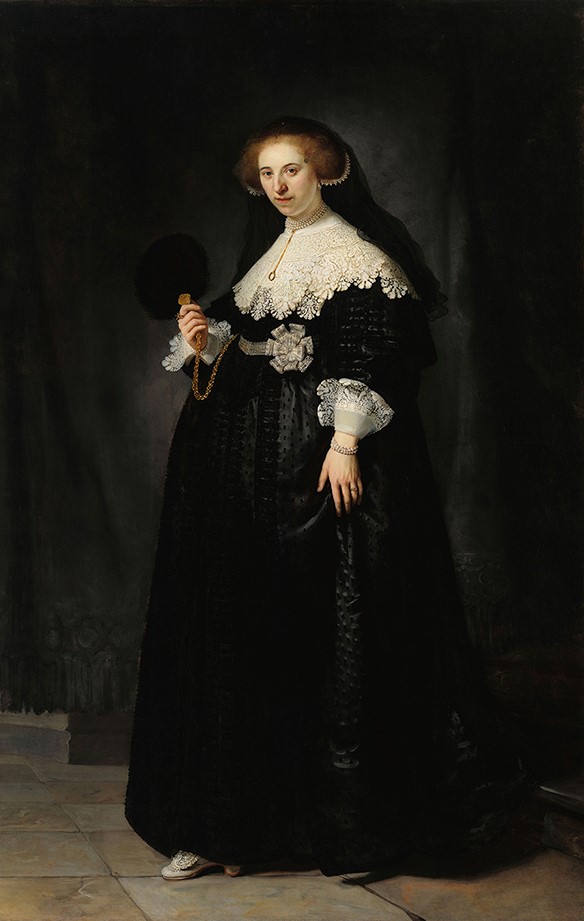
I had recently visited a number of exhibitions which had given me fresh ideas about abstraction: Postwar: Art Between the Pacific and the Atlantic, 1945-1965 (Munich, 2016) and Soul of a Nation: Art in the Age of Black Power 1963-1983 (London, 2017), being two stand out examples. I was especially interested in a group of artists associated with ‘Black abstraction’ from the second half 20th century, most of whose work I was familiar with but had not always had the context for. Then I re-read James Baldwin’s short story ’Sonny’s Blues’. And now I stood before Rembrandt’s painting Oopjen Coppit. My intuition told me they were connected. I began to write, the outcome of which is an essay about Oopjen, Black Aesthetics, and abstraction.
Dineke Blom on Black and White abstraction.
Who’s Afraid of Black and White: two narratives
I was on my way to Cologne, or perhaps it was Düsseldorf (it was a long time ago). I had just turned eighteen. We took the bus, we being the students and staff of Ateliers 63 (now known as De Ateliers), to visit a Barnett Newman retrospective. When I was not looking out the window I was reading ‘Sonny’s Blues’, a short story by James Baldwin – “The Greatest Negro Writer” it said on the cover of my 1965 edition of Going to Meet the Man, the collection the story is part of. These are the opening lines of ‘Sonny’s Blues’:
“I read about it in the paper, in the subway on my way to work. I read it, and I couldn’t believe it, and I read it again. Then perhaps I just stared at it, at the newsprint spelling out his name, spelling out the story. I stared at it in the swinging lights of the subway car, and in the faces and bodies of the people, and in my own face, trapped in the darkness which roared outside.”
I felt the narrator’s anxiety, his sense of impending disaster, and instantly connected with him. The space beyond my narrow bus seat became a darkness which roared. Baldwin’s story had stirred something in me, I was immersed in Sonny’s world. When we arrived at the museum, the spell was broken. Barnett Newman’s work did not move me the way Baldwin’s story had. It was Modern Art and I felt detached. In the years to come, Newman’s work has grown on me, with Who’s Afraid of Red, Yellow and Blue one of my favorite paintings.
A recent plan to write about abstraction and 17th century Dutch painting brought back the memory of this excursion. I had recently visited a number of exhibitions which had given me fresh ideas about abstraction: Postwar: Art Between the Pacific and the Atlantic, 1945-1965 (Munich, 2016) and Soul of a Nation: Art in the Age of Black Power 1963-1983 (London, 2017), being two stand out examples. I was especially interested in a group of artists associated with ‘Black abstraction’ from the second half 20th century, most of whose work I was familiar with but had not always had the context for. These artists from the African diaspora were either born and raised in, or had emigrated to, the USA (particularly New York), or they originated from the former British colonies and had landed in London.
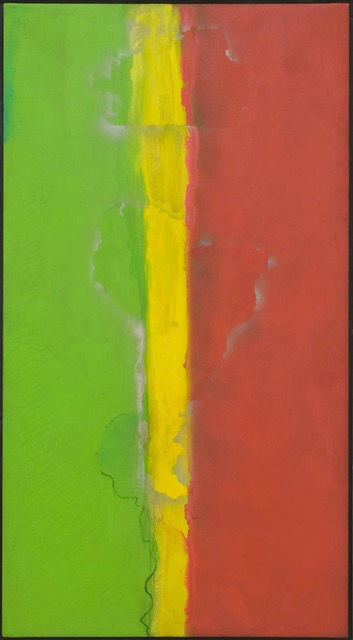
Frank Bowling, Who’s Afraid of Barney Newman,1968, acrylic on canvas 236,4 × 129,5 cm Tate Gallery, Londen
One of the abstract works that struck me was the painting Who’s Afraid of Barney Newman by Frank Bowling. Bowling, who was born in Guyana in 1934, painted it in 1968, one year after Barnett Newman had painted his Who’s Afraid of Red, Yellow and Blue. Having seen Bowling’s painting I could not but look at Newman’s with a fresh eye. The same held for other artists whose work I had been familiar with, such as Jack Whitten and Howardena Pindell, and which I now studied with renewed attention. This was also prompted by new information about the context of their work, including the artists’ personal backgrounds.
The background of these painters from the African diaspora resembles the world of ‘Sonny’s Blues’. To a certain extent I am familiar with this world, due to my own half Dutch half Surinamese background. It is obvious that such a personal history is not necessary for appreciating these works, or Baldwin’s story, though in my case it helped pieces of a puzzle fall into place, and see that this heterogeneous group of works I was thinking about formed in fact a whole of interrelated pieces: from Jack Whitten’s Birmingham, to Rembrandt’s Oopjen and other works from Dutch 17th century painting.
What connects them is that, for me, in these specific works the meaning of concepts such as trust, disruption, intimacy, hierarchy, or being of ‘two worlds’ (a first and a secondary) is investigated. The works are abstract or, in the case of the 17th century works, they demonstrate a degree of abstraction that catches my attention. I became curious about the ways in which these artists, who differ so much in background and era, are connected, and I delved deeper into my intuition. The motivation was less from an art theory or art history perspective and rather from myself being an artist: such research gives me insight into my own work process, it helps me move forward.
I, Black Abstraction
I begin with the artists from the former British colonies who had settled in London and New York. They share a mixed cultural background. Coming from the colonies they have two narratives, so to speak, a primary and a secondary one, which are related to each other. ‘Hierarchy’ is in my view a suitable term to define the inter-relation (and is related to the hierarchy between the so-called First and Third worlds). The relationship between the two cultural backgrounds is precarious, often problematic, and – speaking from my own experience – it may take years to approach the situation from a more playful angle and let the two stories interact and switch places in a dynamic way.
In the second half of the 20th century a debate took place about the position in the aristic mainstream that was allotted to these artists. The critic Wilson Harris wrote in reference to their mixed cultural backgrounds that: “the difficulty […] of accepting multiplicity as a difficult condition in which […] the cross-cultural tensions between one-and-many [are kept] unresolved and open-ended”. (Kobena Mercer, Black Atlantic Abstraction: Aubrey Williams and Frank Bowling in Kobena Mercer, ed: Discrepant Abstraction, pp.192, 197) What I appreciate about Wilson’s view of ‘the difficulty’ is that multiplicity is not to be leveled out but brought to light and left open-ended. Another topic in the debate was the idea that emigration, or frequent resettling, can instill a sense of “belonging nowhere”. Such a feeling might culminate in nostalgia, but it could equally shield the artist from nostalgia because ‘belonging nowhere’ opens up multiple artistic points of identification. In other words: it leaves their artistic orientation open-ended (here I’m paraphrasing Kobena Mercer).
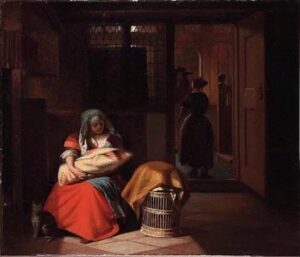

Pieter deHooch Woman with child on her lap, ca. 1675–1680 51.8 × 60.7 cm oil on canvas, private collection +detail
Keeping opposites open-ended is an attitude that I embrace whole-heartedly. I perceive it in 17th century paintings: specific paintings by Pieter de Hooch, Gabriël Metsu or Rembrandt are open-ended in the sense that, to me in any case, they evoke contrary emotions, of feeling at home and feeling alienated from home; of belonging and not belonging, of trust and disruption. They do not shy away from multiplicity, and this I find generous. In line with this characteristic is the co-existence of ‘two narratives’ (cf https://africanah.org/dineke-blom-surinamese-and-her-affection-for-dutch-paintings-from-the-17th-century/). Further on in this essay I will expand on this, taking Rembrandt’s painting Oopjen Coppit as an example.
In the USA a similar debate was being held in the second half of the 20th century, but here it focused on the question of Black Aesthetics. One question was whether any such aesthetics could be said to exist at all, and if so, what would it look like? I find it interesting that some even questionened whether a Black artist should make abstract work. Would they not be bowing to the ruling ‘white’ aesthetics? (cf https://africanah.org/quintus-jan-telting/). It might well be more effective (in the era of Civil Rights and Black Power) to express the Black experience by means of direct and literal imagery rather than through abstraction. The Black abstraction discussion has provided me with much information about the context of abstract art. I had never incorporated such context into my general knowledge of abstract art. It handed me a new lens through which I look at the works.
Here I proceed cautiously because ‘context’ is related to but does not fully align with ‘social narrative’, and this latter term was a precarious concept in the discussion around Black Aesthetics. Artists such as Jack Whitten and Frank Bowling, for example, were emphatically opposed to ‘social narrative’ as prescribed artistic form of expression. Here I quote the painter Jack Whitten (Bessemer, Alabama 1939 – 2018): “My early 1960s’s visits to Norman Lewis’ studio on 125th Street [were] a highlight of my life as a young artist. We spoke about painting, and we spoke about ‘The Problem.’ His insistence on the Black artists’ freedom to investigate pure abstraction without the intervention of social narrative continues to nourish my commitment to abstract painting.” (in Sarah Lewis, African American Abstraction, note 17, p.170; https://www.academia.edu/41503658/_African_American_Abstraction_) In an abstract work of art, experience, social narrative, be it Black or otherwise, is present implicitly rather than being spelled out in a direct and literal way. Put simply, the question was whether a socially engaged and/or activist artist should follow the path of “enunciation,…
